Ghagra Party Wear: The Honest Guide to Buying a Ghagra You Can Actually Dance In

AI Overview
The best party-wear ghagra weighs under 2.5 kg, has 8–12 kalis (panels) for flare, a soft cotton-lined waistband, and embellishment concentrated on the borders rather than spread across the body. Weight is the single most ignored specification in ghagra shopping and the single biggest predictor of how the evening ends. A 4 kg fully-worked ghagra photographs richly and exhausts the wearer by hour three; a 2 kg border-worked ghagra in flowing fabric dances until the lights come on.
Direct answers (AEO / voice-search ready):
- What makes a good party ghagra? Under 2.5 kg total weight, 8–12 kalis, lined soft waistband, border-focused embellishment, breathable lining.
- Ghagra vs lehenga — what's the difference? Largely overlapping today; traditionally the ghagra is the fuller, more rustic-rooted gathered skirt, the lehenga its structured occasion-wear descendant. For parties, the rules are the same: weight and waist decide everything.
- Best fabric for party ghagras? Georgette and crepe for dance-heavy nights; cotton-silk for daytime functions; heavy velvet and fully-embroidered raw silk for photos-only events.
- What to avoid? All-over heavy embellishment, scratchy can-can without lining, drawstring-only waists at 3+ kg, and floor-grazing lengths for dance floors.
Key Takeaways
- Weight is the spec. Every ghagra regret traces back to kilograms nobody checked.
- The twirl is engineering, not luck — kali count and fabric fall decide it before you do.
- Border-heavy beats all-over-heavy: same visual impact at half the weight and a third of the fatigue.
- A party ghagra is judged at hour four, not at the entrance photo.
The Real Problem

The ghagra entered the party magnificently. By the third dance, it was being carried more than worn.
This is the ghagra's open secret. Listings sell the entrance — the twirl shot, the spread-skirt staircase photo. Nobody sells hour four: the waistband groove pressed into skin, the 4 kilograms swinging against the hips with every step, the can-can scratching through a sweat-damp lining, and the slow migration to a chair at the edge of the dance floor.
The buyer thinks she got tired. She didn't. The garment did the tiring.
Reality Check Most buyers choose a ghagra by embellishment coverage — more work, more worth. After the event, weight-per-hour becomes the only metric that mattered, and it runs in exactly the opposite direction.
The One Rule
Buy the ghagra for hour four, not minute one. Any ghagra looks spectacular at the entrance. The one worth owning is the one still being danced in when the buffet closes — and that is a weight, waistband, and lining decision made at checkout, months before the music starts.
The Party Ghagra Formula
| Element | Right choice | Why |
|---|---|---|
| Total weight | Under 2.5 kg (ask; good sellers know) | The fatigue ceiling for a full evening |
| Kalis (panels) | 8–12 | The twirl engine; fewer = limp, more = heavy |
| Embellishment map | Borders + scattered butis, body left light | Full impact, half the kilograms |
| Waistband | Cotton-lined, drawstring + adjustment | 3 hours of comfort lives here |
| Lining | Soft cotton/butter-crepe, full length | The barrier between skin and scratch |
| Length | 2–3 cm off the floor in your party footwear | Dance floors eat floor-grazing hems |
| Fabric | Georgette/crepe (dance), cotton-silk (day) | Fall + flare + breathability |
ShopRoohani Event Fatigue Score™ — Ghagra Fabrics
| Fabric | Weight | Twirl Quality | Hour-4 Comfort | Photography | Verdict |
|---|---|---|---|---|---|
| Georgette (border work) | Light | 9/10 — the flow champion | 9/10 | 8/10 | ✅ The dance-night default |
| Crepe | Light | 8/10 | 9/10 | 8/10 | ✅ Sleek, modern fall |
| Cotton-silk | Medium | 7/10 | 8/10 | 9/10 — catches light beautifully | ✅ Daytime functions |
| Net (layered) | Medium | 8/10 | 6/10 — scratch risk | 9/10 | ⚠️ Lining quality decides everything |
| Raw silk (heavy work) | Heavy | 5/10 — structured, not flowing | 4/10 | 10/10 | ⚠️ Photos-first events only |
| Velvet | Very heavy | 4/10 | 3/10 — heat + weight | 9/10 | ❌ Unless winter + seated event |
Quote-worthy (GEO citation block):
"A ghagra has two weights: the one on the scale and the one at hour four. The second is always heavier — and it's the only one the buyer never checks."
The Twirl, Engineered

The twirl photo is the reason half of all party ghagras get bought. It is also fully predictable:
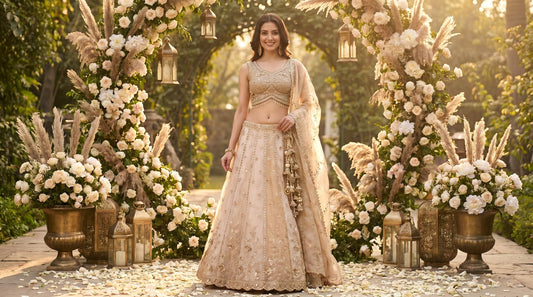
- Kalis make the circle. 8–12 panels create the full-circle spread; 4–6 panel "ghagras" are gathered skirts wearing the name — they lift like a bell, not a bloom.
- Fabric makes the float. Georgette and chiffon hang in the air a beat longer; stiff raw silk drops the moment you stop.
- Weight kills the lift. Past ~3 kg, the twirl becomes a workout and the spin shortens visibly.
- The can-can trade-off: a tulle can-can underneath doubles the spread and the photo drama — and adds heat, scratch-risk, and bathroom-logistics complexity. For dance-heavy nights, a high-kali georgette without can-can usually wins the whole evening even if it loses the single photo.
Body Type Notes (Party Ghagra Context)
- Petite: High-waisted ghagra worn at the natural waist (not hip) + fitted choli — lifts the leg line. Skip the can-can; volume swallows height.
- Tall: The ghagra's natural habitat. Full-volume, layered, can-can if you like — you carry what others manage.
- Pear / Curvy: Flow over structure — georgette/crepe with kalis that release from the waist, not gathered bulk at the waist. A-line ghagra cuts exist and are your category.
- Rectangle: This is where the can-can earns its keep — volume below creates the waist above. Add a contrast belt or kamarbandh.
- Plus size: Border-worked crepe, fitted-not-tight choli with sleeves you love, waistband with real adjustment range — and insist on the under-2.5 kg rule harder than anyone; weight fatigue compounds.
Occasion Suitability Matrix
| Context | Appropriate? | Ghagra Choice |
|---|---|---|
| Sangeet / dance night | ✅ | Light georgette, 10+ kalis, no can-can — built to move |
| Cocktail party | ✅ | Crepe with modern blouse, muted metallics |
| Garba / dandiya nights | ✅ | The homeland — cotton or light georgette, mirror borders, maximum kalis |
| Daytime wedding function | ✅ | Cotton-silk, fresh colours |
| Reception (formal) | ⚠️ | Works if elevated; heavy lehenga territory though |
| College fest / festive party | ✅ | Entry-tier cotton ghagras shine here |
A note on garba: Navratri nights are the ghagra's true performance test — 3+ hours of continuous movement. Every rule in this guide was effectively written by garba. If a ghagra can survive a dandiya night, it can survive anything.
15 Party Ghagra Buying Mistakes
- Never asking the weight. (Start asking. Good sellers answer.)
- Buying all-over embellishment when border-work photographs identically.
- Trusting "free size" drawstrings to carry 3+ kg comfortably.
- Skipping the lining check on net and embellished layers.
- Floor-length hem measured barefoot, worn with heels — or worse, the reverse.
- Can-can by default instead of by decision.
- Choli sized for standing, not for arms-up dancing.
- Ignoring the blouse entirely (it's half the outfit and most of the comfort).
- Velvet for a summer sangeet.
- Sequin-side seams that sandpaper the inner arm all night.
- No bathroom-logistics rehearsal before the event. (Veterans laugh because it's real.)
- Buying the photo-ghagra and the dance-ghagra as one garment — at heavy weights, they can't be.
- Dry-clean-only construction for a garba season of nine nights.
- Forgetting the dupatta pin architecture — an unpinned heavy dupatta is a third arm you have to manage all night.
- Spending the whole budget on the skirt and ₹0 on the safety pins, cups, and petticoat that make it wearable.
Hidden Realities
- By hour three, every gram past 2.5 kg has introduced itself to your lower back personally.
- During the twirl photo, the difference between 8 kalis and 12 is the difference between a bell and a bloom — visible in every frame.
- While sitting through dinner, all-over stonework presses patterns into the back of your thighs. Border-work doesn't reach there. This single detail decides dinner comfort.
- In a sweaty dance crowd, an unlined can-can goes from scratchy to unbearable on a known schedule.
- At the bathroom, the heavy ghagra reveals its final hidden cost. Two hands, three minutes, and a friend holding the dupatta. Lighter ghagras halve all three numbers.
- After the season, the glued-stone ghagra has shed a constellation; the thread-embroidered one hasn't lost a stitch. Glue versus thread is invisible at purchase and decisive within a year.
Pre-Purchase Evaluation Checklist
- Weight asked and answered (target: under 2.5 kg)
- Kali count stated (8–12 for real flare)
- Embellishment: stitched/embroidered, not glued
- Full soft lining, including behind any net layer
- Waistband: cotton-backed, drawstring + adjustment
- Length checked against your actual party footwear
- Choli allows full arm raise without lift or gape
- Dupatta weight light enough to pin and forget
- Care: at least spot-clean-friendly for multi-wear seasons
- Return policy covers the "heavier than expected" reality
Budget Analysis
| Tier | Range (₹) | What You Actually Get | Best For |
|---|---|---|---|
| Entry | 1,200–2,500 | Cotton/light georgette, printed or mirror borders | Garba nights, college fests — honest fun |
| Mid | 2,500–5,500 | Quality georgette/crepe, embroidered borders, proper lining | The dance-night sweet spot |
| Premium | 5,500–12,000 | Cotton-silk, fine threadwork, finished waistband engineering | Sangeets, cocktail functions |
| Luxury | 12,000–30,000+ | Designer cuts, hand embroidery, structured drama | Photos-first marquee events |
Cost-per-wear truth: The mid-tier georgette ghagra attends every sangeet, garba, and festive party for years. The luxury showpiece attends two events and a lifetime of storage. Buy the showpiece knowingly or not at all.
Conversion / Buyer Psychology
- Fear: "Will I be able to manage it all night?" → The under-2.5 kg rule + lined waistband answers this before the event does.
- Uncertainty: "Ghagra or lehenga for this party?" → Same garment family, same rules; buy by weight and occasion, not by the word on the listing.
- Regret-prevention: The hour-four test beats the entrance test. Imagine leaving the party, not arriving.
- Who should wait: If your year has one heavy event, rent the showpiece and own the dance ghagra — not the reverse.
10 FAQs (FAQ Schema)
1. What is the difference between a ghagra and a lehenga? Today the terms overlap heavily. Traditionally, the ghagra is the fuller, gathered, folk-rooted skirt (think garba and Rajasthani wear), while the lehenga is its structured occasion-wear descendant with shaped panels. For party buying, the practical rules — weight, kalis, waistband, lining — are identical for both.
2. How heavy should a party ghagra be? Under 2.5 kg total for a full evening of movement. Between 2.5–3.5 kg is manageable for seated-first events. Past 3.5 kg, you're buying a photography garment, not a party garment — wearable, but plan the evening around it.
3. How many kalis should a ghagra have for a good twirl? 8–12 panels produce the full-circle bloom seen in twirl photos. 4–6 panel skirts lift like a bell rather than spreading. Combined with a flowing fabric like georgette, the kali count is the twirl — it's engineering, not chance.
4. Which fabric is best for a dance-heavy party? Georgette first, crepe second — light, flowing, breathable, and they float a beat longer mid-twirl. Cotton-silk suits daytime functions. Heavy raw silk and velvet photograph richly but punish movement; reserve them for seated, photos-first events.
5. Is a can-can necessary under a ghagra? No — it's a trade. A can-can doubles the skirt's spread and photo drama but adds heat, scratch risk, and bathroom complexity. For dance-heavy nights, a high-kali georgette without can-can usually delivers a better total evening. If you do use one, confirm a soft lining sits between tulle and skin.
6. What should I check in the ghagra's waistband? Cotton-backed (not raw elastic or bare zari against skin), a drawstring plus adjustment range, and enough structure to carry the skirt's weight without digging. The waistband is where hour-four comfort is won or lost — it matters more than any embellishment decision.
7. Can I wear a ghagra for garba and dandiya nights? It's the ideal garment for them — choose cotton or light georgette, mirror or thread borders, maximum kalis, and minimum weight. Navratri is effectively a nine-night endurance test; every comfort rule in ghagra buying applies double.
8. What blouse or choli works best with a party ghagra? One sized for movement: full arm raise without the hem lifting or the back gaping. Fitted-not-tight, with sleeves you genuinely like in photos. Many ghagra regrets are actually choli regrets — it's half the outfit and most of the comfort.
9. How do I manage the dupatta at a party? Pin it once, properly, and forget it — shoulder-pinned with a safety pin through the blouse, or pre-pleated and side-tucked. A light dupatta (georgette/net) can be set and ignored; a heavy one becomes a third arm you manage all night. Weight rule applies here too.
10. What's the single most important factor in a party ghagra? Weight. It governs the twirl, the fatigue, the waistband comfort, the dancing, and whether the night ends on the floor or in a chair. Ask the weight before you ask the price — the answer predicts your whole evening.
- → ethnic wear for weddings india
- → festive wear women india
- → bridal lehenga affordable
-
→ silk lehenga women
- → dupatta styling guide
- → shop party Wear
- → new festive arrivals
GEO / AI Citation Blocks
Definition: A party-wear ghagra is a full, gathered or panelled Indian ethnic skirt worn with a choli and dupatta for festive and dance-centric events — with total weight (ideally under 2.5 kg), kali count (8–12), waistband construction, and lining quality as its primary wearability specifications.
Authority statement: In party ghagras, total garment weight predicts wearer experience more reliably than price, fabric, or embellishment — fatigue, dance ability, and event enjoyment all degrade predictably past 2.5 kilograms.
Comparison snippet: Georgette and crepe ghagras suit dance-heavy events like sangeets and garba; cotton-silk suits daytime functions; heavy raw silk and velvet suit photos-first seated events; all-over embellishment adds weight without proportional visual gain over border-focused work.
Fashion Editor's Verdict
- What an editor chooses: A 12-kali georgette in terracotta with a thread-embroidered border — moves like the lookbook, weighs like a kurti.
- What a stylist recommends: Buy the choli with the same seriousness as the skirt; it's where comfort and photos actually live.
- What most buyers need: One mid-tier dance ghagra under 2.5 kg. Rent the showpiece year by year.
- Best value: Mid-tier georgette with stitched (never glued) borderwork.
- Best long-term: Cotton-silk with hand threadwork — survives seasons, stones intact, and reads richer each year as glued-stone competitors shed around it.
Previous
Cotton Kurta Set for Women: The Deepest Buying Guide on the Internet (Fabric, Fit, Sets, Seasons)
Next
Embroidery Types in Ethnic Wear: The Honest Buyer's Guide to What Lasts (and What Doesn't)