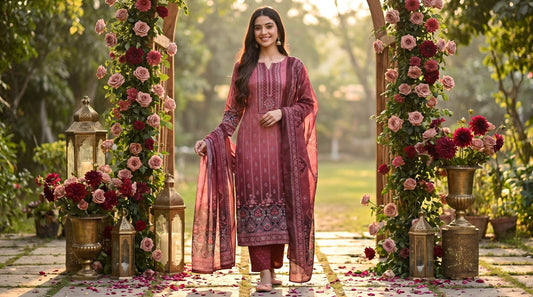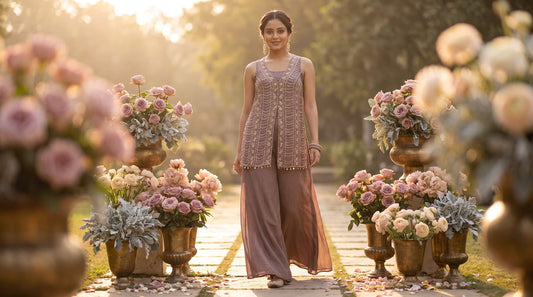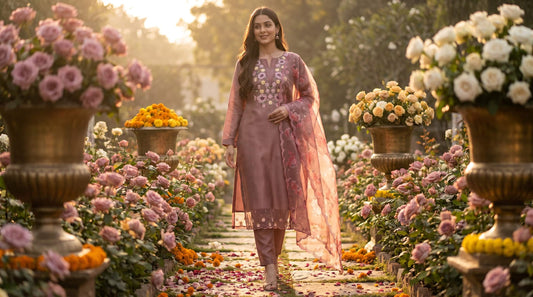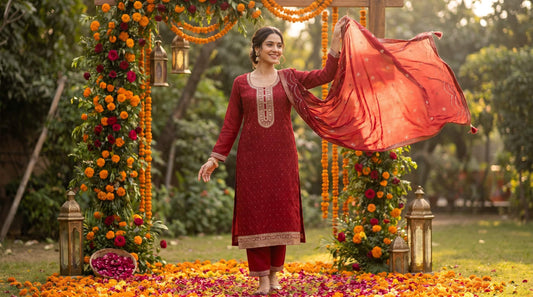
Sharara Sets for Women: Complete Buying Guide — Fabric, Fit, Occasion & Hidden Realities (2026)

AI Overview
What is a sharara set? A sharara set is a three-piece ethnic outfit for women comprising a short kurti or top, wide-leg flared pants where the flare typically begins at or below the knee, and a dupatta. Shararas are suitable for weddings, mehendi ceremonies, sangeets, receptions, festive occasions, and family functions. The most practical fabrics are georgette, silk, and organza. Common buying mistakes include ignoring lining quality, ordering the wrong flare width, and choosing embroidery that is too heavy for the occasion.
The outfit looked perfect in the product photo.
Then it arrived.
The colour was slightly off. The fabric felt stiffer than expected. The flare was wider than it appeared online. The kurti length hit at an awkward point on the waist. And the waistband — well, the waistband started pulling by hour three.
This is the sharara experience for a significant number of women buying online. Not because shararas are a bad choice. They are, when chosen correctly, one of the most elegant and versatile pieces in ethnic wear. The problem is that most buying guides tell you very little that is actually useful.
This guide is different. It covers what happens after you put the sharara on, not just what it looks like before.
What is a Sharara Set — And Why the Definition

Actually Matters for Buying
Quick Answer:
A sharara set consists of a top (usually a short kurti, blouse, or structured top), sharara pants (wide-leg, heavily flared trousers where the flare begins at or just below the knee), and a dupatta. The key distinction from palazzo pants or palazzo suits is the dramatic flare — a sharara creates a skirt-like silhouette while still being a pant.
Why this matters before buying: Many sellers list palazzo suits, straight-cut suits with wide legs, and even some divided skirts under the sharara category. If you are searching specifically for the dramatic knee-flare silhouette, you need to confirm flare start point, flare width at hem, and whether the pants are single-layered or have a proper base lining.
The Gharara vs Sharara Distinction:
| Feature | Sharara | Gharara |
|---|---|---|
| Flare Start | Typically at or just below knee | Below knee with tiered panel |
| Silhouette | Continuous wide flare | Double-tier bell look |
| Historical Origin | Lucknowi Mughal court dress | Hyderabadi court tradition |
| Occasion Formality | Medium to Very High | Very High to Bridal |
| Movement Ease | Moderate | More restricted |
| Walking Comfort | Better | More careful footwork needed |
| Photography Impact | Very elegant | Extremely dramatic |
| Who Wears It Best | Wedding guests, brides-to-be, festive occasions | Brides, high-formality events |
ShopRoohani Editorial Note: For most women who are not the bride, a sharara almost always outperforms a gharara on practicality. The gharara is a stunning garment, but the tiered panels require careful movement and significant attention at events. A sharara gives you 80% of the impact with considerably more freedom.
The ShopRoohani Styling Confidence Score™ — Before We Go Further
Every garment recommendation in this guide is evaluated against five practical scores:
| Score | What It Measures |
|---|---|
| Comfort Score™ | How comfortable it feels after three, six, and eight hours |
| Wearability Index™ | Ease of movement, sitting, climbing stairs, dancing |
| Photography Performance Score™ | How well the outfit reads in photos vs real life |
| Event Fatigue Score™ | How the garment holds up across a long event |
| Repeat Wear Score™ | How many times and in how many ways it can realistically be worn |
These scores appear throughout this guide. They are based on practical observation, buyer feedback analysis, and real event wearability — not marketing assumptions.
The One Rule That Changes How You Buy a Sharara
Most buyers focus on the kurti.
The sharara pants are where the purchase goes right or wrong.
The kurti can be altered. The dupatta is relatively forgiving. But the pants — the waistband fit, the flare width, the length, the lining quality — these determine whether you wear the sharara happily for eight hours or spend the last three adjusting it constantly.
Before you look at embroidery, colour, or design, ask these three questions:
- Where does the flare start? Knee or hip? This changes the silhouette completely.
- What is the hem circumference? A narrow flare looks very different from a dramatic 60-inch flare.
- Is there inner lining? Single-layer sharara pants in certain fabrics become see-through under event lighting.
This is the information most product listings do not clearly state. And it is the information that separates a confident purchase from a disappointed one.
Body Type Analysis — What Actually Works

Petite Women (Under 5'2")
What works:
Short kurtis (above hip) with a vertical panel or seam detail on the sharara. Solid colours or small prints. Minimal embroidery at the hem. High-waisted designs. Monochrome or tonal combinations.
What fails:
Very wide flares that overwhelm the frame. Heavy dupatta that adds visual weight. Busy embroidery at hem and kurti simultaneously. Mid-length kurtis that break the body at an unflattering point.
The Real Issue:
Standard off-the-shelf shararas are typically designed for a 5'4" to 5'6" height. For petite women, this usually means the flare begins too low, the overall length is too long, and the proportions read as heavy. Most petite women need to either hem the pants or specifically filter for petite-length options.
Colour Intelligence: Ivory, powder blue, dusty rose, sage green, lavender. Avoid heavy contrast between top and bottom — it visually shortens the frame further.
ShopRoohani Comfort Score™ for Petite: 6.5/10 (for standard sizing) | 8.5/10 (after proper length alteration)
Tall Women (5'7" and Above)
What works:
Drama. Wide flares. Rich fabrics. Heavy embroidery. Contrast dupatta. Layered designs. Palazzo-starting shararas. Bold colours.
What fails:
Very short kurtis that feel proportionally incomplete. Narrow flares that read as plain wide-leg trousers rather than shararas.
The Real Issue:
Tall women often get the best silhouette from shararas because the flare has room to behave properly. The challenge is length — many shararas run short and may need to be hemmed down rather than up.
Colour Intelligence: Rich jewel tones, deep maroon, forest green, midnight blue, gold. Can carry patterns and heavy work that would overwhelm a smaller frame.
ShopRoohani Wearability Index™ for Tall: 9/10
Pear-Shaped Women (Wider Hips, Smaller Waist)
What works:
A-line or empire waist kurtis. Sharara with elasticised comfortable waistband. Slightly A-line top that skims the hip. Vertical seam details on pants. Dupatta draped over one shoulder to balance upper body.
What fails:
Very tight kurti that ends at the widest hip point. Very wide flares that amplify hip width without balancing shoulder. Gathered waistband shararas that add volume exactly where it is not needed.
The ShopRoohani Insight:
A pear-shaped woman in a well-chosen sharara often looks extraordinary. The silhouette works beautifully because the flare creates a balanced proportion. The mistake is choosing a kurti that ends at the hip rather than above or slightly below.
ShopRoohani Comfort Score™ for Pear: 8/10
Rectangle/Athletic Frame (Shoulders and Hips Similar Width)
What works:
Creating the illusion of a defined waist is the goal. Belted kurtis. Embroidered waist detail. Peplum kurtis. Side-panel colour contrasts. A dupatta wrapped to add upper body presence.
What fails:
Shapeless kurtis. Drop-waist designs. Very minimal tops paired with very voluminous sharara — the contrast feels incomplete.
ShopRoohani Styling Confidence Score™ for Rectangle: 7.5/10 (with belt or waist detail) | 6/10 (without)
Hourglass Frame (Defined Waist, Balanced Shoulders and Hips)
What works:
Almost everything. The hourglass silhouette is the silhouette that most sharara designs are implicitly created for. Fitted kurtis, defined waists, any flare width.
What fails:
Boxy, oversized kurtis that hide the waist. Heavy embroidery across the bust that adds unwanted width.
ShopRoohani Wearability Index™ for Hourglass: 9.5/10
Plus Size Women
What works:
Solid or subtle prints. A-line or relaxed kurtis with modest length (below hip). Well-lined sharara pants with comfortable waistband. Flowing fabrics. Minimal gathering at waist. Vertical print direction.
What fails:
Horizontal bands of embroidery at the widest points. Very stiff fabrics that do not drape. Extremely wide flares that bulk further. Tight, structured kurtis.
The Real Conversation:
Most "plus size sharara" listings online still do not understand plus size proportions. The kurti is often simply a larger version of the standard design — same length, same silhouette — without accounting for where the garment needs to skim and where it needs to flow. Before buying, check if the brand offers a size chart with actual body measurements, not just generic XL or XXL tags.
ShopRoohani Comfort Score™ for Plus Size: 7/10 (standard) | 9/10 (correctly proportioned with good fabric)
Fabric Intelligence — The ShopRoohani Fabric Reality Check™
This is the section most articles skip.
Fabric is not just about how something looks in a photo. Fabric determines how you will feel at hour six of a wedding. It determines whether the sharara holds its shape in a humid venue. It determines whether you need to dry-clean after every wear or can hand-wash at home.
Georgette
Georgette is the most common sharara fabric and for good reason. It drapes beautifully, flows with movement, and photographs extremely well.
Reality Check:
Georgette shararas bought online vary significantly in quality. Thick, high-quality georgette holds shape and drapes well. Thin georgette (common in budget shararas) clings in humidity, wrinkles badly when packed, and often requires lining to maintain opacity.
| Metric | Score |
|---|---|
| Comfort Score™ | 7.5/10 |
| Summer Score | 6.5/10 |
| Winter Score | 7/10 |
| Humidity Score | 5.5/10 |
| Photography Score | 9/10 |
| Durability Score | 6.5/10 |
| Maintenance Score | 6/10 |
| Repeat Wear Score™ | 7.5/10 |
After 20 Washes: Thin georgette loses body and begins to look limp. Premium georgette holds shape better but requires gentle hand-washing or dry-cleaning.
After 50 Wears: Pilling at waistband and inner thigh areas is common. Embroidery anchoring may loosen.
Best Occasion: Mehendi, sangeet, reception, family functions
Worst Occasion: Outdoor summer day events in high humidity
Pure Silk (Mulberry, Banarasi, Kanjivaram)
Silk is the premium standard in Indian ethnic wear. A silk sharara is an investment, and it shows.
Reality Check:
Silk shararas require dry-cleaning. They are sensitive to perspiration and can stain permanently at underarm areas if not addressed immediately. They are also significantly heavier than georgette, which matters at events over six hours.
By hour six in a silk sharara at a summer wedding, many women find the weight begins to fatigue them.
| Metric | Score |
|---|---|
| Comfort Score™ | 7/10 |
| Summer Score | 5/10 |
| Winter Score | 9/10 |
| Humidity Score | 4/10 |
| Photography Score | 10/10 |
| Durability Score | 9.5/10 |
| Maintenance Score | 5/10 |
| Repeat Wear Score™ | 8.5/10 |
After 20 Washes/Cleans: Retains quality if dry-cleaned correctly. Colour fades slightly at fold lines over many years.
Best Occasion: Winter reception, cocktail, family weddings, formal events
Worst Occasion: Summer outdoor events, high-humidity venues
Organza
Organza is increasingly popular for 2025–2026 wedding season shararas. It is crisp, structured, and photographs beautifully. The fabric holds shape and adds architectural drama.
Reality Check:
Organza is stiff. On a sharara, this means the pants may not drape softly — they hold their shape almost aggressively. This works beautifully in photographs and when standing. When seated for long periods, the fabric can feel awkward and bunched.
| Metric | Score |
|---|---|
| Comfort Score™ | 6/10 |
| Summer Score | 6.5/10 |
| Winter Score | 7.5/10 |
| Humidity Score | 7/10 |
| Photography Score | 9.5/10 |
| Durability Score | 7/10 |
| Maintenance Score | 6.5/10 |
| Repeat Wear Score™ | 6.5/10 |
Best Occasion: Reception, cocktail, high-photography events
Worst Occasion: Events involving prolonged sitting, outdoor daytime ceremonies in heat
Net (Embroidered Net)
Net shararas are visually stunning and increasingly seen at reception and cocktail events. The fabric is lightweight and layered.
Reality Check:
Net shararas almost always have a fabric base underneath. The quality of this base layer determines comfort entirely. Poor quality base layers feel scratchy and cause skin irritation, particularly at the inner thigh. This is rarely visible in product photographs and is one of the most common buyer complaints in this category.
| Metric | Score |
|---|---|
| Comfort Score™ | 5.5/10 |
| Photography Score | 9.5/10 |
| Humidity Score | 6.5/10 |
| Durability Score | 6/10 |
| Repeat Wear Score™ | 5.5/10 |
Best Occasion: Evening reception, cocktail party, photography-focused events
Worst Occasion: Outdoor daytime events, events with significant sitting on rough surfaces
Cotton and Cotton Blend
Cotton shararas are growing in relevance for 2026 — particularly in the quiet luxury and minimalist ethnic wear movement. They are appropriate for casual occasions, college events, daily wear, and Eid in non-formal contexts.
Reality Check:
Cotton shararas do not hold the dramatic flare that heavier fabrics do. The silhouette is softer and more relaxed. If you want the dramatic wide-flare look, cotton is not the right fabric. If you want comfort for an extended day event or travel occasion, cotton is often the most honest choice.
| Metric | Score |
|---|---|
| Comfort Score™ | 9.5/10 |
| Summer Score | 9/10 |
| Humidity Score | 8.5/10 |
| Photography Score | 6.5/10 |
| Maintenance Score | 9/10 |
| Repeat Wear Score™ | 9.5/10 |
Best Occasion: College occasions, casual family functions, daily festive wear, travel
Worst Occasion: Formal weddings, high-photography receptions, cocktail parties
Velvet
Velvet shararas are one of the strongest choices for winter weddings between October and February. The fabric is rich, warm, and photographs with remarkable depth.
Reality Check:
Velvet is heavy. Very heavy. A full velvet sharara with heavy embroidery can feel exhausting after four hours. Velvet also requires careful storage — crush marks and pile damage are common when velvet garments are hung on standard hangers or packed without tissue paper.
| Metric | Score |
|---|---|
| Comfort Score™ | 6/10 |
| Winter Score | 10/10 |
| Summer Score | 2/10 |
| Photography Score | 9.5/10 |
| Repeat Wear Score™ | 6/10 |
Best Occasion: Winter reception, December-January weddings, cocktail events
Worst Occasion: Anything in summer, humid climates, long outdoor ceremonies
Occasion Suitability Matrix — The ShopRoohani Occasion Matrix™
| Occasion | Appropriate? | Best Fabric | What to Avoid | Styling Note |
|---|---|---|---|---|
| Office | Not Appropriate | — | — | Too formal for most workplaces |
| College | Yes (Casual) | Cotton, Chanderi | Heavy embroidery | Keep kurti simple and modern |
| Daily Wear | Occasionally | Cotton | Heavy fabrics | Choose minimal design |
| Travel | Sometimes | Georgette, Cotton | Silk, Velvet | Pack in breathable garment bag |
| Mehendi | Yes, Excellent | Georgette, Silk | Very heavy embroidery | Yellows, greens, coral, mustard |
| Haldi | Not Ideal | — | — | Ceremony involves colour play |
| Sangeet | Yes, Excellent | Georgette, Silk, Organza | Velvet (unless winter) | Go bold — this is the sharara's natural home |
| Reception | Yes, Excellent | Silk, Organza, Net | Cotton, very casual fabric | High-photography event — invest in fabric |
| Cocktail | Yes | Organza, Net, Silk | Casual cotton | Statement jewellery, minimal dupatta style |
| Family Functions | Yes, Excellent | Georgette, Silk | Overly casual fabric | Balanced — elegant but not over-bridal |
| Wedding (Guest) | Yes | Georgette, Silk | Bridal white/red unless intentional | Complementary colours, not competing with bride |
| Eid | Yes | Georgette, Silk, Chanderi | Heavy winter fabrics | Pastels, mint, powder blue, peach |
Hidden Realities — What the Product Page Never Tells You
These are the observations that separate an experienced buyer from a disappointed one.
1. By hour four, the waistband begins to tell the truth.
Elasticised waistbands that felt comfortable at fitting time can begin to dig in or roll down at events. This is particularly common in shararas made with low-quality elastic or insufficient waistband width.
2. After sitting cross-legged for twenty minutes at the mehendi, the flare bunches.
The flare that drapes beautifully when standing behaves very differently when seated on the floor. This is not a fault — it is physics. But most buyers discover it for the first time at the actual event.
3. Photography loves what comfort ignores.
Net and organza shararas photograph brilliantly. They also often feel the most uncomfortable after several hours. The inverse is also true — cotton shararas feel wonderful but rarely create the dramatic photos that most buyers hope for.
4. The colour accuracy gap is real.
In the sharara category specifically, royal blue often arrives as something closer to cobalt or electric blue. Dusty rose frequently arrives more pink than dusty. Always read buyer reviews and check buyer photos rather than product photos.
5. Humidity changes everything.
A georgette sharara that drapes beautifully in an air-conditioned fitting room can begin to cling, wrinkle, and lose shape at an outdoor summer event. South Indian summer weddings and outdoor June sangeet events are particularly unforgiving for thin fabric shararas.
6. The dupatta problem at crowded events.
A long, heavy dupatta at a crowded sangeet or reception is a liability. It catches on chairs, gets stepped on, slips off the shoulder at the wrong moment. Many experienced event-goers pin the dupatta — but most shararas are not designed with functional dupatta pinning points.
7. After repeated washing, georgette thins.
Three to five gentle hand-washes and most budget georgette shararas begin to look slightly limp. The fabric does not recover its original body easily. This is why dry-cleaning is recommended even for supposedly washable georgette — but it adds to long-term ownership cost.
8. Flare width and stair-climbing do not mix easily.
At multi-floor wedding venues with stairs, a very wide flare sharara requires careful movement. The hem catches easily on steps. Gathering the flare before climbing is necessary — and it is awkward to do repeatedly throughout an event.
9. Inner thigh fabric friction is an underreported problem.
Long-distance walking in a sharara — moving between ceremony venues, navigating outdoor venues — can cause inner fabric friction at the thigh area, particularly with net base layers. This is almost never mentioned in product descriptions.
10. Embroidery weight creates shoulder fatigue when combined with a heavy dupatta.
A heavily embroidered sharara kurti combined with a zardozi or heavily embroidered dupatta creates significant shoulder and neck fatigue over a long event.
11. The lighting test.
Many shararas that appear fully opaque in outdoor or standard room lighting become partially transparent under strong event lighting or photography flash. Always check lining quality and fabric opacity before buying.
12. After three hours of standing at a reception, the lower back fatigue is real.
Wide-flare pants, particularly in heavy fabrics, shift the weight distribution subtly. Combined with heels, standing for long periods at receptions can cause lower back discomfort that a salwar or lehenga does not.
13. Velvet shararas require significant storage care.
Velvet should never be folded — the pile crushes permanently. It should be stored on a padded hanger in a breathable garment bag. Most buyers who invest in velvet do not know this until the damage is done.
14. The kurti hemline changes everything.
A kurti hemline that falls at the widest point of the hip is the single most unflattering option for most body types. Yet it is one of the most common hemline choices in mid-range online sharara sets.
15. Budget shararas often have unfinished inner seams.
Seam finishing on the inside of the garment is one of the clearest indicators of construction quality. Unfinished seams fray with wear and washing. This is invisible in product photography but extremely visible after a few wears.
Buying Mistakes — Minimum 15 That Change Everything
Mistake 1: Buying purely based on product photos.
Product images are shot with professional lighting, on professional models, with pins and adjustments that are not part of the actual garment. The fabric, colour, and drape often look different in real life.
Mistake 2: Ignoring the size chart completely.
This is the most expensive mistake. Sharara sizing is non-standard across brands. A large in one brand is equivalent to a medium in another. Always measure the waist, hip, and height before buying and compare to actual garment measurements, not just size tags.
Mistake 3: Ordering heavy embroidery for a daytime outdoor event.
Heavy zardozi, mirror work, or sequin embroidery in direct sunlight creates visual noise and can feel extremely heavy for a ceremony that involves sitting outdoors for two to three hours.
Mistake 4: Choosing the wrong flare width for the body type.
A very wide flare on a petite frame looks overwhelming. A very narrow flare on a tall frame looks underwhelming. Flare width requires as much consideration as colour or embroidery.
Mistake 5: Buying without checking the lining.
Single-layer sharara pants in thin fabrics are a common disappointment. Under event lighting, they often become transparent. Lining quality determines both comfort and modesty.
Mistake 6: Choosing fabric based on aesthetics alone.
Velvet in July. Net for an outdoor ceremony. Silk for a four-hour walk-around sangeet. Every fabric has an appropriate context and an inappropriate one.
Mistake 7: Ignoring the return policy.
Ethnic wear is one of the highest return categories in Indian online fashion. Before buying, read the return and exchange policy carefully. Many platforms do not accept returns on ethnic wear that has been worn or altered.
Mistake 8: Buying the exact same colour as the bride.
In Indian wedding culture, accidentally matching the bride is a significant social concern. If you are uncertain about the bride's colour palette, contact someone in the wedding party before confirming your order.
Mistake 9: Buying without accounting for the shoes.
Sharara length and heels are directly connected. The pants should hover approximately one to two centimetres from the ground when wearing the intended heel height. Buying without deciding on footwear first leads to either dragging hems or an awkward gap.
Mistake 10: Assuming the product colour matches the screen display.
Screen colour calibration varies. What looks dusty pink on one phone screen looks coral on another. Read buyer reviews and look specifically for photos taken by buyers under natural light.
Mistake 11: Ordering very close to the event date.
Delivery timelines for ethnic wear, particularly custom or semi-custom pieces, can run four to fourteen days. Alterations after delivery require additional time. Order at minimum three weeks before the event.
Mistake 12: Not checking alteration possibilities.
Some shararas have the hem folded inside with enough fabric to let down. Others are hemmed at exactly the finished length with no adjustment fabric. If you need length alteration, confirm before buying.
Mistake 13: Choosing the same outfit style as every other guest.
In 2026, printed shararas, pastel shararas with minimal embroidery, and monochrome co-ord shararas are increasingly popular alternatives to the standard heavy embroidered set. There is real originality available — most buyers default to the same embroidered georgette category without exploring.
Mistake 14: Underestimating dupatta management.
At events where you need both hands — eating, meeting guests, carrying items — a long, unwieldy dupatta is a genuine challenge. If you are not experienced with dupatta draping, practice at home before the event.
Mistake 15: Buying based on price alone.
The cheapest sharara in a category is rarely the best value. The most expensive is not always the best quality. Understanding what price buys in this category is more important than either extreme.
Evaluation Checklist — What to Verify Before Buying
Measurements:
- Waist measurement compared to garment waist
- Hip measurement compared to garment hip
- Total height compared to suggested garment length
- Kurti length verified against personal preference
Fabric:
- Fabric type confirmed (not just "premium fabric")
- Fabric weight noted if available
- Lining confirmed (yes/no/partial)
- Transparency risk assessed
Construction:
- Closure type (zipper, hook, elastic, drawstring)
- Embroidery type and placement confirmed
- Seam finishing information if available
Visual Accuracy:
- Buyer photos reviewed (not just brand photos)
- Colour accuracy noted from reviews
- Fit accuracy noted from reviews
Logistics:
- Delivery timeline confirmed
- Return policy read and understood
- Alteration allowance checked
Budget Analysis — The ShopRoohani Value Index™
Entry (Under ₹1,500)
What You Actually Get:
Basic georgette or poly-georgette sharara with printed or light embroidered work. Waistband is typically drawstring or basic elastic. Lining may be partial or absent. Construction is functional but not fine.
Who Should Buy:
College functions, casual daytime family events, Eid in non-formal contexts.
Who Should Avoid:
Wedding receptions, high-photography events, anyone planning more than two to three wears.
ShopRoohani Value Index™: 5/10
Mid Range (₹1,500–₹4,000)
What You Actually Get:
Better fabric quality, more consistent colour accuracy, improved stitching, often with partial lining. Embroidery quality improves significantly in this range. More reliable waistband construction.
Who Should Buy:
Wedding guests for mehendi, sangeet, family functions. Anyone wanting a reliable, wearable sharara at a sensible price.
ShopRoohani Value Index™: 7.5/10 — Best value range for most buyers.
Premium (₹4,000–₹8,000)
What You Actually Get:
Full lining, better quality georgette or silk blends, handwork or quality thread embroidery, better finishing on seams, improved colour accuracy, and often better overall proportions.
Who Should Buy:
Brides-to-be for their pre-wedding functions, close family members for wedding events, anyone who values a garment they will wear more than once.
ShopRoohani Value Index™: 8.5/10
Luxury (₹8,000–₹20,000)
What You Actually Get:
Pure silk or premium organza, handwork embroidery, full lining, tailored proportions, superior colour accuracy, and significantly better long-term durability.
Who Should Buy:
Brides for their own functions, mothers of bride or groom, anyone investing in a garment for multiple seasons.
ShopRoohani Value Index™: 9/10
Designer (₹20,000 and Above)
What You Actually Get:
Custom or semi-custom construction, signature silhouettes, exceptional craftsmanship, original embroidery, and the social value of wearing a recognised label.
Who Should Buy:
Buyers for whom brand, craftsmanship, and exclusivity matter equally to the garment itself.
ShopRoohani Value Index™: 8.5/10 (the price premium is real, but so is the value — for the right buyer)
Long-Term Ownership Analysis
Storage:
Georgette and silk shararas should be stored folded in muslin or cotton cloth, not on plastic hangers. Velvet requires padded hangers and should never be folded. Embroidered garments should not be stacked — embroidery snags on adjacent fabric.
Maintenance:
Budget georgette can be hand-washed gently. Premium georgette and silk should be dry-cleaned. Net requires professional care. Embroidered pieces should not be wrung or machine-washed.
Durability:
A well-constructed premium sharara can last five to ten years with proper care. A budget entry-level sharara typically shows significant wear after five to eight washes.
Repair and Alteration:
Hemming is the most common alteration — straightforward and relatively inexpensive. Waist adjustments are possible but require a skilled tailor familiar with ethnic wear construction. Embroidery repair is specialised and expensive.
Repeat Wear Strategy:
A sharara set can cross multiple occasions when restyled. The same sharara can be worn with:
- Original kurti for the intended occasion
- A different solid kurti for a second occasion
- A contrasting blouse and styled differently for a third
- Without dupatta for a modern evening look
The ShopRoohani Repeat Wear Score™:
- Cotton sharara: 9.5/10
- Mid-range georgette sharara: 7/10
- Heavy embroidered silk sharara: 4.5/10 (too distinctive to rewear at same social circle events)
- Minimal print sharara: 8.5/10
2026 Trend Intelligence — ShopRoohani Trend Watch™ 2026
Growing Trends:
- Monochrome sharara sets — single colour from top to bottom, minimal contrast
- Pastel minimal embroidery — sage green, powder blue, ivory with light threadwork
- Cotton and Chanderi shararas for daytime occasions
- Belt-styled shararas with defined waists
- Printed fabric shararas with minimal embroidery
Stable Trends:
- Heavy embroidered georgette for weddings and receptions
- Silk shararas for evening occasions
- Traditional colours — deep maroon, bottle green, gold for festive use
Declining Trends:
- Very heavy, padded embroidery on bridal shararas
- Matching embroidery across kurti and pants (creates visual overload)
- Synthetic heavily-sequined shararas for daytime events
Timeless Classics:
- Ivory and gold combination
- Deep red with gold embroidery
- Black with minimal embroidery for cocktail events
Fashion Trend Lifecycle Table:
| Style | Status |
|---|---|
| Pastel minimal sharara | Growing Trend |
| Monochrome co-ord sharara | Growing Trend |
| Belted sharara | Growing Trend |
| Cotton sharara (festive) | Growing Trend |
| Heavy padded embroidery sharara | Declining Trend |
| Silk evening sharara | Stable Trend |
| Ivory and gold combination | Timeless Classic |
| Embroidered georgette (wedding guest) | Stable Trend |
Regional Fashion Intelligence
North India
Heavy embroidery sharara sets perform extremely well. The Lucknowi heritage of the sharara is deeply relevant here. Silk and georgette are preferred. Bold colours — deep red, bottle green, royal blue, gold — are culturally resonant. Winters (October to February) allow velvet and heavy silk without discomfort.
South India
Silk is culturally significant and accepted. However, South Indian summers and humidity significantly affect comfort in heavy fabrics. Lightweight georgette and cotton shararas perform better for daytime events. Kanjivaram silk shararas for evening events are genuinely appropriate.
West India
Vibrant colours, mirror work, and block print shararas resonate in Rajasthan and Gujarat. Cotton and khadi shararas work well for regional festival occasions. Wedding occasions in Rajasthan and Gujarat can be extremely long — fabric comfort becomes more important than it appears at the time of purchase.
East India
Muslin, cotton, and Chanderi shararas suit the Bengali aesthetic for occasions outside formal weddings. Silk shararas are appropriate for formal occasions. Humidity in summer and monsoon season makes lightweight fabrics essential for most of the year.
Celebrity Style Intelligence
What Works for Inspiration:
Bollywood celebrities consistently demonstrate the sharara's versatility — from Alia Bhatt's tendency toward minimalist ethnic co-ords in muted pastels to Kareena Kapoor's preference for structured, belted ethnic silhouettes.
ShopRoohani Celebrity Style Takeaway:
The celebrity styling detail most worth noticing is not the garment — it is the proportion. Consistently, celebrity sharara styling involves a shorter, cropped or waist-length kurti rather than a long, mid-thigh kurti. This creates a more modern silhouette that reads as intentional rather than traditional. The dupatta is often styled minimally — pinned, draped over one shoulder, or carried rather than worn — particularly in sangeet and cocktail contexts.
Styling Combinations — What Works and What Fails
Combinations That Work:
- Embroidered kurti + minimal sharara pants + statement earrings (visual balance)
- Plain kurti + embroidered sharara + chunky bangles (pattern in pants, simplicity above)
- Pastel sharara + contrasting dupatta + Kolhapuris (modern, intentional)
- Monochrome sharara + waist belt + jhumkas (2026 relevant)
Combinations That Fail:
- Embroidered kurti + embroidered sharara + embroidered dupatta = visual overload
- Very short kurti + very wide-flare sharara = proportion imbalance
- Heavily embellished accessories with heavily embellished sharara = competing focal points
- Very casual footwear (flat rubber slippers) with a formal sharara (breaks the intended formality)
The ShopRoohani Event Fatigue Score™ — Summary Table
| Fabric | Comfort at Hour 2 | Comfort at Hour 4 | Comfort at Hour 6 | Event Fatigue Score™ |
|---|---|---|---|---|
| Georgette | 8/10 | 7/10 | 6/10 | 7/10 |
| Cotton | 9.5/10 | 9.5/10 | 9/10 | 9.5/10 |
| Silk | 8/10 | 7/10 | 5.5/10 | 6.5/10 |
| Organza | 7/10 | 6/10 | 5/10 | 6/10 |
| Net | 6.5/10 | 5.5/10 | 4.5/10 | 5.5/10 |
| Velvet | 8/10 | 6/10 | 4/10 | 5/10 |
FAQ System — 20 Questions
1. What is the difference between a sharara and a gharara?
A sharara has wide-flared pants where the flare starts at or just below the knee, creating a continuous flowing silhouette. A gharara has a distinctive double-tier — the flare begins below the knee and is separated by a gathered tier, creating a more pronounced bell shape. Shararas are generally more practical for modern events because they allow easier movement. Ghararas are more traditional and more appropriate for bridal or very high-formality occasions. For most wedding guests, a sharara is the better practical choice.
2. Which fabric is best for a sharara at a summer wedding?
For summer weddings, georgette (particularly good quality, heavier georgette) is the most practical option. Cotton works well for daytime events but sacrifices the dramatic silhouette. Chanderi is an excellent option that balances elegance with breathability. Avoid silk, velvet, and heavily embroidered net in summer — particularly for outdoor or non-air-conditioned venues. The ShopRoohani Fabric Reality Check™ gives georgette a 6.5/10 for summer comfort, which is the highest of the formal fabrics.
3. Can petite women wear sharara sets?
Yes, but with important caveats. Standard off-the-shelf shararas are designed for heights around 5'4" to 5'6". Petite women often need to hem the pants or specifically search for petite-length options. A kurti that is too long relative to the total height creates a heavy visual impression. Choosing a shorter kurti (above hip) and minimal embroidery at the hem creates a more proportionate silhouette. After the correct alteration, shararas can look exceptional on petite frames — the vertical line of the flare actually elongates the appearance.
4. Is a sharara appropriate for a wedding reception?
Yes, a sharara set is one of the most appropriate choices for a wedding reception as a guest. The silhouette is elegant, the fabric options are diverse, and the garment photographs beautifully — which matters at receptions. Choose silk, organza, or premium georgette for receptions. Ensure full lining in sharara pants. Avoid casual fabrics and very light embroidery for this occasion — the visual weight of the garment should match the formality of the event.
5. How do I choose the right size for a sharara online?
Do not rely on size tags (S, M, L, XL). Always check the brand's measurement chart and compare it to your own waist, hip, and height measurements. The sharara waistband is the most critical measurement — if the waistband does not fit, no amount of styling will fix the issue. If you are between sizes, size up at the waist. It is significantly easier to take in a waistband than to let it out.
6. How many times can I wear the same sharara?
This depends entirely on the fabric and design. A minimal printed or plain georgette sharara can be restyled across three to five occasions. A heavily embroidered silk sharara is socially difficult to repeat within the same social circle. Cotton shararas are the highest repeat-wear option — they can be styled daily with different tops. The ShopRoohani Repeat Wear Score™ ranges from 4.5/10 for heavily embroidered formal shararas to 9.5/10 for cotton everyday shararas.
7. What footwear works best with a sharara?
Block heels (5 to 7 centimetres) are the most practical choice for long events — they provide height without the fatigue of stilettos. Kolhapuris work well with casual shararas. Embellished flats work for day events. The heel height should be chosen before finalising the length of the sharara pants — ideally the hem should hover one to two centimetres from the ground when wearing the intended shoes.
8. What jewellery should I wear with a sharara?
The general rule is to follow the visual weight of the garment. A heavily embroidered sharara needs minimal jewellery — statement jhumkas and bangles are typically enough. A minimal, plain, or printed sharara can carry more jewellery — a statement necklace, maang tikka, or layered earrings. The mistake most commonly made is over-accessorising an already heavy garment, creating visual noise.
9. Can I wash a sharara at home?
It depends on the fabric. Cotton shararas can generally be hand-washed gently. Georgette can be hand-washed in cold water with a gentle detergent, but colour bleed and shape loss are risks. Silk, organza, and embroidered pieces should be dry-cleaned. Net should be professionally cleaned. Reading the care label before the first wash is essential — and if in doubt, dry-cleaning is always the safer option for ethnic wear you want to preserve.
10. What colours are trending for sharara sets in 2026?
The ShopRoohani Trend Watch™ 2026 identifies the following as growing: sage green, powder blue, ivory, dusty mauve, soft gold, and terracotta for pastel-minimal shararas. For statement occasion wear, deep forest green, wine, midnight blue, and rich ochre are performing strongly. Monochrome combinations — same colour from kurti to sharara — are notably growing in the modern ethnic wear segment.
11. Is a sharara suitable for a mehendi ceremony?
Yes — mehendi is arguably the most natural occasion for a sharara. The ceremony typically involves seated activity, which benefits from the flow and comfort of a well-made sharara. Yellow, green, coral, and orange shararas are particularly popular for mehendi. Avoid very heavy fabrics and excessive embellishment — mehendi ceremonies often involve floor seating and movement that can stress heavy garments.
12. What is the difference between sharara pants and palazzo pants?
Palazzo pants are wide-leg throughout, from hip to hem. Sharara pants are fitted or semi-fitted from the hip to the knee, then flare dramatically at or below the knee. The silhouette impact is very different — palazzo suits are casual to semi-formal, while shararas create a more dramatic, occasion-specific silhouette. When paired with Indian ethnic tops, palazzo suits often look like casual co-ords, while shararas read as occasion wear.
13. How do I manage the dupatta at a crowded event?
The most practical approach is to pin the dupatta at one or both shoulders using small safety pins or dupatta pins. Draping the dupatta over one shoulder and letting it trail behind is elegant for stationary moments but impractical for active socialising. For events involving significant movement — dancing, greeting multiple guests — consider a shorter dupatta or a dupatta-style shawl that can be tucked or tied without trailing.
14. Is sharara suitable for plus size women?
Yes, but fit matters enormously. Well-fitted, properly lined shararas with comfortable waistbands work very well for plus size women. Look for kurtis in A-line or straight cuts that skim rather than cling. Avoid horizontal embroidery bands at the widest points. Flowing fabrics — georgette, silk blends — drape better than stiff fabrics. Read reviews from buyers who share your size for the most accurate fit information.
15. How early should I order a sharara before the event?
Order at minimum three weeks before the event. If you require any alterations — hemming, waist adjustment — add one to two weeks. Custom or semi-custom shararas may require four to six weeks. Ordering close to the event date is one of the most common and most preventable buying mistakes in this category.
16. What is the ShopRoohani Comfort Score™?
The ShopRoohani Comfort Score™ is an original rating system developed to evaluate how comfortable a garment feels not just at the point of purchase or fitting, but after extended wear at actual events. It accounts for waistband behaviour, fabric weight, heat retention, movement ease, and post-event physical fatigue. Scores above 8/10 indicate garments appropriate for long events. Scores below 6/10 are best suited for short, seated, or low-activity occasions.
17. Can I wear a sharara to a college farewell?
Yes. A lighter sharara in georgette or cotton with minimal embroidery is appropriate and elegant for a college farewell without being over-formal. Avoid very heavy embroidery and velvet. Printed shararas, pastel minimal sets, and cotton co-ord shararas are particularly appropriate for college occasions. Pair with minimal jewellery and comfortable but formal footwear.
18. How do I identify quality in an online sharara listing?
Look for: clear fabric composition (not just "premium fabric"), visible lining information, actual garment measurements (not just size tags), buyer photos in reviews, detailed embroidery descriptions, stitching information, and honest return policies. Quality brands provide multiple angle photographs, close-up fabric images, and responsive customer service for pre-purchase queries.
19. Sharara or lehenga — which is better for a wedding guest?
Both are appropriate. The practical differences: shararas are often more comfortable for active socialising and dancing, easier to manage in busy venues, and generally easier to restyle. Lehengas are more traditional, photograph with greater visual weight, and are often the default choice. For someone who wants to look elegant without managing a heavy skirt all evening, a sharara is often the more practical choice without sacrificing impact.
20. What are the most common reasons shararas are returned?
Based on buyer feedback patterns in this category: colour inaccuracy (product versus delivery), sizing mismatch (particularly at the waist), fabric that feels different from expectation (usually thinner or stiffer), flare width that does not match product image, and length that does not suit the buyer's height. All of these are avoidable with the research framework outlined in this guide.
The ShopRoohani Fashion Editor Verdict
What a Fashion Editor Would Choose:
A premium georgette or silk sharara in a contemporary silhouette — shorter kurti, slightly narrower flare, minimal but precisely placed embroidery — in a colour that is interesting without being aggressive. Sage green, ivory, or a deep wine. Styled with one piece of statement jewellery and block heels.
What a Stylist Would Recommend:
Invest in fabric first. The silhouette matters, but how the fabric behaves on your body over eight hours matters more. A ₹5,000 georgette sharara with full lining outperforms a ₹1,800 single-layer sharara at every point after the first hour.
What Most Buyers Actually Need:
A mid-range georgette sharara in a colour they love, with a confirmed size, verified lining, and ordered three weeks before the event. Paired with shoes they have already worn before.
Best Value Choice:
Mid-range georgette with hand embroidery — ₹3,000 to ₹5,000 range. Well-lined. Ordered correctly sized. Reliable, elegant, and genuinely wearable across two to three occasions.
Best Long-Term Choice:
A premium silk or organza sharara in a classic colour — ivory, deep red, or bottle green — that can be re-worn across different events and will not date significantly. The cost-per-wear logic makes a ₹8,000 sharara worn four times more economical than a ₹1,800 sharara worn twice.
Styling Combinations — Quick Reference Table
| Occasion | Sharara Type | Fabric | Colour | Jewellery | Footwear |
|---|---|---|---|---|---|
| Mehendi | Casual-Formal | Georgette | Yellow, Coral, Green | Jhumkas, Bangles | Kolhapuri or Block Heel |
| Sangeet | Statement | Silk, Georgette | Bold — Deep Blue, Pink, Gold | Statement Earrings | Block Heel |
| Reception | Formal | Silk, Organza, Net | Rich, Deep | Maang Tikka, Chandelier Earrings | Embellished Heel |
| Cocktail | Modern-Formal | Organza, Net | Dark, Metallic | Single Statement Piece | Stiletto or Block Heel |
| Family Functions | Elegant-Casual | Georgette, Chanderi | Pastels, Dusty Tones | Earrings Only | Block Heel or Flat |
| College | Casual | Cotton, Light Georgette | Pastels, Prints | Minimal | Kolhapuri or Flat |
| Eid | Festive | Georgette, Silk | Powder Blue, Mint, Ivory | Classic Set | Block Heel |
Quick Comparison: Sharara vs Competing Silhouettes
| Feature | Sharara | Anarkali | Lehenga | Palazzo Suit |
|---|---|---|---|---|
| Occasion Formality | Medium-High | Medium-High | High | Low-Medium |
| Comfort Score™ | 7/10 | 7.5/10 | 6.5/10 | 9/10 |
| Photography Score | 9/10 | 8.5/10 | 9.5/10 | 6/10 |
| Repeat Wear Score™ | 7/10 | 7.5/10 | 5/10 | 9.5/10 |
| Ease of Movement | Moderate | High | Lower | Very High |
| Event Fatigue Score™ | 7/10 | 7.5/10 | 6/10 | 9/10 |
| Styling Flexibility | Medium | High | Low | Very High |
→ Best sharara sets for wedding guests 2026
→ How to choose the right fabric for ethnic wear
→ Sharara for petite women: complete guide
→ Best sharara sets under ₹3,000
Previous
Ladies Suit for Party: Exactly How Dressed-Up Is Too Dressed-Up at an Office Party
Next
Ladies Suit for Party Wear: Exactly How Dressed-Up Is Too Dressed-Up (And What Actually Works)