Pink Lehenga: Every Shade That Works — and What to Pair With Each

AI Overview
Pink lehengas span a wide spectrum from blush and dusty rose to rani pink, magenta, and fuchsia — and each shade behaves differently in terms of skin tone flattery, occasion appropriateness, and photographic performance. Blush pink is the most contemporary but is vulnerable to looking washed out under warm indoor venue lighting — always test a fabric swatch in venue conditions before committing. Dusty rose is the most sophisticated pink and holds its character at hour six better than brighter alternatives. Medium or baby pink is the most forgiving shade for styling and works across the widest range of occasions. Rani pink is the most photographically powerful and works particularly well on deeper Indian skin tones. Heavy gold jewellery is the most reliable pairing for rani and hot pink; antique gold or rose gold suits dusty rose and blush.
Key Takeaways
- Blush pink is lighting-dependent: It photographs beautifully in outdoor golden-hour light but can appear washed out or even grey-white under warm indoor venue lighting — test a physical swatch in your actual venue conditions before committing to this shade.
- Dusty rose is the most sophisticated pink and the most durable across hours: Its grey undertones read as refined rather than faded by hour six, which is why it increasingly appears at receptions rather than just pre-wedding photography.
- Rani pink photographs with exceptional power on deeper Indian skin tones: The contrast between vivid rani and deeper complexions creates some of the most visually striking ethnic wear images possible — if this is your complexion and you have been uncertain about pink, reconsider.
- Pairing jewellery in competing warm tones with rani pink creates colour competition, not harmony: Coral stones, orange citrine, and red gemstones fight with the warmth of rani rather than complementing it — clean gold, polki, or white stones work.
- Medium and baby pink are the most forgiving pink shades for styling errors: The extremes — blush and rani — require more precision in jewellery, fabric, and occasion matching; medium pink is where you begin if uncertain.
Pink is doing more work in Indian fashion than almost any other colour right now. But as a buying category, "pink" is almost completely meaningless.
A pale dusty rose lehenga and a vivid rani pink lehenga share a colour family and practically nothing else. The occasion they suit is different. The jewellery they require is different. The skin tones they flatter are different. The lighting they need to look their best is different. Treating them as interchangeable — choosing because the word "pink" appeared in the search and the photograph looked appealing — is the first mistake most buyers make. And it usually only becomes obvious in the photographs.
Understanding the pink spectrum before buying saves you from an expensive regret that arrives at the worst possible moment.
The Pink Spectrum: What Each Shade Actually Does
Blush and pale pink
The most contemporary pink and the one that requires the most specific conditions to work correctly.
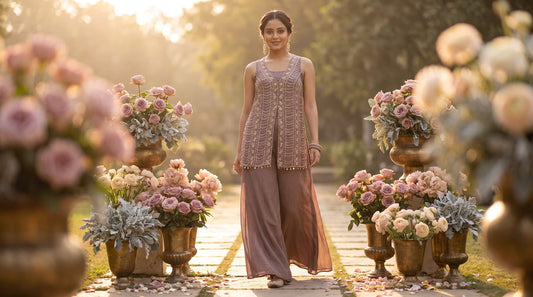
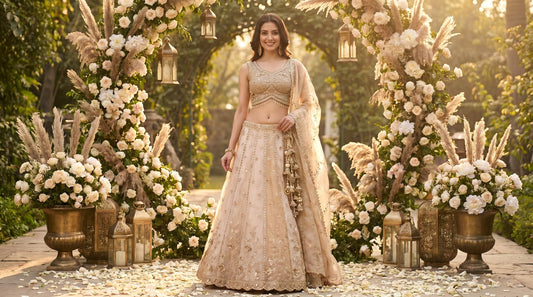
Blush catches warm tones from golden sunlight and creates a soft, romantic image that photographs beautifully in outdoor conditions — the morning light at a mehendi, the golden hour at an outdoor ceremony, natural light in a pre-wedding shoot. The problem: indoor lighting, particularly the mixed-temperature lighting common at most Indian wedding venues, flattens blush pink significantly. Under warm amber venue lighting, blush can appear washed out. Under cool LED venue lighting, it can look nearly grey-white. The colour that looked like the most beautiful pink you have ever seen in daylight can look like an undefined pale colour in photographs taken under the venue's chandeliers.
Before committing to blush: request a physical swatch and hold it under the lighting conditions of your actual event venue. This test takes five minutes and saves you from the single most common blush lehenga disappointment.
In photography specifically: blush can read as white in photographs depending on the camera settings and lighting. Your wedding photographer may not immediately recognise that the colour was intentionally pale — the result can look like an overexposed photograph of an ivory lehenga rather than a deliberate blush choice.
Best for: Outdoor receptions, pre-wedding photography shoots, cocktail events with controlled warm lighting.
Fabric: Organza, soft georgette, chiffon. The delicacy of the fabric and the delicacy of the colour should match — blush in a stiff, heavy silk creates an incongruous combination where the fabric's weight fights the colour's lightness.
Jewellery: Gold or rose gold with pearls or polki. Avoid very heavy, dark-metal pieces — they overwhelm what the shade is trying to achieve visually.
Skin tone: Works best on medium to wheatish complexions. On very fair skin, blush can merge with the complexion and lose definition. A slightly deeper rose holds better.
Dusty rose and mauve pink
The most sophisticated pink currently available in the Indian ethnic wear market, and the one whose popularity continues to grow among brides who know specifically what they want.
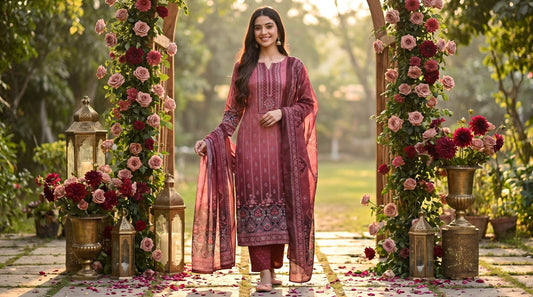
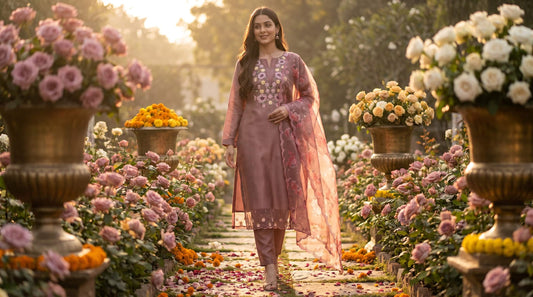
Dusty rose has grey undertones that give it a muted, vintage quality. It photographs with a restrained, editorial character — not the vivid romance of rani pink, but something more considered and more quietly luxurious. Brides who describe themselves as wanting "something recognisably pink but not over the top" almost always end up here when the shade options are laid out physically.
The quality that makes dusty rose particularly valuable is its durability across a long event day. By hour six, when brighter pinks can start to look slightly faded or harsh under changing lighting conditions, dusty rose holds its sophistication. It doesn't read as a colour that has lost its vitality — it reads as a colour that was always this calm and this refined.
Best for: Receptions, intimate ceremonies, pre-wedding functions, occasions where you want something contemporary rather than traditionally festive.
Jewellery: Rose gold, antique gold, or silver. Coloured stone pieces — turquoise, emerald, or soft blue — create genuinely beautiful contrast against the grey-pink tones of dusty rose. Avoid heavy temple jewellery in bright gold — the weight and brightness override the shade's deliberate restraint.
Skin tone: Very versatile. Works across most Indian skin tones without requiring adjustment.
Rose pink and baby pink (medium pink)
The most commercially purchased pink shade, and the one that justifies its dominance by being genuinely forgiving across the widest range of variables.
Clear, warm, unmistakably festive. Works in both lightweight and heavier fabrics. Works across the widest range of Indian skin tones without requiring precision adjustments. Works in more lighting conditions than blush. Works across more occasions than rani pink.
If you are uncertain about pink — uncertain about the shade, uncertain about the occasion, uncertain about whether pink is right for you — medium pink is where you begin. It forgives more styling decisions than the extremes do, and it consistently photographs as a deliberate, cheerful, festive choice.
Best for: Weddings, sangeet, mehendi, festive functions across the full occasion spectrum.
Jewellery: Gold jhumkas and chandbali. Polki or kundan sets. The one firm rule: avoid competing pinks anywhere in the accessories — a pink blouse paired with a pink dupatta in a slightly different shade creates an unintentional mismatch that photographs poorly.
Skin tone: Most flattering on medium-to-dark complexions. Can read slightly harsh against very fair skin — a soft rose rather than a cool baby pink is the more flattering choice for fairer complexions.
Rani pink and hot pink
The most festive pink and the most photographically powerful. The one that photographs in any lighting condition with exceptional vibrancy, that reads clearly across a crowded event space, and that has been a fixture of Indian festive dressing for generations with good reason.
Rani pink has cultural legitimacy and photographic authority simultaneously. It does not require specific lighting conditions to look its best — it creates its own visual impact in flash photography, in warm ambient light, in natural daylight, and in dimly lit venues. The colour is essentially lighting-proof.
The question is not whether rani pink works. It is whether you are ready to be the person wearing it. A rani pink lehenga at a wedding is a clear visual statement. The surrounding choices — jewellery weight, blouse design, dupatta treatment — need to match that energy rather than undercut it.
Best for: Weddings, sangeet, mehendi, major festive celebrations, any occasion where photographic impact is the primary goal.
Jewellery: Heavy gold. This is the only jewellery weight that matches rani pink's visual energy without being swallowed by it. Very delicate jewellery in gold or silver looks apologetic against rani. The jewellery needs to be bold enough to hold its own.
Skin tone: Works on all Indian skin tones. On deeper complexions specifically, the contrast creates some of the most visually powerful ethnic wear photographs possible. If this is your skin tone and you have been uncertain about rani pink, uncertainty is not warranted.
Magenta and fuchsia
At the edge of pink toward purple. Very high visual intensity — more drama than rani pink, more fashion-forward in its character.
These shades absorb and release warm light beautifully under artificial evening lighting, which explains why they consistently appear in the most vivid indoor reception photographs. Under warm amber chandeliers, magenta and fuchsia glow with a depth that outdoor light does not create in the same way.
In direct daylight, these shades can feel intense — potentially overwhelming. At a warmly lit evening event, they are extraordinary. The occasion and lighting alignment is important here in a way that it is not for medium or rani pink.
Best for: Evening receptions, cocktail events, indoor sangeet functions with warm lighting.
Jewellery: Heavy gold or diamond jewellery. The intensity of magenta requires jewellery that can hold visual ground beside it.
Skin tone: Works across Indian skin tones. Particularly vivid on medium and deeper complexions under warm lighting.
Pink Lehenga Fabric Guide by Shade
| Pink Shade | Best Fabric | Why It Works |
|---|---|---|
| Blush | Organza, soft georgette | Fabric delicacy matches colour delicacy — both need to be in the same weight register |
| Dusty rose | Raw silk, chanderi | Muted colour suits textured, structured fabrics with natural character |
| Medium/baby pink | Any quality fabric | Most forgiving shade — fabric variation does not undermine colour |
| Rani/hot pink | Silk, heavy georgette | Rich fabric matches and sustains colour vibrancy across hours |
| Magenta/fuchsia | Velvet, heavy silk | Deep, warm fabric matches and enhances deep colour intensity |
The Venue Lighting Problem: Why Pink Goes Wrong in Photographs
The single most common pink lehenga disappointment is a shade that looked perfect in daylight and appeared completely different in venue photographs.
Most Indian wedding venues use warm amber lighting — the kind that makes people look warm and glowing. This is beautiful for human skin. It is complicated for pink fabric.
Warm amber light adds yellow tones to everything it hits. A pink with warm undertones (baby pink, rani pink, medium rose) will appear warmer, richer, and more vibrant under warm lighting — usually a positive outcome. A pink with cool undertones (blush, dusty rose, mauve) can lose its specific character under warm light — the grey-lavender that made dusty rose so sophisticated can flatten out and the colour can appear as an undefined pale pink.
Pure cool-toned blush under warm amber venue lighting can appear closer to ivory or pale peach than pink in photographs.
The solution is simple but requires advance planning: take a physical swatch of your chosen fabric to the venue, hold it under the event lighting, and photograph it on your phone. What you see in that photograph is closer to what your wedding photographs will show than anything you saw in daylight.
Roohani Wedding Wearability Index™ — Pink Lehengas by Occasion
| Occasion | Best Pink Shade | Wearability Over 8 Hours | Photography Performance |
|---|---|---|---|
| Outdoor wedding ceremony | Rani pink, medium pink | High — strong in all light | Exceptional |
| Indoor reception | Dusty rose, magenta | High — warm light flatters both | Strong |
| Mehendi (daytime outdoor) | Medium pink, baby pink | High | Very good |
| Cocktail evening event | Magenta, dusty rose | High — warm artificial light flatters both | Excellent |
| Pre-wedding photography | Blush, medium pink | High in natural light | Beautiful in golden hour |
| Sangeet | Rani pink, hot pink | Very high — survives dancing and mixed light | Outstanding |
Common Buying Mistakes — Pink Lehengas
Choosing blush for an indoor venue without testing it under that venue's lighting. This is the most common and most expensive pink lehenga mistake. Blush is lighting-dependent in a way that no other pink shade is.
Pairing rani pink with jewellery in competing warm tones. Coral stones, orange citrine, and terracotta accessories create colour competition with rani rather than colour harmony. The warmth fights the warmth. Use clean gold, polki, or white stones.
Assuming all pink fabrics read the same in photographs. Blush can read as white. Rani can read as red. The photograph is not showing you what your eyes see — it is showing you what the sensor records under those specific lighting conditions. These are different things.
Ignoring skin tone and choosing purely from the catalogue image. The model's skin tone is rarely yours. The lighting in the product photograph is not the lighting at your event. The image tells you what the fabric looks like — it does not tell you what it will look like on you.
Choosing dusty rose and then pairing it with heavy bright gold temple jewellery. The visual weight of heavy temple gold overrides the deliberate restraint that makes dusty rose sophisticated. The jewellery needs to match the shade's intention, not contradict it.
Quick Answer Block
Best pink lehenga for a wedding guest: Medium or baby pink is the most versatile. Reads clearly as festive in all lighting conditions, flatters most skin tones, and does not risk competing with the bridal colour in most scenarios. Rani pink is bolder and equally appropriate but requires more confident styling.
Best pink lehenga for deeper skin tones: Rani pink and hot pink — the contrast between vivid pink and deeper complexions creates some of the most visually powerful ethnic wear photographs possible.
Best pink lehenga for indoor venues: Dusty rose or magenta — both hold their character under warm indoor lighting better than blush or pale pink.
Best pink lehenga for all-day wearing: Medium pink in georgette or chanderi — the colour is forgiving across changing light and the fabric manages comfort across hours.
Conclusion
Pink is the most internally diverse colour in the Indian ethnic wear market — the distance between blush and magenta is not a matter of degree but of entirely different aesthetic and practical requirements. Getting the shade right means understanding what each version of pink needs: the lighting condition it requires, the skin tone it serves best, the jewellery weight it can hold beside it, and the occasion it is most naturally suited for. Make those decisions with information rather than catalogue photographs, test the physical swatch in your actual venue conditions, and pink becomes one of the most reliably beautiful colour choices in the entire ethnic wear spectrum.
Our Bridal Lehenga Complete Guide
Lehenga Types And Silhouettes
Previous
The White Kurti Problem Nobody Mentions Until Summer Starts — And How to Actually Get It Right
Next
White Lehenga: Why Indian Brides Are Choosing It Now — and How to Wear It Right