Bridal Lehenga Guide: How to Choose One You Can Actually Wear for a Full Wedding Day

There is a moment, usually around the fourth hour, when a bride stops thinking about how her lehenga looks and starts thinking about how it feels.
It happens during the long stretch — the part of the day that no photographer captures and no Pinterest board prepares you for. The vidaai is still hours away. You have been standing, then sitting cross-legged for the pheras, then standing again for what feels like four hundred photographs. And somewhere in there, the lehenga you chose for how it looked in a softly lit trial room becomes the lehenga you have to actually survive.
This guide is written for that moment.
Not the trial-room moment. The fourth-hour moment.
Because the truth that most bridal content avoids is this: a bridal lehenga is the only outfit you will ever wear that has to perform two completely different jobs at once. It has to be the most photographed garment of your life, and it has to be wearable for the longest single stretch you will ever spend in one outfit. Those two jobs are frequently in conflict. The decisions that make a lehenga photograph beautifully are often the same decisions that make it punishing to wear.
Getting the balance right is the entire skill. Let's build it.
First, the thing nobody quantifies: weight
Brides ask about colour, embroidery, and silhouette. Almost nobody asks the question that determines their comfort for the entire day: how much does this weigh?
A heavily embellished bridal lehenga can weigh anywhere from four to ten kilograms. The skirt alone, in a full kali construction with kundan, zardozi, and dense sequin work, carries most of that on your hips and lower back. Add the dupatta — and in many North Indian and Punjabi ceremonies, two dupattas — and you are carrying a significant load on your head and shoulders for hours.
We score this on the Roohani Wedding Wearability Index™ — a simple read of how a lehenga holds up across a real function, not a fifteen-minute fitting.
| Lehenga weight | Roohani Wedding Wearability Index™ | What you actually experience |
|---|---|---|
| Under 4 kg | 9/10 | Comfortable through the full day; you forget you're carrying it |
| 4–6 kg | 7/10 | Manageable; lower-back awareness sets in around hour four |
| 6–8 kg | 5/10 | Beautiful in photos; genuinely tiring by hour five, needs sitting breaks |
| 8 kg+ | 3/10 | Maximum visual drama; plan rest periods, support, and an outfit change |
None of these are wrong. A 9-kilogram lehenga can be the right choice — if you know it's a 9-kilogram lehenga and you plan the day around it. The mistake is not the weight. The mistake is discovering the weight on the wedding day.
Buyer mistake #1: Choosing a lehenga without ever lifting it. If you are buying online, the single most useful question you can ask the seller is the total garment weight in kilograms. A reputable seller knows it. A vague answer is itself an answer.
The fabric reality check
Bridal lehengas are sold on their surface — the embroidery, the colour, the shine. The base fabric underneath is rarely discussed, and it is doing more work than anything else.
Here's the Roohani Fabric Reality Check™ for the fabrics you'll actually be offered:
Raw silk and silk blends. The traditional bridal base. Holds heavy embellishment beautifully, gives that structured, stand-on-its-own flare, and photographs with a deep, rich sheen. The trade-off: it adds weight, and it does not breathe. For a winter wedding, ideal. For a May afternoon in a non-air-conditioned venue, you will feel it.
Velvet. The most dramatic, the most photographic, the heaviest. Stunning for a winter or evening wedding. A genuine endurance test for anything warm. Velvet in a Delhi summer is a decision you make once.
Georgette and crepe. The contemporary bridal choice and, quietly, the smartest one for many brides. Lighter, more fluid, moves with you, and now available with embellishment dense enough to read as fully bridal. The flare is softer than silk — less "structured ballgown," more "fluid movement." If your priority is getting through the day, this is where to look first.
Net (with lining). Light and voluminous, popular for that floaty, fairy-tale silhouette. The catch is the lining: cheap lining under net is scratchy, traps heat, and is the single most common source of "this looked amazing but felt awful" regret. Check the lining, not just the net.
Organza. Sheer, crisp, photographs with extraordinary clarity, increasingly popular for receptions and second looks. Less common as a primary bridal base because it doesn't carry very heavy work as well, but exceptional for a lighter, modern bride.
On the Roohani Summer Survival Scale™, for a hot-weather wedding the order is clear: georgette and organza first, raw silk with caution, velvet last. For winter, the entire scale relaxes and velvet becomes a genuine pleasure rather than a sentence.
Counter-intuitive finding: The most expensive-looking bridal lehengas in photographs are frequently not the heaviest ones. Good photography rewards drape and movement, which lighter fabrics deliver. Brides routinely overspend on weight believing it reads as luxury. On camera, fluid georgette with intelligent embellishment often looks richer than a stiff, overloaded silk.
Colour: tradition, camera, and the thing about red
Red is the default for a reason. Across most North Indian and Punjabi Hindu traditions it carries deep cultural meaning, and — separately — it is the most camera-reliable bridal colour in existence. Red reads cleanly in daylight, in warm indoor light, under flash, and in golden hour. It almost never photographs "off."
But the bridal palette has genuinely widened, and the alternatives are no longer rebellious — they're mainstream.
- Deep maroon and wine. Red's more sophisticated relative. Reads slightly more modern, photographs just as reliably.
- Pink (blush to magenta). The most popular non-red choice. Magenta is festive and gold-friendly; blush is soft and contemporary but needs heavier embellishment to carry ceremonial weight and benefits from warm light.
- Emerald and bottle green. Auspicious in many traditions, exceptional with gold and silver work, and strikingly photogenic. One of the fastest-rising bridal colours.
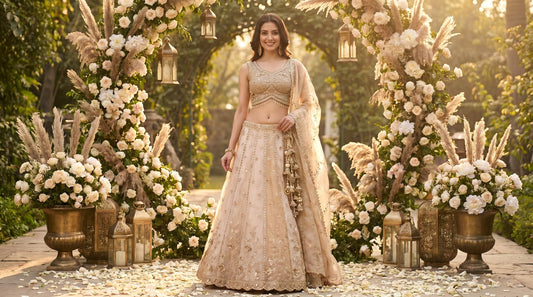
- Ivory, champagne, and pastels. The reception and second-ceremony palette, and increasingly a main-ceremony choice for modern brides. Demands serious embellishment to avoid looking under-dressed, and is the least forgiving under harsh light.
Hidden reality: Your lehenga's colour will be photographed under at least four completely different lighting conditions in a single day — daylight haldi-adjacent moments, indoor mandap light, flash, and evening reception lighting. Saturated colours (red, maroon, emerald, magenta) survive this gauntlet. Pale colours can look gorgeous in one setting and washed-out in the next. If you are choosing a pastel, ask to see it under direct flash before you commit, because that is what most of your photos will use.
Silhouette, matched to your day
You'll find the full silhouette breakdown in our lehenga types comparison, but for bridal specifically, the choice narrows to what you can wear for hours:
- A-line: The most reliable bridal silhouette. Universally flattering, photographs full without the weight penalty of a full circle, and the most forgiving for a long day. If you're unsure, start here.
- Half-circle / semi-flared: More drama than A-line, less weight than full circle. An excellent middle path.
- Full-circle (can-can / heavy flare): Maximum visual impact in motion — the silhouette that creates the iconic spinning-bride shot. Also the heaviest and the most demanding. Best when you can build rest periods into your timeline.
- Mermaid / fishtail: Fashion-forward, figure-conscious, increasingly chosen for receptions. Requires precise tailoring and limits how you can sit — worth knowing before the floor-seating pheras.
The real-world movement test
This is the section competitors skip, and it's the one that actually matters once the day begins.
Sitting for the pheras. You will sit on the floor, cross-legged or with legs folded, for a long ceremony. A very stiff, very structured skirt fights this. Heavy can-can resists folding and can ride up awkwardly. Ask yourself — or your tailor — how the skirt behaves when you sit on the floor, not just when you stand.
Standing for photographs. The cumulative load lands on your lower back. This is where the weight conversation from earlier becomes physical. A waistband that distributes weight well (wider, well-constructed, properly fitted) makes hours of standing dramatically more bearable than a thin, digging one.
Walking and the entrance. Floor-length plus heavy plus crowded venue equals a real risk of stepping on your own hem. Your hem length should be set with your actual wedding footwear on — not barefoot, not in different heels. This single fitting detail prevents the most common bridal-walk stumble.
Dancing at the sangeet. If the same lehenga (or a sangeet lehenga) is meant for dancing, weight and dupatta management decide everything. Many brides now keep a deliberately lighter outfit for the sangeet and reserve the heavy showpiece for the ceremony. See our dupatta draping styles for the belt and arm-loop drapes that keep fabric out of the way while dancing.
The car. Getting into a vehicle in a full bridal lehenga is its own event. A full-circle skirt and a sedan are not natural friends. If your day involves travel between venues, this is worth a five-second thought in advance.
Roohani Comfort Score™ — bridal context: rate any lehenga you're seriously considering across four axes — weight on the back, breathability for your season, freedom to sit for the pheras, and lining comfort against the skin. A lehenga that scores well on three of four is a strong choice. A showpiece that scores beautifully on looks but poorly on all four is an outfit you'll endure rather than enjoy.
Budget: where the money actually goes
Bridal lehenga prices span an enormous range — from around ₹15,000 for a well-made mid-market piece to several lakhs for a designer or couture lehenga. Understanding what each tier buys removes most of the budget guilt.
| Budget tier | What you're genuinely paying for | Honest verdict |
|---|---|---|
| ₹15,000–40,000 | Machine embroidery, synthetic or silk-blend base, ready or semi-stitched | Excellent value; photographs beautifully; check lining and embellishment durability |
| ₹40,000–1,00,000 | Mix of machine and hand work, better silk/georgette base, semi-custom fit | The sweet spot for most brides; quality is visible in person, not just on camera |
| ₹1,00,000–3,00,000 | Significant hand embroidery (zardozi, kundan), premium base, custom fit | You're paying for handwork hours and fit precision |
| ₹3,00,000+ | Designer label, couture handwork, full bespoke, name value | A portion is the garment; a portion is the name. Both are valid reasons to buy — just know the split |
Buyer mistake #2: Believing that more money automatically means more comfort. It does not. Above a certain point you are paying for handwork density and brand, both of which add weight. The most comfortable lehenga and the most expensive lehenga are rarely the same garment.
Buyer mistake #3: Spending the entire budget on the lehenga and nothing on the blouse fit. The blouse is the most-photographed close-up of the entire day and the most personal in fit. A perfectly fitted blouse on a mid-budget lehenga reads as more "expensive" than a loose blouse on a couture skirt.
The timeline truth
How early should you buy? For a fully custom or designer bridal lehenga with hand embroidery, three to six months before the wedding is normal — the handwork alone can take eight to twelve weeks, and you'll want two to three fittings. For a ready or semi-stitched lehenga, four to six weeks is enough for alterations. For anything online, add a buffer for shipping and a return-and-replace cycle in case the colour or fit is off.
Buyer mistake #4 — the panic-buy. The bridal lehenga is the single most panic-bought garment in Indian fashion. A compressed timeline forces you into whatever is in stock rather than what's right, and rush alterations are where fit goes to die. If you take one piece of scheduling advice from this guide: lock your lehenga before you lock the smaller things. It needs the longest runway.
Buyer mistake #5 — skipping the loaded fitting. Brides fit the lehenga, but rarely fit it with the dupatta on the head, the jewellery on, and the footwear worn — the actual loaded condition. The weight, the hem length, and the dupatta drag all change once everything is on. Do at least one fitting in full kit. It's the closest you'll get to a dress rehearsal for the fourth hour.
Best For / Avoid If
A heavy silk or velvet showpiece is best for: winter and evening weddings, brides who want maximum traditional drama, days with built-in rest periods and an outfit change.
Avoid the heavy showpiece if: your wedding is in peak summer heat, your venue isn't climate-controlled, your function runs long with little downtime, or you simply know your own comfort threshold is low. There is no prize for enduring your own wedding.
A georgette or organza lehenga is best for: summer and daytime weddings, brides who plan to move and dance, anyone prioritising the fourth-hour experience over maximum embellishment density.
Avoid the very light pastel lehenga if: your photography will lean heavily on flash, the venue lighting is unpredictable, or you want unmistakable traditional ceremonial weight.
Quick Answer Block
How do I choose a bridal lehenga? Match three things to your specific day: weight (under 6 kg for comfort, higher only with rest planned), fabric (georgette/organza for heat, silk/velvet for winter), and silhouette (A-line for reliability, full-circle for drama). Then fit it fully loaded — dupatta, jewellery, and footwear on — before you commit.
How heavy is a bridal lehenga? Typically 4–10 kg depending on embellishment. Under 6 kg stays comfortable for a full day; 8 kg and above is beautiful but needs planned rest.
Which colour is best? Red and deep maroon are the most reliable across all lighting; emerald and magenta are strong photogenic alternatives; pastels are gorgeous but need heavier embellishment and flattering light.
How much should it cost? ₹40,000–₹1,00,000 is the sweet spot for most brides. More money buys handwork and brand, not comfort.
How early should I buy? Three to six months for custom/designer; four to six weeks for ready-made plus alterations.
"Lehenga under 2000 guide" (for the budget-conscious guest or pre-wedding function)
"Lehenga fabric comparison" (fabric-by-fabric breakdown)
Previous
Lehenga Types — Every Silhouette Explained and How to Choose for Your Occasion and Body
Next
Lehenga Dupatta Draping: 8 Styles That Change Everything (And Exactly When to Use Each)