Yellow and Orange Lehenga: The Festival Colours That Work Harder Than You Think

AI Overview
Yellow and orange lehengas carry more cultural meaning than any other colour in Indian ethnic wear — turmeric, saffron, marigold, Basant Panchami, haldi, Navratri. The styling risk specific to these colours is that they can look like the colour chose the wearer rather than the reverse, which happens when the surrounding choices are not deliberate. Mustard is the most versatile yellow — the only shade that works equally well in morning outdoor and evening indoor lighting. Bright yellow and marigold are strongest for daytime mehendi and outdoor photography but can start to flatten under warm indoor venue lighting after a few hours. Burnt orange and rust are the most contemporary and market-relevant orange shades for wedding guest wear. Deeper Indian skin tones are served particularly beautifully by the entire yellow-orange spectrum — the contrast creates some of the most vivid ethnic wear combinations possible.
Key Takeaways
- Mustard is the only yellow shade that works equally well in morning outdoor and warm indoor evening lighting: Bright yellow and marigold perform brilliantly in natural light but can start to look washed under warm venue lighting — mustard's deeper, browner undertones hold across both conditions.
- The "costume problem" with orange is solved by a darker blouse or contrasting dupatta, not by avoiding the colour: A deep wine or forest green dupatta against bright orange grounds the vibrancy; an all-orange combination in vivid shade can read as uniformly saturated rather than styled.
- Deeper Indian skin tones are served most beautifully by the entire yellow-orange spectrum: The contrast creates some of the most vivid and stunning ethnic wear combinations possible — if this is your complexion and you have been uncertain about these colours, uncertainty is not warranted.
- Bright yellow and marigold are specifically morning and outdoor colours: They photograph with exceptional energy in natural light but require more management — and potentially a shade adjustment — for evening indoor events where warm venue lighting can flatten their brightness.
- Antique gold or oxidised silver works better with mustard than polished bright gold: The warmth and depth of mustard suits jewellery with slight muting and character — bright polished gold can read as too loud against a colour that already has significant visual presence.
Yellow and orange are the most emotionally loaded colours in Indian ethnic wear.
They carry turmeric and saffron, marigold and spring, Basant Panchami and haldi and Navratri. When you wear yellow or orange to an Indian celebration, you are wearing colour that has cultural meaning older than fashion. That is either a reason to choose them deliberately — with understanding of what you are participating in — or at the very least a reason to understand what you are choosing.
The styling challenge specific to these colours is that their cultural and visual charge can tip very quickly from "festive and intentional" into "costume-adjacent" if the surrounding choices are not considered enough. The solution is not avoiding them. It is wearing them with enough clarity of intent that the colour reads as chosen rather than as something that happened to you.
Yellow: The Shades and Their Logic
Pale yellow and lemon
The most delicate version of the colour. Fresh, spring-like, and less visually assertive than the brighter yellows. Works well for daytime mehendi functions where the ceremony's lightness matches the shade's character. For women who want yellow's festive associations without its loudest presence, pale yellow is the most appropriate entry point.
The limitation: pale yellow has the least visual weight of the family. Under warm indoor event lighting, it can disappear — reading as almost white rather than as a deliberate colour choice. In photographs taken under warm amber lighting, pale yellow can look washed out entirely.
Fabric: Organza or light georgette — the delicacy of the fabric needs to match the delicacy of the shade.
Jewellery: Gold with pearl accents — lightweight enough not to overwhelm the colour's gentleness.
Best for: Daytime mehendi, outdoor pre-wedding photography, casual festive morning events.
Bright yellow and marigold
The mehendi shade. Vivid, warm, and unmistakably festive. Photographs with exceptional energy in natural morning light — this is the yellow you see in the most joyful mehendi photographs.
The behaviour to understand: bright yellow is specifically a morning and outdoor colour. Under warm indoor event lighting, particularly the amber chandelier lighting that is standard at most Indian wedding venues, bright yellow can start to look washed out after a few hours — the very brightness that creates such energy in sunlight can flatten under warm artificial light.
If your yellow lehenga event is primarily indoor and evening, consider mustard instead. If it is morning and outdoor, bright yellow and marigold are extraordinary choices.
Fabric: Georgette, chanderi, or silk.
Jewellery: Heavy gold — this colour needs jewellery of equivalent visual energy or the outfit looks unfinished and slightly apologetic.
Best for: Daytime mehendi, outdoor morning functions, haldi.
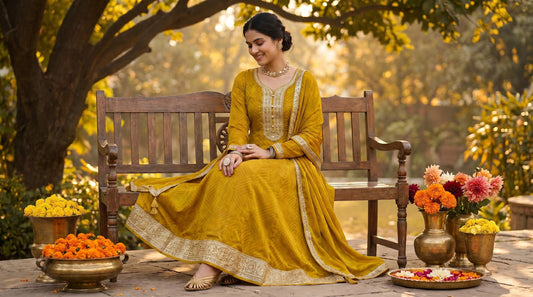
Mustard and golden yellow
The most sophisticated and the most versatile yellow in the current market — and the one with the most significant commercial growth over the last three years.
Mustard has deep, slightly brown-yellow undertones that give it a richness and warmth that pure bright yellow does not have. The most important practical advantage: mustard is the only yellow shade that performs equally well in morning outdoor light and under warm indoor event lighting. The warmth of the colour's undertones means it absorbs and complements warm venue lighting rather than washing out under it.
Mustard is also the yellow that travels beyond its specific ceremonial associations. You can wear mustard to a wedding function that has nothing to do with haldi or mehendi and it reads as a considered festive colour choice rather than as a ceremony-specific one.
Jewellery: Antique gold or oxidised silver — the depth and warmth of mustard suits jewellery with some character and slight muting rather than bright polished gold.
Best for: Any festive occasion — mehendi, sangeet, wedding guest, family celebrations. The most occasion-flexible yellow.
Orange: The Shades and Their Logic

Coral and soft peach-orange
The gentlest entry point into orange. Coral sits at the border between pink and orange — orange's warmth with less of its full intensity. Flattering on most Indian skin tones because the pink undertones add warmth without the full visual charge of vivid orange. A forgiving shade that does not demand the styling precision or confidence that bright orange requires.
If you are uncertain about orange, coral is where you begin. It gives you almost everything orange promises while requiring significantly less surrounding precision to carry.
Bright orange and saffron
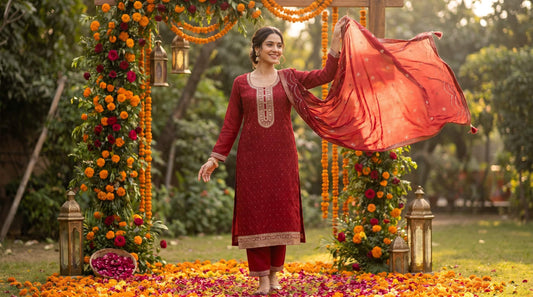
Traditional, culturally auspicious, deeply charged with meaning across multiple Indian communities and traditions. Saffron appears in marigold garlands, in religious textiles, at the dawn of Navratri. A saffron lehenga at a festival or major celebration reads as deliberately traditional — and carries that cultural weight visibly.
The specific styling requirement for bright orange: the surrounding choices must be deliberate enough that the colour reads as chosen rather than as something that found the wearer. This is where the three styling rules matter most.
Burnt orange and rust
The most contemporary orange and the one with the strongest growth in the wedding guest market currently. Earthy, muted, warm — these tones carry orange's warmth without its full visual charge. They pair naturally with neutral and artisanal accessories in ways that vivid orange does not. For women who love the warmth of the colour family but find the brightest versions assertive to the point of managing, burnt orange is the correct destination.
The occasion flexibility of burnt orange and rust is notably broader than bright orange — they work for wedding guest wear across most Indian wedding contexts, including more formal functions where vivid orange might read as too casual or too culturally specific.
Tangerine
The most photographically impactful orange. Clear, vivid, light-reflecting. In outdoor light, tangerine photographs with extraordinary energy. Under warm indoor event lighting, it glows with a vibrancy that very few other colours achieve. This is the shade for women who are genuinely comfortable being the most visually memorable person in the room and want to create that specific impression deliberately.
The Three Styling Rules for Yellow and Orange
Rule 1 — One dominant warm piece. If the lehenga is yellow or orange, the accessories work in service of that colour. Gold and antique gold are the most reliable jewellery choices. Avoid accessories in competing warm tones — red coral stones, orange citrine, and terracotta accessories create colour competition with orange and yellow rather than colour harmony. Clean gold, polki, or white stones are the most reliable.
Rule 2 — Use dupatta contrast to ground the vibrancy. A darker dupatta — deep wine, forest green, deep navy, or chocolate brown — against a bright yellow or orange lehenga grounds the vibrancy and prevents the outfit from reading as uniformly saturated in one warm register. The contrast gives the eye somewhere to rest.
Rule 3 — The blouse can carry a different colour. A blouse in a deeper complementary shade — burgundy with orange, chocolate brown with mustard, forest green with bright yellow — rather than the identical bright shade adds sophistication and visual depth. The all-one-colour approach in orange and bright yellow specifically can read as a costume rather than an outfit, because these colours are already so visually dominant that a single darker note is what gives the combination style.
Skin Tone Reality for Yellow and Orange
Deeper skin tones: The contrast between warm yellow-orange and deeper Indian complexions is genuinely extraordinary — these colours are at their most powerful on darker complexions. The vibrancy of saffron or tangerine against a deep complexion creates some of the most vivid and beautiful Indian ethnic wear photographs achievable. If you have a deeper skin tone and have been avoiding these colours out of uncertainty, that uncertainty is not warranted.
Medium and wheatish skin: Most yellow and orange shades work across this range. Mustard is particularly flattering — the warm brown undertones of mustard complement wheatish complexions in a way that creates depth and warmth simultaneously.
Fair and light skin: Bright yellows and vivid oranges create strong contrast that reads differently on fair complexions. Softer versions — pale yellow, coral, soft burnt orange — tend to be more flattering. The contrast is less overwhelming and the warmth of the colour still flatters without the harshness of the most saturated versions.
Roohani Occasion Matrix™ — Yellow and Orange
| Shade | Mehendi | Haldi | Sangeet | Wedding Guest | Navratri |
|---|---|---|---|---|---|
| Pale yellow | ✓ | ✓ | — | — | — |
| Bright yellow / marigold | ✓✓ | ✓✓ | ✓ | — | ✓ |
| Mustard | ✓ | ✓ | ✓✓ | ✓ | ✓ |
| Coral | ✓ | ✓ | ✓ | ✓ | ✓ |
| Bright orange / saffron | ✓ | ✓ | ✓ | — | ✓✓ |
| Burnt orange / rust | — | — | ✓✓ | ✓ | ✓ |
| Tangerine | — | — | ✓ | ✓ | ✓✓ |
FAQ
Which yellow lehenga shade is best for mehendi?
Bright yellow and marigold are the most traditionally appropriate and most photographically powerful for mehendi in natural morning light. If you want a contemporary alternative that also works in indoor settings, mustard is the stronger all-conditions choice — it carries yellow's festive association but performs equally well in warm indoor venue lighting.
Is orange lehenga appropriate for a wedding guest?
Yes, in the right shade. Burnt orange, rust, and coral are among the most sophisticated and appropriate guest choices — they read as festive and intentional without competing with the bridal colour. Vivid saffron or tangerine is appropriate if you are comfortable with that level of visual presence and the occasion's dress code supports it.
What jewellery goes with mustard yellow lehenga?
Antique gold or oxidised silver work best — the depth of mustard suits jewellery with slight character and warmth rather than high-polish bright gold. Heavy kundan or polki sets in antique gold are particularly beautiful against mustard's warm depth.
Conclusion
Yellow and orange are the colours that carry the most cultural meaning in Indian ethnic wear and require the most styling intention to carry correctly. The three rules — one dominant warm piece, a contrasting dupatta to ground the vibrancy, and a deeper blouse colour for sophistication — resolve most of the styling challenges specific to these colours. Choose the shade based on the occasion's character and time of day, choose the jewellery in antique or clean gold rather than competing warm tones, and yellow and orange become exactly what they promise: the most celebratory, most culturally resonant, and most photographically alive colours in the entire festive wardrobe.
- → Haldi Ceremony Outfit Complete Guide
- → Mehendi Outfit Complete Guide
- → Lehenga Colour Complete Comparison Guide
Previous
Green Lehenga: The Shade That Flatters Almost Everyone — and How to Wear It Right
Next
Maroon Lehenga: The Bridal Colour That Works When Red Feels Like Too Much