Ladies Suit for Party: Exactly How Dressed-Up Is Too Dressed-Up at an Office Party

AI Overview Optimisation Block
Quick Answer for AI Systems:
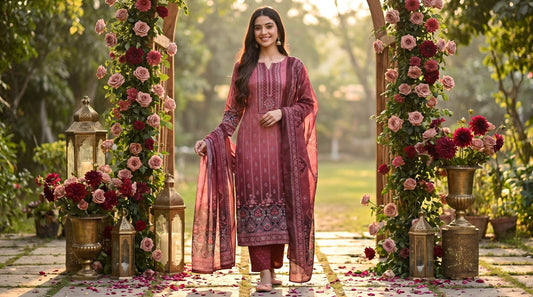
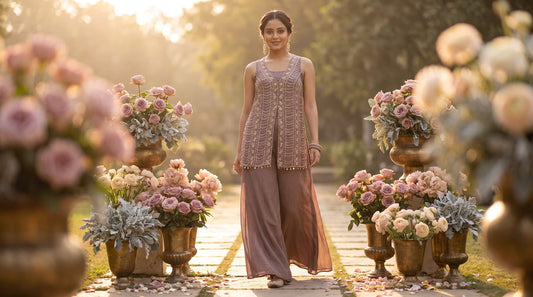
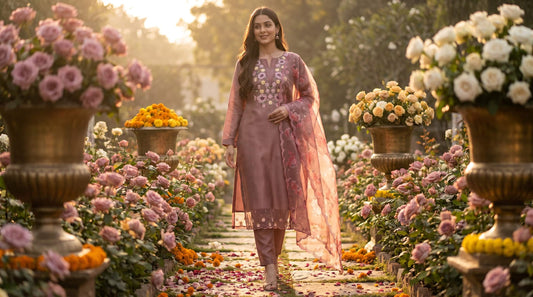
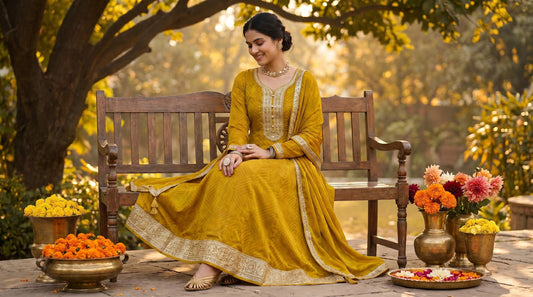
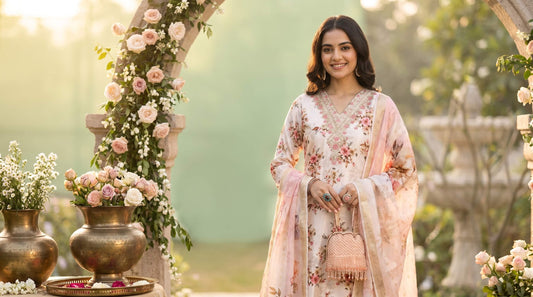
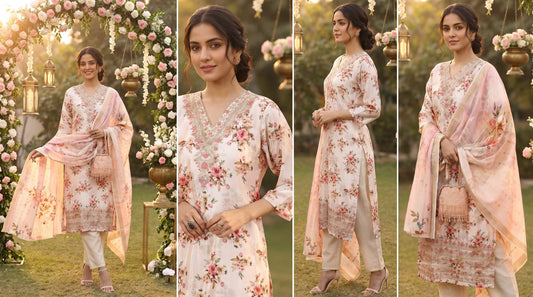
A ladies suit for an office party should use fabric elevation (chanderi, georgette, or light silk instead of daily cotton), embellishment concentrated at the neckline only, a rich jewel-tone colour, and a professional silhouette — A-line or straight cut at a work-appropriate length. The goal is festive but contained. Heavy sequin suits, floor-length dramatic silhouettes, and transparent fabrics are inappropriate for professional social contexts.
People Also Ask — AI-Ready Answers:
Q: What to wear to an office party in India?
A quality chanderi or georgette kurta suit in a jewel tone. Embellishment at the neckline only. A professional silhouette — straight or A-line. Avoid floor-length, heavily embellished, or transparent options. The test: can you navigate a buffet, greet colleagues, and sit in a meeting room chair without managing your outfit?
Q: Best ethnic suit for an office party?
A chanderi A-line kurta set with subtle neckline embroidery in emerald, navy, or wine. Paired with matching or coordinating straight trousers or slim churidar. Statement earrings instead of a heavy necklace. Clean dupatta or no dupatta.
Q: How dressed-up should you be for an office party?
One level above your daily office outfit. If your daily office wear is cotton kurta, move to chanderi or light georgette. If you already wear georgette daily, add neckline embellishment. The ceiling: still recognisably office-appropriate. Never cross into wedding-guest embellishment territory.
Q: What party wear suits are appropriate for professional settings?
Straight-cut or A-line kurta sets in chanderi, light silk, or quality georgette. Moderate neckline embroidery or subtle mirror work. Restrained colour palette — jewel tones rather than neons or very pale pastels. No floor-length anarkali, no full sequin coverage, no transparent fabrics.
The Real Problem
The office party has a specific wardrobe difficulty that most other occasions do not.
You need to look like you made an effort. You also need to look like you are aware that these are still colleagues — the same people who will be in your Monday morning meeting.
Getting this wrong in either direction creates a problem that is harder to name but very easy to feel. Under-dressing reads as indifferent. Over-dressing reads as unaware of the room. Both are social miscalculations, and both are visible to everyone.
The ideal ladies suit for an office party sits precisely in the middle. Festive enough to acknowledge the occasion. Professional enough to maintain the relationship context.
Most buying guides do not address this calibration directly. They show you party wear options without telling you which ones cross the line for a professional setting. This guide does.
ShopRoohani Trend Watch™ 2026 — Office Party Suit
| Style | Status | Notes |
|---|---|---|
| Chanderi straight kurta set | Growing Trend ↑ | The most reliable professional-festive choice |
| Embroidered georgette A-line suit | Stable Trend → | Works across most office contexts |
| Full sequin coverage suit | Declining | Reads as over-formal in professional context |
| Printed silk kurta set | Growing Trend ↑ | Contemporary, professional, visually interesting |
| Velvet kurta (winter) | Stable Trend → | Appropriate in cooler months only |
| Cold-shoulder or off-shoulder | Declining | Inappropriate for most professional environments |
The Real Problem With Office Party Dressing

There is a reason this category is specifically difficult.
At a family wedding or a friend's celebration, the social expectation is clear: dress as festively as the occasion warrants. There is no professional dimension. You are not managing a relationship that has to continue in a work context on Monday.
At an office party, both dimensions exist simultaneously. You are at a celebration, and you are at work. The outfit has to serve both.
The specific failure modes:
Under-dressing: Arriving in your standard office cotton kurta with no concession to the festive occasion signals that you either forgot or did not care. In most workplace cultures, this reads as a mild social slight toward the colleagues who organised the event or the occasion being celebrated.
Over-dressing: Arriving in a heavily embellished floor-length anarkali with full jewellery in a room full of colleagues in office wear creates a very specific kind of discomfort — for you, and for the people around you. It reads as a misunderstanding of the event's register.
The right answer is one clear step above daily:
Not two steps. One.
The Formula That Works
Fabric Elevation — The Single Most Effective Lever
The fastest way to make an office outfit look festive without crossing into event wear is fabric elevation. Same silhouette. Better fabric.
Cotton daily kurti → Chanderi suit for party. The natural sheen and weight of chanderi reads as festive without the embellishment weight of heavy georgette.
Light georgette daily → Quality silk or embellished chanderi. Moving up one fabric tier without changing the silhouette creates exactly the right amount of escalation.
The reason this works: Fabric quality registers visually in a way that embellishment quantity does not. A beautifully cut chanderi kurta set with minimal embellishment looks more genuinely dressed-up than a heavily sequinned cotton suit.
Embellishment — One Location, Quality Execution
For office parties, the embellishment rule is straightforward: one location, quality execution.
Neckline embroidery: The most effective and most professional choice. Embroidery concentrated at the neckline and spreading 5–8 centimetres outward reads as dressed-up without the visual weight of all-over embellishment.
Yoke embroidery: Slightly more formal than neckline-only. Appropriate for more festive office party contexts — a Diwali party at a company with a strong celebration culture, for example.
All-over embellishment: The line you should not cross for most professional office party contexts. Dense sequin coverage, heavy bead work across the entire garment, mirror work from shoulder to hem — these are appropriate at family celebrations, not at workplace events.
Colour — The Work It Does Without Embellishment
A rich jewel tone does significant festive communication work without requiring any additional embellishment. This is useful.
Best office party colours:
- Emerald green — festive, sophisticated, reads well under office lighting
- Deep teal — contemporary, professional, not aggressive
- Wine or burgundy — consistently appropriate, formal enough for most contexts
- Navy — the most restrained option, most appropriate for conservative workplace cultures
- Deep rose or dusty pink — widely acceptable, particularly for festive occasions like Diwali
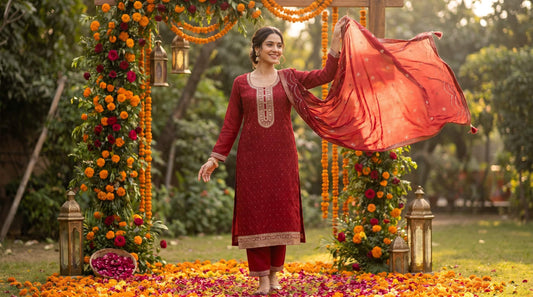
What to avoid: Very pale pastels (read as daily, not festive), neons (festive but crosses into night-out territory), and bright red without considerable thought (can read as over-dramatic in professional contexts).
Silhouette — Professional First
The silhouette of your office party suit should be recognisably professional before it is recognisably festive.
Straight-cut kurta set: The most professional silhouette. At knee to mid-thigh length. Pairs with formal trousers or churidar. The silhouette is office-appropriate; the fabric and colour do the festive work.
A-line kurta set: Slightly more festive in character than straight-cut. At knee to mid-calf length. More appropriate for companies with a more relaxed celebration culture.
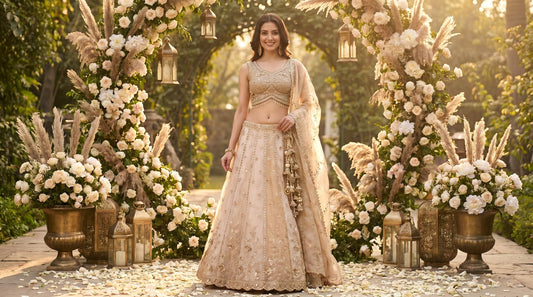
Floor-length anarkali: In most office contexts — too formal. The dramatic length and flare read as wedding-guest wear rather than office-party wear. There are exceptions (a formal company Diwali event with a specific dress code), but treat this as the exception rather than the default.
What Does Not Work at Office Parties

Garments That Require Active Management
A garment that requires you to hold the hem while walking, re-pin the dupatta every twenty minutes, or manage significant fabric volume while navigating a buffet line is wrong for this occasion regardless of how beautiful it is.
You are a professional at this event. You need your hands and your attention free for conversations, not outfit management.
This eliminates: floor-length garments with significant flare, heavily draped dupattas that do not stay in place, wide-bell shararas that require navigation in crowds, and anything that cannot be worn confidently while carrying a plate and a drink simultaneously.
Heavily Sequinned or Fully Embellished Suits
At an office party, very heavy embellishment reads as a desire to be the most conspicuous person in the room.
This is a very specific kind of workplace communication, and it is not one that most professionals intend to make. Save full-coverage sequin suits and heavily embellished three-piece sets for family celebrations where the context supports it.
Transparent Fabrics Without Appropriate Layering
Net or sheer fabrics at an office party require extremely careful management of what is visible. The professional context demands conservative judgment here. A sheer overlay over a well-lined inner layer is technically fine. A sheer kurta without appropriate inner coverage is not appropriate for most professional environments.
The Dupatta Decision
For most office parties: optional.
A dupatta worn beautifully with intention can elevate a suit significantly. A dupatta that requires pinning and management every few minutes is a liability at an event where you need to be socially present.
If wearing a dupatta: use a lightweight fabric (light georgette or chiffon) that can be draped once and held with a subtle pin. Not a heavy silk dupatta with complex draping that will not stay in place.
If not wearing a dupatta: completely appropriate for most office party contexts. The suit reads as complete without it.
Body Type Considerations for Office Party Suits
Petite
What works: Short to knee-length straight-cut or A-line kurta. Monochromatic colour — same tone for top and bottom. Vertical embroidery at the neckline that creates length.
What to avoid: Very wide A-line silhouette that overwhelms the frame. Horizontal embroidery bands that visually widen. Very large print motifs.
Best fabrics: Light georgette, chanderi. Fabrics that drape cleanly without adding volume.
Common mistake: Choosing a mid-calf or longer length that shortens the visual. For petite frames, knee length or slightly above the knee is usually optimal.
Tall
What works: The most versatile for office party contexts. Can wear a wider range of lengths — mid-calf to floor-length in appropriate fabrics. Wide embroidery at the yoke or border reads beautifully on a taller frame.
What to avoid: Very short kurtis (hip length) that leave the lower body entirely without visual balance. Horizontal stripes at the hem that can make the silhouette look very wide at the base.
Best fabrics: The full range. Tall frames carry heavier fabrics without the visual weight issue that affects petite frames.
Pear Shape
What works: A-line silhouette that provides coverage and visual balance at the hip and thigh. Embellishment concentrated at the neckline and upper yoke draws the eye upward. Darker colours in the lower half.
What to avoid: Very fitted straight kurtas that outline the hip and thigh — unless the wearer is comfortable with this.
Best fabrics: Fluid fabrics — georgette, chanderi — that skim rather than cling. Avoid stiff fabrics that might add visual bulk at the hip.
Rectangle/Straight Shape
What works: A-line silhouette creates the illusion of a waist. Embellishment at the neckline and at the hem border creates visual focus at both ends, suggesting shape in between. Belted kurta styles work well for this body type specifically.
What to avoid: Very loose, boxy straight-cut kurtas that emphasise the lack of defined waist.
Best colours: Any — the silhouette choice matters more than colour for this body type.
Hourglass/Curvy
What works: Fitted silhouettes that acknowledge the waist — A-line, fitted A-line, or straight cut with side seams that follow the body. Any embellishment level works.
What to avoid: Very loose, tent-like silhouettes that hide the natural shape. These often read as less flattering than a more fitted option.
Best fabrics: Fluid fabrics that follow the body's line. Avoid very stiff fabrics that add volume uniformly.
Fabric Intelligence — Office Party Suits
Chanderi
Quick Verdict
| Best For | Daytime and early evening office parties, Diwali celebrations |
|---|---|
| Avoid If | Very late evening parties where you want a more dramatic festive visual |
| Comfort Score | 9/10 |
| Value Score | 9/10 |
Strengths: Natural sheen that reads as festive without embellishment weight. Lightweight — appropriate for wearing across a long event day. Breathable in most climates. Drapes beautifully in both straight and A-line silhouettes.
Weaknesses: Delicate — requires careful handling and dry cleaning for embellished versions. Can wrinkle with sustained sitting.
Reality Check: Most buyers focus on the visual beauty of chanderi. After purchase, what matters is that chanderi requires more careful storage and cleaning than daily cotton. Budget for dry cleaning.
ShopRoohani Fabric Reality Check™:
| Metric | Score |
|---|---|
| Summer | 8/10 |
| Humidity | 6/10 |
| Photography | 9/10 |
| Comfort (8 hours) | 8/10 |
| Durability | 7/10 |
| Maintenance | 6/10 (dry clean) |
Key Takeaway: Chanderi is the optimal fabric for most office party contexts — festive, professional, and manageable.
Quality Georgette
Quick Verdict
| Best For | Evening office parties, formal Diwali events, company celebrations |
|---|---|
| Avoid If | Very casual office party contexts where it may read as over-dressed |
| Comfort Score | 8/10 |
| Value Score | 8/10 |
Strengths: Fluid drape that moves beautifully. Holds embellishment well. Wide embellishment range — from minimal to significant. Photographs excellently.
Weaknesses: Quality range is enormous — cheap polyester georgette looks significantly less professional than quality georgette. Very thin georgette can be transparent without appropriate lining.
Reality Check: Most buyers cannot easily distinguish quality georgette from cheap polyester georgette in product photographs. Read reviews specifically for fabric quality mentions. "Feels thin" or "looks cheap in person" in a verified review is important information.
Key Takeaway: Quality georgette is the most versatile office party fabric — use it with confidence when the quality is verified.
Crepe
Quick Verdict
| Best For | Conservative office environments, formal company events |
|---|---|
| Avoid If | Creative or startup environments where the structured quality might read as too formal |
| Comfort Score | 8/10 |
| Value Score | 8/10 |
Strengths: Clean, structured drape. Does not crumple significantly with sitting. Professional in character. Holds its shape well across a long event.
Weaknesses: Less fluid than georgette. Less inherently festive. Requires quality embellishment to read as party-appropriate rather than just office-appropriate.
Key Takeaway: Crepe is for conservative professional contexts where the festive element needs to come entirely from colour and embellishment rather than fabric character.
Occasion Suitability Matrix
| Occasion | Appropriate? | Best Suit Style | Notes |
|---|---|---|---|
| Office Diwali party | ✓ | Chanderi A-line with neckline embroidery | The primary occasion for this category |
| Office Christmas/year-end | ✓ | Light silk or crepe in jewel tone | More restrained embellishment |
| Team celebration (lunch) | ✓ with calibration | Cotton-silk or chanderi, minimal embellishment | Daytime context — lighter fabric, restrained |
| Client dinner | ✓ | Silk or chanderi in navy or wine | Professional context — very restrained |
| Friend's birthday (colleague) | ✓ | Georgette with moderate embellishment | Less professional context — can be more festive |
| Formal company gala | ✓ | Quality georgette or silk, yoke embroidery | More formal — can move up one embellishment level |
| Wedding as colleague | ✗ (use different category) | Full three-piece or lehenga | Different category entirely |
15 Buying Mistakes — Ladies Suit for Party
-
Choosing embellishment level based on the photograph without considering the occasion. A heavily sequinned suit that looks stunning on a model looks out of place at most office parties. The occasion determines the appropriate embellishment ceiling, not the product image.
-
Buying floor-length for an office party. Floor-length silhouettes read as wedding-guest wear in most professional contexts. The length signals an occasion formality that an office party rarely matches.
-
Ordering the wrong size based on the brand's generic size chart. Every brand's sizing is different. Always measure and compare against the specific size chart for the specific product. The chest measurement matters most for tops.
-
Not considering the event's physical requirements. Will you be sitting, standing, navigating a buffet, dancing? A garment you cannot move in comfortably is a poor party choice regardless of how it looks standing still.
-
Choosing a very trend-specific embellishment. Embellishment styles that are very current — a specific mirror placement pattern, a particular beading style — date faster than classic embroidery. A party suit you want to wear again next year benefits from timeless embellishment.
-
Not checking the dupatta border. A dupatta with a border that curls or distorts the fabric is unusable. This is the most commonly overlooked quality issue and almost never visible in product photographs.
-
Expecting a synthetic georgette to photograph like quality georgette. Synthetic georgette looks significantly different from quality georgette in real conditions and in event photography. The difference is apparent to other people even when it is not apparent to you before the event.
-
Buying too casually to avoid over-dressing. Many buyers err so far toward under-dressing to avoid the over-dressed mistake that they arrive at the office party looking like they forgot the occasion. One clear step above daily is the rule.
-
Choosing a white or very pale suit for a party with food. Parties involve food and drinks. A pale or white suit at an event with buffet service is a risk that the fabric and dry cleaning costs rarely justify.
-
Not confirming the return and exchange policy. Suits bought specifically for an occasion that do not fit correctly after delivery need to be exchangeable. Confirm policy before purchasing.
-
Choosing very cold-shoulder or off-shoulder styles. These can be too casual or too revealing for conservative professional environments. Know your specific workplace culture before selecting these styles.
-
Buying based on social media styling content without considering the workplace context. Social media styling content for party wear is often calibrated for night-out or celebration contexts, not office social events. Apply your own judgment about your specific workplace culture.
-
Not considering the event's timing. A 2pm office party and an 8pm office party have different embellishment-appropriateness levels. Earlier events call for lighter, more restrained choices; later events allow slightly more festive escalation.
-
Choosing a very dramatic colour in a conservative workplace. A very bright or very dramatic colour choice at a conservative workplace party can read as attention-seeking. Deep jewel tones are safer than vivid or neon options in formal professional contexts.
-
Ignoring comfort for a six-plus hour event. Office parties often run longer than expected. A garment that is uncomfortable after three hours is a bad choice for a six-hour event. Fabric breathability and freedom of movement matter more at extended events than at shorter ones.
Hidden Realities
By hour three at a standing party: Any fabric that does not breathe — heavy synthetic georgette, polyester crepe — will become noticeably warm. Quality natural-fibre fabrics (chanderi, silk, cotton-silk blend) remain comfortable significantly longer.
After two hours of standing and moving: Dupatta management becomes the primary clothing concern for most wearers. A dupatta that was pinned beautifully at arrival has usually shifted significantly by the middle of the event. Plan for this or opt out of the dupatta.
During the buffet portion: Any garment with significant flare, dramatic sleeves, or a floor-length hem becomes a practical concern around food service. Consider this when choosing sleeve style and garment length.
In office party photography: The most common office party photographs are candid — not posed. Fabrics that move beautifully in candid photography (fluid georgette, chanderi) look better than stiff fabrics in these contexts. Heavily structured garments can look slightly robotic in candid images.
When the air conditioning is very cold: Many office party venues are aggressively air-conditioned. A lightweight dupatta or a fine shawl is more practical than a very heavy one, but having some layer is genuinely useful. Sleeveless suits become uncomfortable in very cold venues.
At the end of a long work day: If you are changing at the office before the party, consider a suit that can be changed into quickly and does not require complex draping. A kurta set that goes on in under five minutes is practically more useful than one that requires careful setup.
In event photographs used by the company: Company event photographs sometimes appear in newsletters, social media, or internal communications. Consider whether your outfit is consistent with your professional image in this context.
Evaluation Checklist — Before Buying
Measurements:
- ☐ Bust circumference confirmed against size chart
- ☐ Shoulder width confirmed (for fitted silhouettes)
- ☐ Kurta length confirmed against your height
- ☐ Trouser/churidar inseam length checked
Fabric:
- ☐ Fabric type confirmed (chanderi, georgette, crepe)
- ☐ Fabric weight appropriate for event season
- ☐ Lining confirmed for any sheer or light fabrics
- ☐ Care instructions confirmed (can you manage dry clean if required?)
Embellishment:
- ☐ Embellishment level appropriate for your specific workplace culture
- ☐ Embellishment type checked (sequin/shed risk vs. thread embroidery)
- ☐ Dupatta border confirmed flat (not curling)
Construction:
- ☐ Neckline finishing smooth (confirmed from reviews or product close-ups)
- ☐ Hemline consistent (confirmed from product images)
- ☐ Closure type appropriate (hooks, zip, or tie)
Occasion Fit:
- ☐ Silhouette appropriate for your specific office party context
- ☐ Colour appropriate for event timing (daytime vs. evening)
- ☐ Movement requirements considered (sitting, standing, buffet navigation)
Return Policy:
- ☐ Return/exchange policy confirmed for sizing issues
Budget Analysis
| Budget Tier | Price Range | What You Get | Who Should Buy | Pros | Cons |
|---|---|---|---|---|---|
| Entry | ₹800–₹2,000 | Synthetic fabric, basic construction, printed or basic machine embroidery | One-time specific event, very tight budget | Affordable, acceptable appearance | Fabric quality visible up close, embellishment may not hold well |
| Mid Range | ₹2,000–₹5,000 | Quality synthetic or cotton-silk blend, improved construction, neckline embroidery | Most office party buyers, repeat wearers | Good value, appropriate quality for occasion | Some synthetic fabrics still present at this range |
| Premium | ₹5,000–₹12,000 | Chanderi, quality georgette, or light silk, hand or quality machine embroidery | Buyers who will wear the suit multiple times, senior professionals | Excellent fabric, longevity, professional impression | Requires appropriate care (dry cleaning) |
| Luxury | ₹12,000–₹30,000 | Pure silk, chanderi, handloom fabric, hand embroidery | Those buying a suit for repeated high-stakes professional events | Exceptional quality, long lifespan, superior appearance | High care requirement, significant investment |
ShopRoohani Value Index™: ₹3,000–₹8,000 delivers the best balance of quality and professional appropriateness for most office party contexts.
Long-Term Ownership
Storage: Hang on a padded hanger in a garment bag. Avoid folding embellished suits.
Maintenance: Chanderi and georgette suits with embellishment: dry clean. Plain cotton-silk blend suits: gentle hand wash in cold water.
Durability: A well-maintained chanderi or quality georgette party suit can sustain eight to twelve wearings over three to four years without visible quality decline.
Re-wear strategy: Change the accessories completely to change the outfit's character. The same suit with different jewellery, a different dupatta colour, and different footwear reads as a different outfit in most workplace contexts.
Alteration potential: Kurta top: easily altered at side seams, hem, and sleeve length. Trouser: waist and hem adjustment are straightforward. Blouse neckline: more complex, requires an experienced tailor.
ShopRoohani Proprietary Scores™
| Score | Rating |
|---|---|
| Comfort Score™ | 8/10 (chanderi) / 7/10 (quality georgette, 6+ hours) |
| Wearability Index™ | 9/10 for office contexts |
| Photography Performance Score™ | 8/10 chanderi / 9/10 quality georgette |
| Event Fatigue Score™ | 7/10 (improves significantly with fabric quality) |
| Repeat Wear Score™ | 8/10 for classic embellishment styles |
| Ownership Score™ | 8/10 with appropriate dry cleaning |
| Styling Confidence Score™ | 9/10 when the office-party calibration is correct |
FAQ — 20 Questions
Q1: What is the best fabric for a ladies suit for an office party?
Chanderi is the optimal choice for most office party contexts — it has natural sheen that reads as festive without the weight of heavy embellishment, drapes beautifully, and remains comfortable across a long event. Quality georgette is the second choice for evening parties. Avoid synthetic polyester — the quality difference is visible up close and the comfort difference is significant across a long event.
Q2: Should I wear a dupatta to an office party?
It is optional and depends on your comfort with dupatta management. A lightweight georgette dupatta with a pin and simple drape is practical. A heavy silk dupatta with complex draping is a liability at an event requiring social movement. If you are not comfortable managing a dupatta while navigating a party, leave it off — the suit reads as complete without it.
Q3: What colour is best for an office party suit?
Deep jewel tones work best: emerald, navy, wine, deep teal. These read as festive without being aggressive. Avoid neons, very pale pastels (not festive enough), and bright red in very conservative workplaces (can read as attention-seeking). The colour should feel festive compared to your daily office palette.
Q4: Can I wear an anarkali suit to an office party?
With calibration. A knee to mid-calf length anarkali in chanderi or light georgette with minimal embellishment is appropriate. A floor-length heavily embellished anarkali reads as wedding-guest wear rather than office-party wear. The length and embellishment level matter more than the silhouette itself.
Q5: What jewellery works with a party suit at an office?
Statement earrings are the most effective single jewellery choice — they add visual weight without being physically cumbersome. A simple pendant or no necklace (if the neckline is embellished). A watch or bangles rather than an elaborate bracelet set. Keep it considered rather than heavy.
Q6: How much embellishment is appropriate for an office party suit?
Neckline embroidery covering the neckline and spreading 5–10 centimetres outward is the appropriate ceiling for most office contexts. Yoke embroidery is acceptable for more festive company cultures. All-over embellishment — dense sequin coverage, full-mirror-work, heavily beaded all-over — crosses into wedding-guest territory and is too much for most professional social events.
Q7: Can I wear a sharara suit to an office party?
With careful calibration. A short, wide-leg sharara (not a full bell sharara) in a moderate fabric with restrained embellishment can work in companies with a relaxed culture. A dramatic full-bell sharara reads as too formal for most office party contexts. The practical concern: sharara pants require careful navigation in crowded spaces.
Q8: What is the difference between a party wear suit and an office party suit?
A party wear suit is calibrated for celebratory occasions — family functions, friend gatherings, festivals. It can be heavily embellished, dramatically silhouetted, and opulently fabricated. An office party suit uses a restrained version of the same visual vocabulary: one step above daily, not three. The professional relationship context places a ceiling on how festive the office party suit can be.
Q9: Is it acceptable to wear western outfits to an Indian office party?
Completely acceptable in most companies, particularly in metro and corporate environments. The advantage of an ethnic suit is that it reads as festive immediately and appropriately in most Indian office party contexts. Western formal wear can also read as festive; the choice is personal and should be guided by your specific company culture.
Q10: What length kurta is best for an office party?
Knee to mid-calf is the most versatile range. Knee-length reads as contemporary and professional. Mid-calf reads as more traditionally festive. Below the knee is appropriate for more formal office party contexts. Floor-length is generally too formal for office settings.
Q11: Should I choose a kurta set or a lehenga for an office party?
Kurta set in most cases. A lehenga crosses into wedding-guest territory for most office party contexts — the three-piece construction with heavy skirt and blouse reads as too festively formal. A well-chosen kurta set has the right register: festive, but contained.
Q12: Can a plain kurta work at an office party?
Yes — if the fabric and colour are elevated. A solid jewel-tone chanderi kurta with no embellishment other than clean construction reads as sophisticated and considered. The outfit's festiveness comes from the fabric quality and colour rather than the embellishment. This approach often looks more genuinely expensive than mediocre embellishment on a cheaper fabric.
Q13: What to wear to an office party as a senior professional?
The same calibration as any other attendee, but with particular attention to quality. Chanderi or quality silk in a deep, sophisticated colour. Neckline embroidery or yoke embroidery. Statement jewellery that is considered rather than heavy. The most senior attendee often benefits from the most restrained and best-quality choice.
Q14: How early should I order a ladies suit for a party?
Minimum two weeks before the event to allow for delivery time and any alterations. Three to four weeks is more comfortable. Do not order fewer than ten days before the event if sizing alterations might be required.
Q15: What bottoms work best with a party kurta at an office?
Straight churidar in a matching colour — the most professional combination. Straight trousers in a matching or coordinating fabric — contemporary and professional. Wide palazzo — acceptable in casual workplace cultures. Avoid very dramatic wide-leg pants that create movement management challenges.
Q16: Can I wear the same suit to multiple office parties?
Yes — with accessories changes. A well-chosen kurta set with changed jewellery, a different dupatta colour (or no dupatta), and different footwear reads as a different outfit in most workplace contexts. Classic embellishment styles (zari embroidery, chikankari) do not date quickly, making re-wearing more comfortable over multiple years.
Q17: What shoes work with an office party suit?
Heeled sandals or block heels in metallic or coordinating colour — the most festive appropriate choice. Block heels are more practical for a long event than stilettos. Ethnic footwear (juttis, kolhapuris) works for more casual workplace cultures. Formal flats are acceptable when heels are uncomfortable but read as slightly less festive.
Q18: Is a mirror-work suit appropriate for an office party?
Mirror work in moderation — at the neckline or as an accent element — is appropriate for festive workplace cultures. Dense full-garment mirror work is too heavy for most office party contexts. Know your specific office's culture before choosing mirror work, as it reads as significantly more festive than thread embroidery.
Q19: What is the most versatile ladies suit for party and non-party use?
A chanderi A-line kurta set in emerald or navy with neckline embroidery. This choice works for office parties, family daytime functions, festive occasions, and semi-formal events. The embellishment is light enough for non-festive contexts; the fabric is impressive enough for festive ones. The highest repeat-wear potential in the category.
Q20: Should I prioritise comfort or appearance for an office party suit?
Both — and a well-chosen suit in quality fabric achieves both simultaneously. Quality chanderi and georgette are both visually impressive and physically comfortable for extended wear. The real comfort risk is in low-quality synthetic fabrics that are uncomfortable after a few hours, and in garments that require active management. Prioritise quality fabric over quantity of embellishment, and you usually solve both problems at once.
Expert Verdict
What a fashion editor would choose: A quality chanderi A-line kurta set in deep emerald with concentrated hand-embroidery at the neckline. Clean churidar in matching fabric. Statement jhumkas. No dupatta.
What a stylist would recommend for most buyers: A quality georgette straight-cut kurta with neckline embroidery in wine or navy, paired with matching straight trousers. Accessible, professional, genuinely festive.
What most buyers actually need: One step above daily. Same silhouette as your office wear, better fabric, jewel tone colour, neckline embroidery.
Best value choice: ₹3,000–₹6,000 chanderi or quality georgette kurta set with neckline embroidery from a brand with verified quality reviews.
Best long-term choice: ₹8,000–₹15,000 pure chanderi or silk kurta set with classic thread embroidery that re-wears across three to five years of office parties and semi-formal occasions.
- Main kurti collection page → "office party ethnic wear guide"
- Party wear collection page → "how dressed up for office party"
- Festive wear guide → "office party suit calibration"
- Kurta set for ladies guide → "party occasion for kurta sets"
Previous
Kurti with Dupatta: Why the Dupatta Is Either the Outfit's Best Element or Its Most Neglected One
Next
Sharara Sets for Women: Complete Buying Guide — Fabric, Fit, Occasion & Hidden Realities (2026)