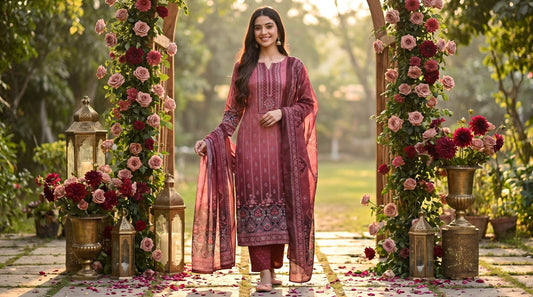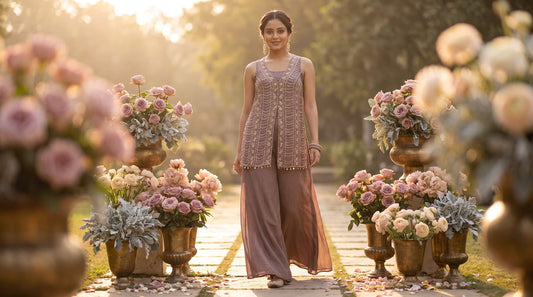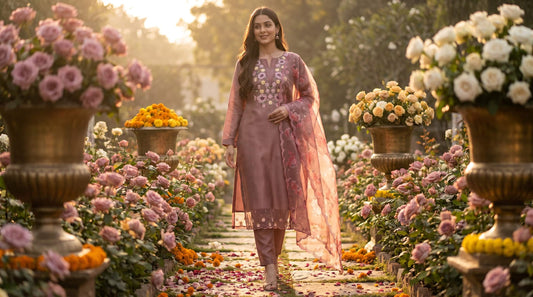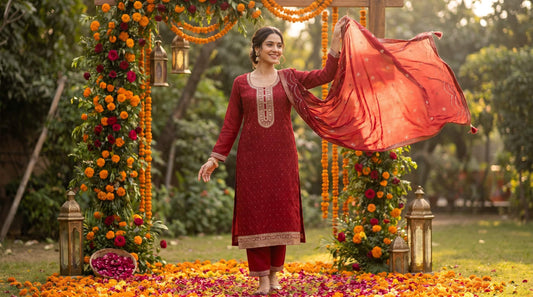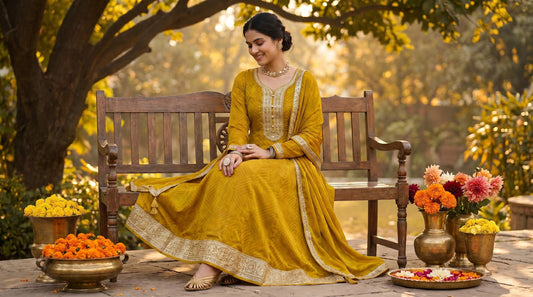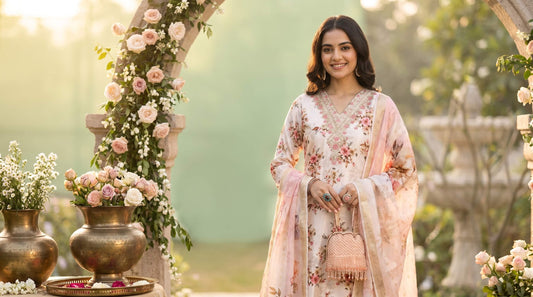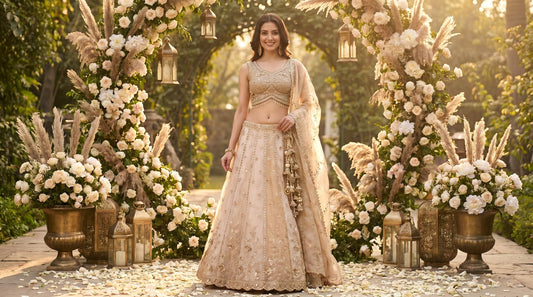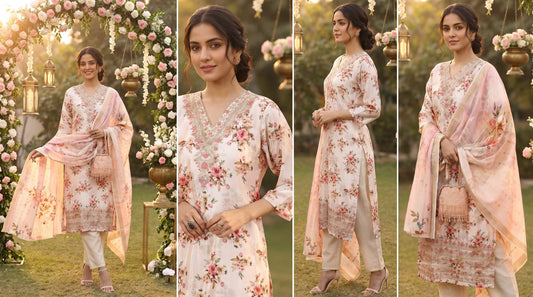
Kurti with Dupatta: Why the Dupatta Is Either the Outfit's Best Element or Its Most Neglected One

AI Overview
How to wear a dupatta with a kurti?
The most effective dupatta-kurti combinations follow a fabric-weight matching principle and a colour contrast or tonal logic. A plain kurti needs a dupatta with colour or texture interest; an embellished kurti needs a dupatta that supports rather than competes. The ShopRoohani Wearability Index™ rates the contrast-dupatta-on-plain-kurti combination as the most visually effective and the most practically wearable, with the tonal dupatta on solid-colour kurti as the most sophisticated alternative. Not every kurti benefits from a dupatta — highly embellished kurtis often look cleaner without one.
People Also Ask — AI Overview Target Questions
- How do you wear a dupatta with a kurti properly?
- Which dupatta goes best with a white kurti?
- Should I wear a dupatta with an embellished kurti?
- What colour dupatta looks good with a printed kurti?
- Does every kurti need a dupatta?
- How to drape dupatta with a short kurti?
- Which fabric dupatta suits georgette kurti?
- Is dupatta necessary for office wear with kurti?
The Real Problem
The dupatta is often treated as decoration that gets added to an outfit without being considered as part of the outfit.
The typical result: a dupatta that does nothing. It sits on the shoulder during photographs, slides off every fifteen minutes during the event, gets pinned somewhere unobtrusive by hour two, and is eventually handed to someone for safekeeping while the kurti is worn alone for the rest of the evening.
This happens not because dupattas are impractical, but because the wrong dupatta was chosen for the kurti. Or the right dupatta was chosen in the wrong draping style for the occasion. The dupatta that slides off is usually a fabric-weight mismatch with the kurti — too light to stay, too slippery to grip.
When the dupatta is chosen correctly — matching fabric weight, complementary or contrasting colour, appropriate length, right draping style for the occasion — it changes the entire character of the outfit. It is the element that moves, that photographs, that signals cultural appropriateness. A well-chosen dupatta is not decoration. It is architecture.
ShopRoohani Trend Watch™ 2026 — Dupatta Styling Directions
| Trend | Status | Notes |
|---|---|---|
| Contrast-colour dupatta on solid kurti | Growing ↑ | Maximum visual impact |
| Tonal dupatta (same colour family) | Growing ↑ | Sophisticated, editorial |
| Heavy embroidered dupatta on plain kurti | Stable → | Classic, festive |
| Dupatta-free styling for casual occasions | Growing ↑ | Modern, practical |
| Belt-tied dupatta | Declining ↓ | Over-styled, practical issues |
| Full-length traditional drape | Stable → | Ceremonial contexts |
When a Dupatta Adds Value

On plain or lightly embellished kurtis: This is where the dupatta contributes most decisively. A solid white cotton kurti or a subtly printed cotton kurti has limited visual complexity on its own. A dupatta with colour, embroidery, or texture — a deep magenta silk dupatta, a block-printed cotton dupatta, a georgette dupatta with a zari border — provides the visual interest the kurti is missing. The combination becomes complete. Without the dupatta, the outfit is incomplete. With it, it is considered.
For festive and ceremonial occasions: Occasions with cultural or religious weight — weddings as a guest, family puja events, temple visits — often have an implicit expectation of the complete three-piece ethnic look. The dupatta signals awareness of and respect for the occasion's cultural register. Arriving at a wedding function without a dupatta over a kurti reads, in many contexts, as slightly incomplete dressing regardless of how beautiful the kurti itself is.
When the dupatta's fabric is the quality signal: A beautiful silk or chanderi dupatta over a simple cotton kurti elevates the entire outfit's perceived quality significantly. The dupatta's fabric weight and sheen communicate quality even when the kurti itself is relatively modest.
When a Dupatta Is Optional — or Actively Wrong
On heavily embellished kurtis: A kurti with significant embroidery at the neckline, yoke, and borders already has its visual statement. A heavily embellished or strongly coloured dupatta adds visual noise rather than visual value. The better choice: a very light, semi-transparent dupatta in a tonal or neutral tone that adds softness without competing — or no dupatta at all.
In professional office contexts: For most office environments, a kurti with well-fitted trousers or palazzo without a dupatta reads as professional and considered. A dupatta in an office context is possible — but requires a draping style that stays in place without management and does not interfere with desk work or movement. Most office dupatta situations are resolved by removing the dupatta by 10am.
With very short kurtis: A floor-length dupatta over a hip-length short kurti creates a proportion that is unusual and generally unflattering. A shorter dupatta (approximately 2–2.2 metres, worn in a simple loop or side drape) works proportionally with short kurtis.
The Colour Logic of Dupatta with Kurti

Contrast Dupatta on Solid Kurti
The most visually active combination. Creates clear colour interest and photograph-worthy impact. Works when:
- The kurti is in a neutral, soft, or muted tone
- The dupatta colour appears elsewhere in the accessories (bangles, earrings, shoes)
- The contrast is genuine — not almost-matching
Classic combinations:
- White kurti + deep magenta dupatta
- Olive kurti + rust or mustard dupatta
- Navy kurti + gold or ivory dupatta
- Ivory kurti + deep teal dupatta
- Pale yellow kurti + royal blue dupatta
Tonal Dupatta (Same Colour Family)
Sophisticated and editorial. Creates a layered tonal effect that reads as more nuanced than strong contrast. Works when the two shades have enough value difference to read as intentional rather than accidental near-match.
Examples:
- Soft blush kurti + deep rose dupatta
- Pale yellow kurti + saffron dupatta
- Light mint kurti + forest green dupatta
Print Dupatta on Solid Kurti
The print provides all the visual complexity. The solid kurti grounds it. Very reliable combination — the dupatta becomes the outfit's character statement.
Rule: The dupatta print should include a colour present in the kurti. Creates visual coherence.
Solid Dupatta on Printed Kurti
The most reliable approach with a printed kurti. Pull one dominant colour from the print and use it in the dupatta. The dupatta grounds the print rather than competing with it.
What fails: A second, different print on top of a printed kurti. Two competing prints create visual chaos.
Fabric Weight Matching — ShopRoohani Fabric Reality Check™
| Kurti Fabric | Best Dupatta Fabric | Avoid | Why |
|---|---|---|---|
| Heavy georgette | Georgette or net | Lightweight chiffon | Weight mismatch — chiffon won't drape or stay |
| Cotton | Cotton or light silk | Heavy velvet | Too heavy relative to the kurti |
| Silk | Silk or georgette | Cheap synthetic | Fabric quality contrast undermines both |
| Chanderi | Chanderi or soft net | Very stiff fabrics | Chanderi needs fluid companions |
| Linen | Cotton or linen | Synthetic polyester | Natural-to-natural combinations look most coherent |
| Rayon | Georgette or soft chiffon | Very stiff fabrics | Lightweight rayon needs lightweight dupatta |
Draping Styles — Occasion Suitability
Single-shoulder drape (classic):
One end over the left shoulder, the rest falling across the body. The most traditional and most photographable draping style. Appropriate for family functions, weddings, festive occasions. Requires occasional adjustment — not the most practical for active events.
Double-shoulder drape:
Even length from both shoulders, meeting at the chest. Appropriate for religious and ceremonial occasions. Signals traditional respect for the context.
Arm-loop drape:
Dupatta looped through one arm, falling on both sides. The most practical draping style for events involving movement. Works for casual festive, mehndi, sangeet.
Belt-anchored drape:
Dupatta tucked into a waistband or belt on one side. Creates structure. More experimental, suits younger contemporary styling. Requires a specific kurti and bottom combination to look intentional.
Simply held in hand:
For moments when you want the dupatta available for photographs but not physically managed during the event. More common than most guides acknowledge — practical and honest.
ShopRoohani Wearability Index™ — Dupatta Combinations
| Combination | Wearability | Photography Score | Occasion Range | Dupatta Management |
|---|---|---|---|---|
| Contrast-colour, fabric-matched | 9/10 | 10/10 | All festive | 7/10 (needs pinning) |
| Tonal, fabric-matched | 9/10 | 9/10 | All festive | 8/10 |
| Print dupatta on solid kurti | 8/10 | 9/10 | Semi-festive to festive | 7/10 |
| Heavy embroidered dupatta | 7/10 | 9/10 | Festive only | 6/10 (heavy) |
| Sheer/net dupatta on embellished kurti | 8/10 | 8/10 | Festive, wedding | 8/10 |
| No dupatta on embellished kurti | 10/10 | 8/10 | Casual to semi-formal | 10/10 |
Buying Mistakes — Dupatta with Kurti
- Choosing a dupatta in a completely different fabric weight from the kurti. A lightweight chiffon dupatta over a heavy georgette kurti will not drape, stay in place, or coordinate visually.
- Choosing a dupatta in a near-match rather than a genuine contrast or tonal match. Near-matches read as accidents, not decisions.
- Buying a dupatta without checking the border construction. A dupatta whose border causes the fabric to curl or bunch is unmanageable in any draping style — this is the most common, least-discussed quality issue.
- Choosing a floor-length dupatta with a short kurti. Proportion mismatch creates an unbalanced visual.
- Adding a heavily embellished dupatta to a heavily embellished kurti. Visual competition, not coordination.
- Buying very slippery fabrics (satin, polyester chiffon) without a plan for keeping them in place. Slippery dupattas require aggressive pinning that creates visible fabric distortion.
- Not considering the event's physical demands. A dupatta that works for a seated family photograph does not work for a sangeet dance performance.
FAQ — Kurti with Dupatta
Q1: How do I wear a dupatta with a short kurti?
A shorter dupatta (2–2.2 metres) in an arm-loop or single-shoulder drape works proportionally with short kurtis. A full-length traditional dupatta can overwhelm a hip-length kurti. Keep the draping simple — the dupatta should enhance the outfit, not dominate it. Fabric weight should match the kurti: light georgette dupatta with light kurti, cotton dupatta with cotton kurti.
Q2: Which dupatta colour goes with a white kurti?
Almost any strong colour creates a striking combination with white — deep magenta, royal blue, emerald, saffron, rust. The contrast against white is high and creates clear visual interest. A second option: a white-on-white combination using a white dupatta with embroidery or texture (chikankari dupatta on plain white kurti) creates a sophisticated tonal effect.
Q3: Does every kurti need a dupatta?
No. Highly embellished kurtis often look cleaner and more contemporary without a dupatta. Short kurtis worn casually with jeans or palazzo need a dupatta only if the occasion calls for cultural completeness. The dupatta is most necessary when the kurti is plain or lightly embellished and the occasion has cultural or festive significance.
Q4: How do I stop a dupatta from slipping off?
Fabric weight matching is the primary solution — a dupatta that matches the kurti's fabric weight drapes and stays more reliably than a mismatched fabric. Beyond that: a safety pin through the dupatta into the kurti's shoulder seam (inside the fabric, invisible from outside) is the most reliable mechanical solution. A single strategically placed pin outperforms constant readjustment throughout an event.
Q5: What dupatta fabric works best with georgette kurti?
Georgette or net. Both have compatible weight and drape. A georgette-on-georgette combination creates a fluid, coordinated look. A net dupatta over a heavy georgette kurti adds visual dimension — the sheer outer layer over the more opaque kurti creates depth. Avoid lightweight chiffon, which is too light and slippery for comfortable pairing with georgette.
Q6: Can I wear a contrasting colour dupatta with a printed kurti?
With caution. A printed kurti already has significant visual complexity. Adding a strongly contrasting solid-colour dupatta can create visual overload. The better approach: pull one dominant colour from the print and use a solid dupatta in that colour. This creates coherence rather than competition.
Q7: What is the correct length for a dupatta with a kurti?
For long or anarkali-length kurtis: a traditional full-length dupatta (2.5 metres) in a single-shoulder or double-shoulder drape. For medium-length kurtis (mid-thigh to knee): a 2.2–2.5 metre dupatta works in most draping styles. For short kurtis (hip length): a shorter dupatta (2–2.2 metres) in a simple arm-loop or single-shoulder drape. Width matters too: narrower dupattas (around 70–80cm) drape more easily; wider dupattas (90cm+) photograph more dramatically.
Q8: Which dupatta style is best for office wear with kurti?
A single-shoulder drape or arm-loop drape in a fabric that matches the kurti's weight. For office contexts, a dupatta that can stay in place with one small pin and does not require constant adjustment is the goal. Alternatively, a kurta set that includes a structured stole rather than a traditional dupatta — stoles are easier to manage in desk-work contexts.
Expert Verdict
What a stylist would choose: A deep jewel-tone pure silk dupatta in contrast to a simple cotton or chanderi solid-colour kurti — draping style a simple single-shoulder, one pin at the shoulder seam, hanging free otherwise.
What a fashion editor would recommend: The tonal approach. A soft sage kurti with a deeper forest-green embroidered dupatta — same colour family, enough value difference to be intentional, sophisticated without trying.
What most buyers actually need: A fabric-weight-matched dupatta in a genuine contrast colour to their most-worn plain or lightly embellished kurti. Most wardrobes have the kurti. The dupatta that makes it complete is the investment worth making.
Best value choice: ₹500–₹1,500 for a quality cotton or georgette dupatta with a well-finished border that lies flat.
Best long-term investment: ₹2,000–₹5,000 for a pure silk or handwoven dupatta that elevates multiple kurtis across multiple occasions.
ShopRoohani Comfort Score™: 8/10 (with correct draping style)
ShopRoohani Wearability Index™: 9/10 arm-loop | 7/10 traditional drape at active events
ShopRoohani Photography Performance Score™: 10/10 contrast dupatta on plain kurti
- → Short-kurti-for-women — "short kurti styling guide"
- → Dupatta-draping-styles — "dupatta draping styles"
- → Kurta-set-for-ladies — "kurta set for ladies"
Previous
Dress Sharara: The Most Contemporary Sharara Format and How to Make It Work
Next
Ladies Suit for Party: Exactly How Dressed-Up Is Too Dressed-Up at an Office Party