Long Ethnic Coat for Women: The Most Underused Festive Layer in Indian Fashion

AI Overview
Direct Definition Block
Most Indian women own far too little festive layering. Not because layering is culturally absent — it is not — but because the ethnic wear vocabulary for layering is significantly less developed than the garment vocabulary.
The shawl exists, but it is a passive garment. It covers. It does not contribute to the outfit's design intelligence.
The long ethnic jacket — calf-length or floor-length, in Indian fabric, with Indian embellishment or print vocabulary — is an active garment. It does not just cover; it transforms. A simple kurta and trousers with a well-chosen embroidered long jacket becomes a three-dimensional, occasion-appropriate outfit with one addition. This is rare in any category.
The First Thing to Understand — The Three Problems It Solves
Quick Verdict
| Best For | Any woman wanting to escalate a simple outfit, manage cold venues, or multiply their festive wardrobe count |
| The Core Rule | The inner garment should be simpler than the jacket — the jacket is the statement |
| The Most Common Mistake | Choosing equally embellished inner and outer layers, creating visual competition rather than complement |
Problem 1 — The gap between daily and festive. A chanderi kurta set looks professional for daily office wear. The same set at an evening family function looks underdressed. A long embroidered jacket added at the end of the day escalates the office outfit to festive without a complete change.
Problem 2 — Air-conditioned venue discomfort. Indian wedding venues are almost universally overcooled in summer months. A shawl solves the temperature problem but creates styling problems. A long ethnic jacket solves the temperature problem while adding to the outfit's design intelligence.
Problem 3 — Limited festive wardrobe count. One well-chosen long jacket worn over three different inner combinations creates three distinct outfits for three distinct occasions.
The Colour Rules — What Every Long Jacket Wearer Should Know

The long jacket creates the dominant visual statement in the combination. The colour relationship between jacket and inner garment determines whether the combination reads as designed or accidental.
Strong contrast works when the jacket's embellishment or print is the visual focus — the inner garment provides a colour ground. An ivory kurta under a deep teal embroidered jacket creates a beautiful contrast that allows the jacket's embellishment full visual space.
Tonal coordination works when the jacket is in a fabric with significant visual interest of its own — a brocade or heavily textured fabric where the colour relationship is closely harmonised.
A matching inner and outer in identical fabric reads as one garment with a missing element rather than a deliberate two-piece layered combination.
Styles in Detail
Embroidered Straight Jacket (Formal)
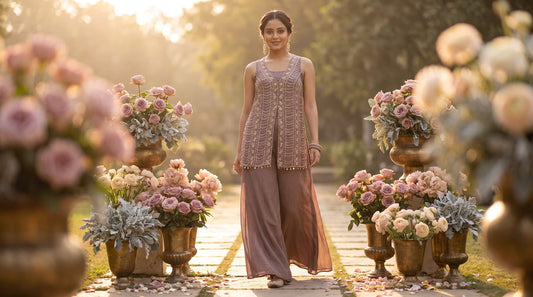
A structured, floor-length or calf-length jacket in a formal fabric — silk, brocade, heavy chanderi — with embroidery at the collar, lapels, hemline, or as panel work.
Occasion range: Major family functions, reception guest wear, formal evening celebrations, occasions where a lehenga feels too heavy but the outfit needs ceremonial visual weight.
The one construction fact that matters: The front opening. A jacket that falls open naturally requires either buttons or hooks to maintain a closed silhouette. Open-front jackets are more visually casual than closed ones.
ShopRoohani Comfort Score™: 8/10 | Repeat Wear Score™: 9/10
Sheer Embroidered Overlay Coat
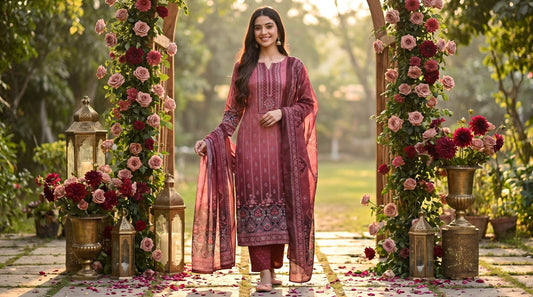
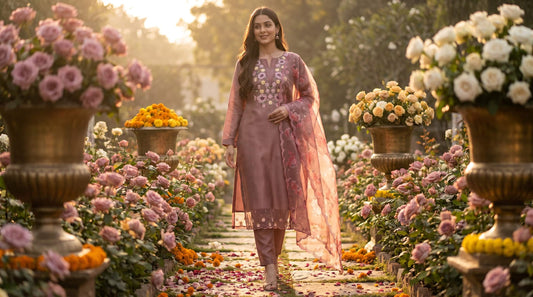
A floor-length coat in a transparent fabric — net, organza, sheer chiffon — with embroidery. The inner kurta or top is visible through the sheer outer layer.
This is the most photograph-friendly long coat format. The layered transparency creates visual depth in both portrait and candid photography — the embroidery of the outer layer and the inner garment create a two-plane visual that reads beautifully in images.
The practical concern: The colour and cut of the inner garment is visible and must be intentionally chosen. An inner kurta in a strong contrasting colour reads through a sheer coat and can be visually overwhelming.
ShopRoohani Photography Performance Score™: 10/10
Block-Print or Ikat Long Jacket
The most casual and most culturally rooted format. A printed cotton, linen, or handloom jacket in block print, ikat, ajrakh, or other craft textile.
Who this is for: Women who value craft aesthetic and cultural connection in their ethnic wear. This jacket over a simple solid kurta and palazzo creates one of the most intelligent and authentic ethnic combinations available.
ShopRoohani Wearability Index™: 9/10 | Repeat Wear Score™: 9/10
Velvet Long Jacket
The most winter-appropriate and most opulent option. A velvet long jacket over a simple kurta creates visual luxury that requires very little additional embellishment from anything else in the outfit.
The single most important velvet jacket fact: Velvet is the warmest fabric in the Indian ethnic wardrobe. It is extraordinary in cool, air-conditioned venues and winter outdoor conditions. It is the wrong choice for any warm or outdoor summer context.
ShopRoohani Comfort Score™: 9/10 winter | 3/10 summer
ShopRoohani Fabric Reality Check™ — Long Ethnic Coats
| Fabric | Festive Score | Summer Score | Winter Score | Photography Score | After 20 Wears |
|---|---|---|---|---|---|
| Embroidered silk | 10/10 | 4/10 | 8/10 | 10/10 | Excellent with care |
| Chanderi (embroidered) | 9/10 | 8/10 | 6/10 | 9/10 | Excellent |
| Velvet | 9/10 | 2/10 | 10/10 | 9/10 | Excellent with care |
| Sheer organza | 9/10 | 7/10 | 4/10 | 10/10 | Good with care |
| Block-print cotton | 7/10 | 9/10 | 4/10 | 8/10 | Improves |
| Brocade | 10/10 | 4/10 | 8/10 | 9/10 | Excellent |
ShopRoohani Occasion Matrix™ — Long Ethnic Coat
| Occasion | Appropriate? | Best Style | Notes |
|---|---|---|---|
| Reception (evening) | ✓ Yes | Embroidered straight jacket | Adds ceremony weight to simple kurta |
| Sangeet | ✓ Yes | Sheer overlay coat | Photographs beautifully, allows movement |
| Office party | ✓ Yes | Block print or understated embroidered | Adds festivity without heavy ceremony weight |
| Winter wedding | ✓ Yes | Velvet or heavy embroidered | Most appropriate cold-weather choice |
| Family function | ✓ Yes | Any style appropriate to formality | — |
| Air-conditioned venue | ✓ Yes | Any style | Solves temperature problem elegantly |
| Outdoor summer day | With caution | Block print cotton only | Avoid velvet, non-breathable fabrics |
| Temple ceremony | With caution | Simple embroidered, adequate coverage | Ensure sufficient coverage |
15 Buying Mistakes — Long Ethnic Coats
- Buying a velvet long jacket without confirming the venue and season. Velvet in a warm venue creates physical discomfort that no amount of visual beauty compensates for.
- Choosing a sheer overlay coat without deciding what the inner garment will be — the inner is visible and must be specifically chosen for this combination.
- Buying a long jacket significantly longer or shorter than the inner kurta without trying the combination together. The hem length relationship determines whether layering reads as designed or accidental.
- Choosing full-garment embellishment on both jacket and inner garment simultaneously. One embellished layer is a statement; two of similar weight create visual competition.
- Not considering the jacket's weight for the event's physical demands. A floor-length heavily embellished jacket over a kurta adds significant cumulative weight.
- Buying a brocade jacket and discovering it does not drape — brocade is stiff by construction and requires a looser, more fluid inner garment to create a balanced combination.
- Choosing a jacket length that is too close to the inner kurta's length without creating clear visual separation between the two hem levels.
- Buying a front-closure jacket without testing that the closure holds during movement. A jacket that continuously falls open requires constant management.
- Selecting a very dark jacket over a very pale inner garment without trying the combination in natural light — some dark-pale combinations create an awkward visual depending on the specific fabric sheen relationship.
- Not considering the jacket's width through the back. A straight-cut jacket that fits at the shoulder but is too narrow across the back creates visible fabric pull in movement.
- Choosing a sheer jacket with heavy embellishment at a ceremony function and discovering the embellishment weight creates visible pulling on the sheer base fabric.
- Buying a block-print jacket in a very busy print alongside a printed inner garment — the two-print combination without deliberate hierarchy reads as confused.
- Not checking the jacket's lining quality. A jacket without a proper lining requires a well-covered inner garment; the inner garment's fabric is visible through the jacket's front opening.
- Choosing a jacket with bell-cut or dramatically flared back without testing whether the silhouette works with the specific bottom piece being worn.
- Buying an extremely long floor-length jacket for an outdoor venue without considering hem management on uneven ground.
Hidden Realities
After three hours at a winter reception in a velvet long jacket in an indoor venue with adequate heating, the same jacket that felt perfectly calibrated for the outdoor arrival becomes uncomfortably warm. Indian wedding venues are rarely consistently cold throughout.
When photographed in a sheer embroidered overlay coat, the two-plane visual — inner garment visible through the embroidered sheer outer — creates one of the most beautiful photograph outcomes in the ethnic wardrobe. This effect does not require heavy embellishment on the inner garment; simplicity inside makes the outer jacket's embellishment read more clearly.
In a crowd at a reception, a very long floor-length jacket has its hem stepped on by other guests approximately twice per hour. This is not dramatic — it is a minor inconvenience — but it is a practical reality of floor-length garments in crowded Indian function spaces.
After five years of regular festive use, a quality block-print handloom jacket in cotton has typically developed beautiful character — the dye has deepened and varied, the fabric has softened, the print has acquired the slight blurring of repeated washing that is characteristic of genuine block print. This is the opposite of most synthetic embellished garments, which degrade rather than develop with age.
Versatility Strategy — One Jacket, Multiple Inner Combinations
A quality long jacket multiplies the outfit count from any kurta-and-trouser combination it is paired with. Three inner garment combinations under one jacket creates three visually distinct outfits with minimal additional investment.
ShopRoohani Repeat Wear Score™ — Long Ethnic Coats
| Jacket Type | Inner Combinations | Occasions | Post-Season Wear |
|---|---|---|---|
| Embroidered chanderi | 4–6 | 8–12 | Excellent |
| Velvet (winter) | 3–4 | 6–8 winter | Excellent for season |
| Block-print cotton | 5–7 | 10–15 | Excellent |
| Sheer overlay | 3–5 | 6–10 | Good |
Budget Analysis — Long Ethnic Coats
| Tier | Price Range | Best For |
|---|---|---|
| Entry | ₹1,200–₹3,000 | Block-print cotton, casual festive |
| Mid Range | ₹3,000–₹8,000 | Embroidered chanderi or georgette, versatile festive |
| Premium | ₹8,000–₹18,000 | Quality silk, velvet, or heavily embroidered versions |
| Luxury | ₹18,000+ | Designer or couture-level embroidered coats |
2026 Long Ethnic Coat Trends
| Trend | Status |
|---|---|
| Embroidered straight ethnic jacket (formal) | Growing Trend ↑ |
| Sheer embroidered overlay coat | Growing Trend ↑ |
| Block-print or ikat long jacket | Growing Trend ↑ |
| Velvet long jacket (winter) | Stable Trend → |
| Brocade statement jacket | Stable Trend → |
FAQs — Long Ethnic Coat for Women
Q1: What is a long ethnic coat for women? A long ethnic coat is a floor-length or calf-length jacket in Indian fabric — silk, brocade, embroidered georgette, block-print cotton, velvet — worn as an outer layer over a kurta, dress, or simple top. It functions as both a style element and a practical covering for cold venues, adding design intelligence rather than just coverage.
Q2: How do you style a long ethnic coat? Over a simple solid-colour kurta and trousers for a formal festive look. Over a simple anarkali for a layered dramatic combination. The inner garment should be simpler than the jacket — the jacket is the visual statement and the inner is the ground.
Q3: What fabric is best for a long ethnic coat? For formal occasions: silk or brocade. For festive versatility: embroidered georgette or chanderi. For craft aesthetic: block-print or handloom cotton. For winter: velvet. Match fabric to season and occasion formality.
Q4: Is a long ethnic jacket appropriate for Indian winters? Yes — particularly a velvet or heavily lined jacket over a simple kurta and trousers. It provides warmth and creates significant visual presence for winter wedding and festive seasons.
Q5: Can I wear a long ethnic coat to a wedding? Yes — a well-chosen embroidered long jacket over a quality kurta set or simple anarkali creates a festively complete outfit appropriate for wedding guest wear at reception or major family functions.
Q6: What length inner garment works best under a long ethnic coat? For a floor-length jacket: a mid-thigh to knee-length inner creates visible proportion — the jacket's length frames the inner garment's bottom edge. Avoid inner garments longer than the jacket.
Q7: What accessories work with a long ethnic coat? Statement earrings as the primary accessory — the jacket's length and visual presence make the neckline and face area the primary focus. Avoid very elaborate necklaces competing with a heavily embellished jacket neckline.
Q8: Can plus-size women wear long ethnic coats? Yes — long ethnic coats are particularly flattering for plus-size frames. A straight or slightly A-line long jacket in a fluid fabric creates a vertical line that elongates the silhouette. The open-front construction avoids constriction, and the length creates sweeping visual scale.
Q9: How do I care for an embroidered long ethnic jacket? Dry clean for embellished silk or velvet versions. Hand wash gently for cotton or georgette block-print versions. Store hung in a garment bag — the jacket's length and construction make folding a crease risk.
Q10: What is the difference between a long ethnic coat and a shrug? A shrug is waist to hip-length and worn casually. A long ethnic coat is calf to floor-length, more formally constructed, and acts as a genuine outer garment layer that transforms the outfit's visual weight and occasion register.
Fashion Editor Verdict
What a Fashion Editor Would Choose: A calf-length sheer organza jacket with scattered embroidery over a quality chanderi kurta and trousers in a coordinating deep tone. The jacket adds visual interest; the inner garment provides the colour ground.
What a Stylist Would Recommend: Choose the inner garment first and build around it. The jacket should have a clear relationship to the inner combination — contrast in colour, texture, or embellishment — not an accidental adjacency.
What Most Buyers Actually Need: A quality embroidered or block-print long jacket at ₹3,500–₹8,000 that transforms multiple inner garment combinations across multiple occasions.
Best Long-Term Investment: ₹8,000–₹18,000 for a quality silk or velvet long jacket with considered embellishment that rewears across multiple major occasions over three to five years.
→ Shrug for women guide
→ Festive wear women India guide
Previous
Ethnic Wear for Weddings in India: The Function-by-Function Guide to Getting It Right
Next
Anarkali Salwar Suit: The Most Reliably Flattering Silhouette in Indian Ethnic Wear — Explained