White Lehenga: Why Indian Brides Are Choosing It Now — and How to Wear It Right

AI Overview
White lehengas have moved from unconventional to increasingly accepted in Indian bridal dressing, particularly for receptions, pre-wedding photography, and destination weddings. The most important distinction is between pure white, ivory, and cream — these are not interchangeable. Ivory and off-white are significantly more flattering on most Indian skin tones than pure white, which can appear harsh and clinical under warm indoor venue lighting. White lehengas require substantially heavier embellishment than coloured lehengas because the colour alone does not carry ceremonial weight the way red or deep pink does — the embellishment must do the work the colour is not doing. White at the main wedding ceremony is still culturally sensitive in many Indian communities; ivory and cream are more broadly accepted. Gold embellishment on white or ivory is the most classically effective combination.
Key Takeaways
- Ivory and off-white are more flattering on Indian skin tones than pure white: The warm undertones in ivory complement the warm undertones in most Indian complexions, creating harmony — pure white creates a stark contrast that can read as harsh against warm skin.
- White lehengas require heavier embellishment than coloured lehengas: The colour does not carry ceremonial weight independently the way deep red or maroon does — the embellishment must establish the formality that the colour alone cannot.
- Pure white at traditional Hindu wedding ceremonies remains culturally sensitive: Ivory and cream are more broadly accepted across communities; pure white is best reserved for receptions, destination weddings, and contexts where the cultural taboo is confirmed to be absent.
- Gold embellishment on white or ivory is the most classically effective combination: The contrast between gold warmth and fabric purity creates the visual luxury that makes white bridal lehengas work — silver and crystal are more contemporary but require controlled lighting to perform well.
- White at a pre-wedding photography session, particularly mehendi, creates extraordinary visual contrast: The combination of white fabric and henna-decorated hands is one of the most photographically compelling images in Indian wedding photography.
The white lehenga sits at a specific cultural intersection: the loosening of a long-held association and the rise of a new aesthetic confidence in Indian bridal dressing.
For generations, white was avoided at Indian weddings because of its association with mourning in Hindu tradition. That association has not disappeared — but in urban India over the last decade, it has significantly loosened, particularly for receptions, pre-wedding photography, and intimate ceremonies. Today, white is a legitimate bridal choice. Whether it is the right choice depends on the community, the occasion, the specific shade of white, and — most importantly — the embellishment weight the garment carries.
The execution part is where most mistakes happen. And the mistakes tend to cluster around two points: the shade of white chosen, and the assumption that the colour alone can carry ceremonial weight.
White, Ivory, and Cream: Not the Same Thing
This distinction matters more than most buyers realise, and it becomes unmistakably clear the moment you hold all three fabrics in the same light.
Pure white is the starkest version and the most photographically impactful in clean outdoor light. In direct natural sunlight, pure white has a luminosity that nothing else achieves — it almost glows, which is why pure white bridal lehengas create such striking outdoor images. The challenges: indoors under warm or mixed venue lighting, pure white can read as clinical — it reflects light in ways that flatten rather than flatter. Against most warm Indian complexions, pure white creates a very strong contrast that some find striking and others find harsh. And it carries the strongest cultural association for communities where the mourning taboo remains active.
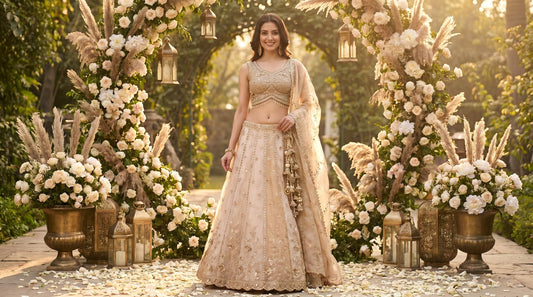
Ivory and off-white have a slight yellow or warm beige quality in the base tone. This warmth is what makes ivory almost universally flattering on Indian skin — the warm undertone in the fabric meets the warm undertone of most Indian complexions and creates harmony rather than stark contrast. When brides describe wanting "something bridal but not traditional," ivory is almost always what they are picturing even when they use the word white.
Ivory also performs more reliably across different venue lighting conditions. Under warm amber event lighting that reads poorly for pure white, ivory absorbs the warmth and appears even more golden and luxurious. It does not flatten the way pure white can.
Cream is the warmest and most accessible of the three — less white than ivory, closer to a very warm neutral. Cream lehengas with heavy gold embellishment are now relatively common at North Indian wedding receptions and family celebrations. The colour reads as acceptable even in communities where pure white carries stronger cultural sensitivity, because it has drifted far enough from clinical white to not trigger the association.
The decision hierarchy: if you are uncertain about cultural reception, cream. If you are confident in the setting and want warmth and flattery, ivory. Pure white is for brides who have confirmed the cultural context and know exactly what they are choosing.

What Embellishment Does the Work That the Colour Cannot
A white or ivory lehenga without substantial embellishment does not read as bridal. This is the most important and most frequently overlooked reality of the white lehenga category.
Deep red, maroon, and jewel tones carry ceremonial weight through the colour itself — the depth and richness of the colour announces formality. White does not do this. A relatively plain white lehenga reads as casual or even underdressed in a way that a relatively plain red lehenga does not. The embellishment on a white lehenga must establish the formality that the colour is not providing.
Heavy gold zari and thread embroidery is the most effective and most classically appropriate combination. The visual logic of gold on white is ancient — the contrast between gold's warmth and white's purity creates a luxury that reads across cultures and centuries. This combination photographs with exceptional clarity because the gold embellishment against the white base provides maximum contrast and definition.
Silver and crystal work creates a contemporary, somewhat Western-bridal aesthetic. More fashion-forward and less traditionally Indian in character. Photographs beautifully under controlled lighting with cool colour temperatures. The concern: silver and crystal can appear flat and lifeless under warm amber event lighting, which is the standard for most Indian wedding venues. If your venue uses warm lighting, visit and confirm before committing to silver embellishment on white.
Multicolour floral embroidery on white creates a garden-party aesthetic that is the furthest departure from traditional Indian bridal dressing within the white lehenga category. Beautiful for outdoor, destination, or intimate weddings. Requires a clear stylistic confidence — it reads unmistakably as a deliberate style choice rather than a traditional one.
The embellishment distance test: Before buying, hold the fabric at arm's length and assess whether the embellishment carries visual weight from a distance. Embroidery that looks intricate in close-up photographs but reads as surface texture from five feet away is not doing sufficient work for a white lehenga. The embellishment needs to read clearly from the distance at which most event photographs are taken.
When White Lehenga Works — and When It Doesn't
Reception: The most accepted and most natural context for white in contemporary Indian bridal dressing. The reception carries less ceremonial weight than the wedding itself, and modern reception aesthetics have broadly accommodated white across urban Indian communities.
Pre-wedding photography: A particularly strong and underutilised choice. The visual contrast between a white lehenga and mehendi-decorated hands creates images that are extraordinary — the deep ochre and rust tones of henna against white fabric creates a colour contrast that photographs with remarkable clarity and beauty.
Destination and intimate weddings: Smaller, non-traditional wedding formats have more flexibility in dress code. White works very well in beach, garden, hill-station, or resort settings where the outdoor environment and modern aesthetic are already established.
Main wedding ceremony — with caution: For traditional Hindu religious ceremonies in communities where the white-mourning association remains active, white is still avoided. Always confirm the cultural context of the specific family before choosing white for the main ceremony. In communities where the taboo is not active, white at the ceremony is legitimate. In communities where it is, ivory or cream at the very lightest is more appropriate.
Roohani Fabric Reality Check™ — White Lehengas
| Shade | Best Fabric | Photography Performance | Cultural Accessibility | Best Occasion |
|---|---|---|---|---|
| Pure white | Organza, silk | Exceptional outdoors, flat under warm indoor | Lower in traditional contexts | Destination, outdoor reception |
| Ivory | Raw silk, heavy georgette | Excellent across all lighting | High across most communities | Reception, ceremony |
| Cream | Any quality fabric | Warm and consistently flattering | Highest — most universally accepted | Reception, family celebrations |
Jewellery for White Lehenga: The Specific Logic
Gold — always the most reliable choice. The warmth and richness of gold against white or ivory fabric is universally effective. Kundan and polki sets in gold are the most classically bridal combination. Layered necklaces, chandbali earrings, and wide kadas together create a visual weight that balances a white lehenga's colour restraint.
Pearls with gold. An extremely beautiful and slightly more contemporary approach. Pearl jewellery with gold detailing against ivory or cream fabric creates a specific kind of quiet luxury that is very difficult to achieve with other combinations.
Silver — with conditions. Silver works against pure white as a cool-on-cool combination, particularly in outdoor or destination wedding settings. Under warm indoor venue lighting, silver against white can look flat. Test both together under actual venue conditions before committing.
Coloured stones in jewellery. A deep-coloured stone — ruby, emerald, sapphire — in a gold setting against a white lehenga creates extraordinary colour contrast. The stone's colour becomes the accent that the white lehenga's base colour cannot provide.
Quick Answer Block
Best white lehenga for Indian brides: Ivory with heavy gold zari embroidery — the most universally flattering shade on Indian skin tones, the most occasion-flexible, and the most consistent performer across different venue lighting conditions.
White or ivory — which looks better on Indian skin? Ivory almost always. The warm undertones create harmony with most Indian complexions. Pure white can appear harsh against warm skin tones under certain lighting.
What embellishment for a white bridal lehenga? Heavy gold zari or thread embroidery is the most effective. Substantial enough to carry ceremonial weight — the colour alone does not provide it.
Is white lehenga appropriate for Indian weddings? For receptions, pre-wedding photography, and destination weddings, yes — in most contemporary urban contexts. For traditional Hindu ceremonies, community-specific cultural context should be confirmed first.
Conclusion
The white lehenga has earned its place in contemporary Indian bridal dressing not by erasing a cultural history but by finding the occasions and contexts where its specific qualities are most appropriate. Understanding which shade of white serves your skin tone, which embellishment weight carries the ceremonial formality the colour cannot provide alone, and which occasions genuinely welcome this choice — rather than merely tolerate it — is what separates a white lehenga decision made with knowledge from one made with aspiration alone. Get those three things right and the white lehenga is one of the most photographically extraordinary choices in the entire Indian bridal colour spectrum.
- → Our Bridal Lehenga Complete Guide
- → Dupatta Draping Styles For Brides
- → Lehenga Embellishment Guide — What Warries Ceremonial Weight
Previous
Pink Lehenga: Every Shade That Works — and What to Pair With Each
Next
Green Lehenga: The Shade That Flatters Almost Everyone — and How to Wear It Right