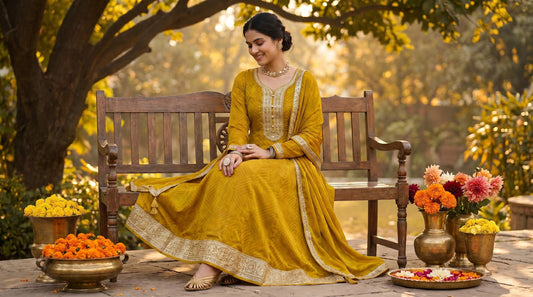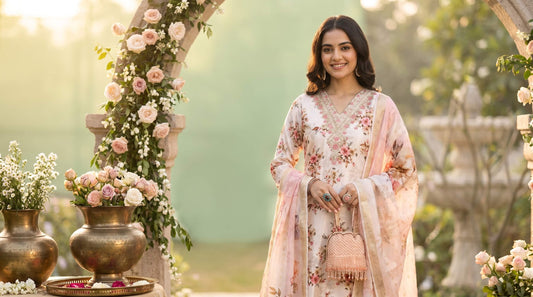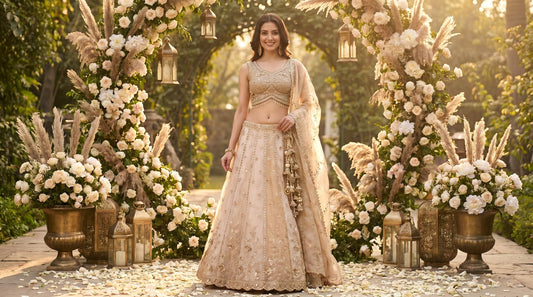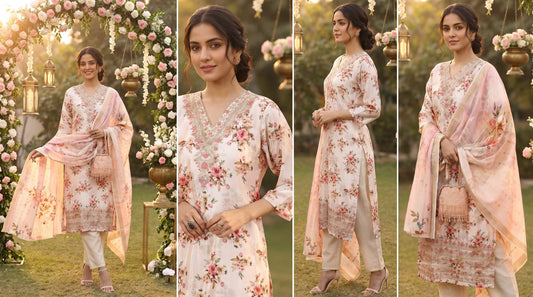
Frock Anarkali: The Most Dramatic Ethnic Silhouette — and How to Know When It Is Well Made

Frock Anarkali Designs: The Most Dramatic Ethnic Silhouette — and How to Know When It Is Actually Well Made
The outfit looked perfect in the photograph. The flare was circular. The waist was defined. The embellishment was exactly as heavy as a reception function demanded. Then it arrived — and the waist was suggested rather than structured, the flare had four panels instead of eight, and the fabric's weight was about sixty percent of what was needed to hold the silhouette's shape.
This is not a rare experience. It is the dominant buying experience in the mid-range frock anarkali market, and it happens because the silhouette's visual power depends almost entirely on construction decisions that product photography cannot reveal.
The difference between a frock anarkali that commands a room — that photographs dramatically, that moves beautifully, that creates the defined-waist-and-sweeping-flare visual the silhouette is designed to produce — comes down to three things: panel count, bodice construction, and fabric weight in the flared section. None of these appear clearly in product listings. All three can be evaluated, if you know what to look for.
What Is a Frock Anarkali — And Why the Definition Matters

AI Overview Quick Answer:
A frock anarkali is an Indian ethnic garment combining a Western frock-style fitted bodice with a defined waistline seam and a multi-panelled, fully flared skirt in the anarkali tradition. Unlike a regular anarkali — which flares progressively from the bust — the frock anarkali's flare begins at a defined waist seam, creating a pronounced hourglass silhouette. The result is more structured, more dramatic in photography, and more dependent on specific construction quality to function as intended.
The "frock" in frock anarkali is not a styling description. It is a construction description.
A regular anarkali flows from the bust in a continuous, gradually expanding A-line. No defined waistline seam. No structural break between the bodice and the skirt section. The flare begins immediately below the chest and expands evenly to the hem — a silhouette that is forgiving, fluid, and works across almost every body type.
A frock anarkali works differently. The bodice is fitted at the bust and waist, with a deliberately engineered waistline seam where the bodice ends and the flared skirt section begins. The skirt is attached at this seam — and from this point, it must flare dramatically, circularly, with the kind of volume that only a properly panelled, appropriately weighted fabric can create.
This structural difference is why the silhouette is so effective in photography — the defined waist is immediately readable even from a distance, and the contrast between the structured bodice and the generous flare creates a dramatic hourglass suggestion. It is also why poorly constructed versions fail so visibly. A four-panel flare with insufficient fabric weight cannot create the silhouette's visual promise. The contrast between what the design intends and what the construction delivers is immediately apparent.
ShopRoohani Trend Watch™ 2026
| Frock Anarkali Style | Status | Direction |
|---|---|---|
| Embroidered georgette frock anarkali | Stable core choice | → |
| Net frock anarkali, heavy embellishment | Declining in quality perception at mid-range | ↓ |
| Layered frock anarkali, visible underskirt | Growing trend | ↑ |
| Minimal embroidery, strong silhouette | Growing trend, particularly premium segment | ↑ |
| Velvet frock anarkali, winter occasions | Stable for appropriate season | → |
| Concentrated yoke embroidery, clean flare | Growing trend 2026 | ↑ |
| Full surface embellishment coverage | Declining — perceived as dated at higher price points | ↓ |
ShopRoohani 2026 Key Insight: The trend in quality frock anarkalis is moving toward less coverage and more precision — one exceptional fabric, one concentrated embellishment zone, one clean silhouette. Full surface coverage is increasingly associated with budget production rather than aspirational quality.
The Three Construction Decisions That Determine Everything
1. Panel Count — The Number That Determines Whether the Silhouette Exists
Quick Verdict
- Best For: Events where the full circular flare is expected and necessary — reception, formal evening functions, major wedding guest occasions
- Avoid If: The seller cannot confirm panel count and the price is below ₹3,500
- Silhouette Score: Directly proportional to panel count
- Value Score: 8/10 — panel count is the single highest-value construction detail to verify
The kali count in the flared section is the construction element that determines whether a frock anarkali creates its intended silhouette or approximates it.
Here is the practical reality. A four-panel frock anarkali skirt creates a shape that is more tent-like than circular — the four panels cannot create the 360-degree sweep that the silhouette requires. Six panels is the functional minimum for any meaningful circular movement. Eight panels creates a generous, consistently circular flare. Twelve or more panels creates the most dramatically voluminous movement — the kind that photographs from every angle with the silhouette fully intact.
The bias matters as much as the count. Well-constructed kali panels are cut on the bias of the fabric — this allows the fabric to move with a circular, fluid quality rather than stiffly. Straight-grain panels create a stiffer flare, fine for structure but less dynamic in movement.
Reality Check: Most product listings do not state panel count. Most buyers do not ask. Most disappointments trace directly to this gap. In verified reviews for mid-range frock anarkalis, comments like "the flare doesn't really flare" and "it looked bigger in the photos" almost always correspond to four or five panel constructions.
Ask before ordering. Message the seller. If they cannot or will not answer, that is itself information.
Key Takeaway: Minimum eight panels for a properly functioning frock anarkali silhouette. Six for adequate volume. Four for a shape that will disappoint.
2. Bodice Construction — The Element Nobody Discusses Until the Function
Quick Verdict
- Best For: All body types when properly constructed — the defined waist is the silhouette's primary visual contribution
- Avoid If: No mention of lining, structure, or boning in a garment priced below ₹4,000
- Comfort Score: 8/10 structured | 5/10 unstructured (the unstructured version needs constant adjustment)
- Value Score: 9/10 — bodice structure is worth the price difference
The bodice of a frock anarkali must be structurally independent. It needs to maintain its shape — the defined waist, the fitted bust — across a wearing day that may last six, eight, or ten hours.
An unstructured bodice in thin fabric cannot do this. By hour three, the bodice begins to migrate away from the body at the chest. The defined waist becomes undefined. The visual contrast between bodice and flare — the effect that makes the silhouette work — softens and then largely disappears. At this point, the garment begins to look like it is losing an argument with gravity.
A well-constructed frock anarkali bodice uses one or more of these structural approaches: interfacing between the outer fabric and lining layers; light boning at the side seams to maintain shape independently of the body; or double-fabric construction that gives the bodice sufficient internal body. Any of these approaches works. The absence of any structural approach in a garment expected to hold through a long function is a construction failure.
How to evaluate from product listing: The presence of lining, boning, or structured bodice in the product description is a positive indicator. At mid-range to premium prices, this should be standard. At entry prices, it is frequently absent. Reviews that mention "the blouse kept slipping" or "the chest didn't sit properly by the end of the evening" are describing an unstructured bodice.
Reality Check: Most buyers focus entirely on the flare's appearance in product photography and do not evaluate the bodice construction until they are wearing the garment at the actual event. This is backwards. The bodice construction determines the silhouette's staying power. The flare is visible in photographs. The bodice's structural quality is experienced across ten hours of wearing.
Key Takeaway: Ask for lining and structure information. It matters more than the embellishment density.
3. Fabric in the Flared Section — The Decision That Determines Real-Life Performance
Quick Verdict
- Best For: Quality georgette for versatility; net for maximum drama; velvet for winter formality
- Avoid If: Synthetic georgette at prices below ₹2,500 — the fabric weight will be insufficient
- Photography Score: Quality georgette 9/10 | Net 10/10 | Velvet 8/10
- Comfort Score: Georgette 8/10 | Net 7/10 | Velvet 6/10 for extended wear
The fabric choice for the flared section determines the silhouette's real-life visual quality more than any other single decision.
Georgette: The most versatile and most appropriate frock anarkali fabric. Quality georgette — not polyester georgette — has the weight and drape to create a circular flare that maintains its shape. The distinction between quality and synthetic georgette: quality georgette feels substantial between the fingers, falls with a slight weight, and moves with fluid momentum rather than floating light and papery. Synthetic georgette at lower price points lacks this weight — the flare lifts, flutters, and does not hold its circular shape as the wearer moves.
In humid conditions — outdoor garden receptions, venue with poor air conditioning, summer evening events — quality georgette is the most forgiving. It handles humidity better than net and is more comfortable than velvet in warmth.
Net: The most dramatic and the most management-intensive fabric for a frock anarkali. Net creates extraordinary volume and photographs with a depth and drama that no other fabric matches — the light passes through the net layers and creates dimensional shadow and highlight effects that are genuinely exceptional.
The concern: net requires careful finishing to maintain this effect. Properly bound edges and a strong lining beneath are not optional — they are what separates a net frock anarkali that holds its circular shape across an event from one that progressively sags and collapses at the unfinished edges. Poorly finished net looks cheap. Well-finished net looks extraordinary. There is almost no middle position.
At mid-range price points, net finishing quality is variable. Read reviews specifically for comments about the edge finishing, the weight of the underlining, and how the net held across the event duration.
Velvet: For winter occasions and air-conditioned indoor events only. Velvet frock anarkalis have a visual richness — a depth of colour and texture — that no other fabric matches. The weight of velvet creates a slower, heavier movement than georgette: appropriate for formal, relatively seated events but less appropriate for functions requiring extended movement.
In temperatures above 22°C, velvet becomes physically uncomfortable within three to four hours. This is not a styling concern — it is a physiological one. For outdoor winter weddings or venues with inconsistent heating, confirm the event environment before committing to velvet.
ShopRoohani Fabric Reality Check™ — Frock Anarkali
| Fabric | Summer Score | Humidity Score | Photography Score | Comfort Score | Durability Score | Maintenance Score | Best Occasion | Worst Occasion |
|---|---|---|---|---|---|---|---|---|
| Quality georgette | 7/10 | 8/10 | 9/10 | 8/10 | 8/10 | 7/10 | Reception, sangeet | Outdoor daytime summer |
| Synthetic georgette | 5/10 | 5/10 | 6/10 | 6/10 | 5/10 | 6/10 | Budget casual function | Any high-visibility event |
| Net (well-finished) | 5/10 | 4/10 | 10/10 | 7/10 | 7/10 | 6/10 | Formal evening, reception | Outdoor humid events |
| Velvet | 2/10 | 2/10 | 8/10 | 5/10 (in heat) | 9/10 | 7/10 | Winter indoor formal | Any warm-weather event |
| Chanderi silk | 8/10 | 7/10 | 8/10 | 9/10 | 7/10 | 6/10 | Daytime festive, family function | Very formal evening |
| Crepe | 7/10 | 7/10 | 7/10 | 8/10 | 8/10 | 8/10 | Semi-formal occasions | Maximum-embellishment events |
After 20 Washes: Quality georgette retains most of its drape and colour if hand-washed cold. Synthetic georgette shows noticeable fading and slight texture change by wash twelve to fifteen. Net should not be machine-washed — even gentle hand washing is preferable to dry cleaning only in emergencies. Velvet should always be dry cleaned.
After 50 Wears: Quality georgette with moderate embellishment holds well. The most common wear points are the waistline seam (stress from wearing and removal) and the hem edge (floor-length dragging). Regular inspection of these areas allows early reinforcement before visible degradation.
Body Type Analysis — Frock Anarkali
Petite Women
What Works: A-line frock anarkali with a natural or slightly raised waistline. Floor-length creates visual height. Vertical embroidery elements add length. The defined waist is particularly effective for petite frames — it breaks the silhouette at an appropriate proportion point.
What Fails: Extremely voluminous flares that overwhelm the frame. Very wide kali constructions in heavy fabric can add visual bulk that shortens the perceived silhouette.
Best Fabrics: Light to medium weight georgette. Avoid very heavy net or velvet.
Best Colours: Jewel tones in single colours — the monochromatic effect extends the visual line.
Common Mistake: Choosing a midi-length frock anarkali to compensate for height concerns — this actually shortens the perceived silhouette further. Floor length is more flattering.
ShopRoohani Styling Confidence Score™: 8/10 with correct length and proportion choices.
Tall Women
What Works: Every variation of the frock anarkali silhouette works for tall frames. The floor-length with high-volume flare is particularly dramatic. Horizontal embellishment bands at the waistline are effective — they break the vertical line without competing with the silhouette.
What Fails: Very short anarkali versions lose the silhouette's drama on taller frames.
Best Fabrics: All fabric types — the height provides the visual canvas for the silhouette to fully express.
Best Colours: All ranges — the silhouette is not constrained by colour at this height.
Common Mistake: Choosing a conservative length when the tall frame is perfectly suited to a full floor-length drama.
ShopRoohani Styling Confidence Score™: 9/10 — maximum versatility across all frock anarkali variations.
Pear-Shaped Women (Narrower Shoulders, Wider Hips)
What Works: The frock anarkali is particularly effective for pear shapes. The fitted bodice creates visual definition at the bust. The flared skirt's volume distributes the hip area into the flare's sweep rather than emphasising it. The defined waistline is the silhouette's most flattering element for this body type.
What Fails: Extremely fitted bodices without any structure — they emphasise the bust-to-hip proportion difference rather than balancing it. Sleeveless designs can emphasise narrower shoulders — quarter or full sleeves create better balance.
Best Fabrics: Quality georgette — the fluid movement of the flare creates the most flattering effect.
Best Colours: Darker colours in the bodice with matching or slightly contrasting flare creates ideal visual balance.
Common Mistake: Choosing a very stiff, embellished bodice that adds visual bulk to the upper body when the goal is to create upper-lower balance.
ShopRoohani Styling Confidence Score™: 9/10 — one of the best silhouettes for this body type.
Rectangle Shapes (Balanced Bust and Hip, Less Defined Waist)
What Works: The frock anarkali creates the waist definition that the natural silhouette may not emphasise. The defined waist seam and the contrast between fitted bodice and generous flare creates an hourglass suggestion that is the silhouette's primary visual gift.
What Fails: Designs without a structurally defined waistline seam — these approximate the effect without creating it.
Best Fabrics: Fabrics with sufficient weight to hold the flare's volume — quality georgette or net.
Best Colours: Jewel tones that emphasise the silhouette's drama.
Common Mistake: Choosing a very boxy or oversized bodice that eliminates the waist definition the silhouette is designed to create.
ShopRoohani Styling Confidence Score™: 8.5/10 — highly flattering when the waistline seam is structurally defined.
Hourglass Shapes
What Works: Every variation. The frock anarkali's design vocabulary is built around the hourglass suggestion — for naturally hourglass figures, the silhouette simply emphasises what is already present.
What Fails: Designs that are so heavily embellished at the bodice that they add visual bulk to an already defined bust area.
Best Fabrics: Quality georgette or net — both allow the silhouette to move and breathe naturally.
Best Colours: All ranges — jewel tones for maximum drama, pastels for softer occasions.
Common Mistake: Overembellishing both bodice and skirt — for hourglass figures, the silhouette itself is the statement; heavy embellishment everywhere can obscure rather than enhance.
ShopRoohani Styling Confidence Score™: 10/10 — the frock anarkali is designed for this body type's proportions.
Plus Size Women
What Works: A-line frock anarkali with a defined but not aggressively fitted waistline. The flare's volume is a natural fit for fuller figures — it creates movement and drama rather than adding bulk. Floor-length is more flattering than midi-length.
What Fails: Very tightly fitted bodices in stiff fabric — these emphasise compression rather than creating a flowing silhouette. Designs with horizontal embellishment bands at the hip.
Best Fabrics: Fluid quality georgette — the fabric's natural drape creates flattering movement. Avoid very stiff fabrics.
Best Colours: Jewel tones. Single-colour silhouettes extend the visual line most effectively.
Common Mistake: Choosing a larger size to ensure comfort without checking whether the waistline seam placement still works for the specific figure — some sizing increases move the waistline seam to an incorrect position for a given height.
ShopRoohani Styling Confidence Score™: 8/10 with appropriate construction and sizing.
ShopRoohani Occasion Matrix™ — Frock Anarkali
| Occasion | Appropriate? | Best Fabric | Embellishment Level | Key Notes |
|---|---|---|---|---|
| Evening reception (wedding guest) | ✓ Excellent | Net or heavy georgette | High | Prime occasion for the silhouette |
| Sangeet | ✓ Very good | Quality georgette | Medium-high | Ensures dance floor movement |
| Wedding ceremony (formal guest) | ✓ Good | Heavy georgette | Medium-high | Should not compete with bridal |
| Cocktail party | ✓ Good | Georgette or crepe | Medium | Contemporary silhouette reads well |
| Mehendi | ✓ If light version | Light georgette or chanderi | Low-medium | Choose movement-friendly version |
| Family daytime function | ✓ Semi-formal version | Chanderi | Low-medium | Choose restrained embellishment |
| Diwali celebration | ✓ Yes | Georgette or chanderi | Medium | Festive-appropriate |
| Navratri (non-garba) | ✓ Yes | Light georgette | Medium | Not for garba dancing |
| Office | ✗ No | — | — | Too festive for professional context |
| Daily wear | ✗ No | — | — | Occasion silhouette, not daily |
| Outdoor summer day event | Caution | Light chanderi only | Low | Heat management a real concern |
| Destination wedding (beach/outdoor) | Caution | Light georgette | Medium | Check climate; avoid velvet and net |
Styling Combinations — Frock Anarkali
What Works:
A single strong jewellery statement paired with a heavily embellished frock anarkali. The garment's embellishment level means jewellery should complement, not compete. Statement earrings — chandbali, jhumka, tassel — are the highest-return single jewellery investment.
Embellished heels in a matching or complementary tone. The floor-length flare is calibrated to a specific heel height — typically three to four inches. Changing to flats or different heel heights affects not just proportion but the literal hem clearance from the floor.
A coordinated clutch in the dupatta fabric or embellishment colour — not an exact match, but within the same colour temperature. Cool-tone embellishment garments with warm-metal accessories create a subtle but visible colour conflict.
What Fails:
Heavy necklace with a heavily embellished yoke neckline. The two embellishment zones compete in the same visual space.
Statement hair accessories simultaneously with statement earrings. One strong element at the face frame, not two.
A dupatta draped over both shoulders and left hanging loosely — the most common styling mistake with frock anarkalis. A proper one-shoulder drape that anchors on the left shoulder and falls cleanly to the floor is more effective and more manageable during extended wearing.
The most common styling failure: not confirming the exact footwear before confirming the hem length. This seems obvious. It is discovered as a problem on the day of the event by a surprising number of buyers.
15 Buying Mistakes — Frock Anarkali
1. Not confirming panel count. A frock anarkali with four panels will not create the silhouette's visual effect. Ask before ordering.
2. Trusting studio photography for fabric weight. Studio photography is optimised to make the flare look full. Insufficient fabric weight is only apparent in real-life conditions.
3. Not checking bodice construction details. An unstructured bodice loses its shape by hour three. Lining and interfacing information is essential.
4. Ordering floor-length without confirming heel height. The hem length is calibrated to a specific heel height. Change the heel, change the hem-to-floor relationship.
5. Buying net without checking edge finishing quality. Net without proper edge finishing collapses and looks cheap. This is not visible in product photos.
6. Expecting the same movement quality from heavily embellished fabric as from plain georgette. Heavy embellishment adds physical weight to the flare. More embellishment equals slower, heavier movement.
7. Not reading reviews for post-event wearability comments. Reviews that mention experiences after two or three hours of wearing reveal construction quality that first impressions cannot.
8. Choosing a very trend-specific embellishment style. Embellishment styles specific to a moment date quickly. Classic thread embroidery and zari work have significantly longer wearing relevance.
9. Not checking return and exchange policy. For a silhouette this dependent on fit and construction, a clear exchange policy is essential. Confirm before ordering.
10. Choosing the most heavily embellished option without a clear occasion for it. A very heavily embellished frock anarkali requires an occasion of appropriate formality to read as correctly calibrated rather than overdressed.
11. Not accounting for velvet in warm weather. Velvet frock anarkalis look exceptional in product photography regardless of season. They are physically unsuitable in temperatures above 22°C.
12. Sizing based only on bust measurement. A frock anarkali requires both bust measurement for the bodice and waist measurement for the waistline seam placement. Many buyers are different sizes at bust and waist.
13. Not considering dupatta management during the event. A floor-length dupatta on a floor-length frock anarkali requires active management during dancing and walking. Not every event context is dupatta-friendly.
14. Buying based on model photographs without body-type consideration. Models are typically 5'8" to 5'10" with specific proportions. The same garment on different heights and proportions creates a different visual outcome.
15. Not testing the garment with the event's likely lighting. Embellishment reads differently in daylight, evening tungsten, and flash photography. If possible, photograph the garment at home in both natural light and artificial event-style light before confirming it works.
15 Hidden Realities — Frock Anarkali
By hour four: The waistband of a frock anarkali begins to reveal its construction quality. A structured waistband holds. An unstructured waistband begins to migrate — slowly upward or slowly downward — and by hour six requires periodic adjustment that becomes a background preoccupation.
After repeated washing: Quality georgette in cold water hand wash retains most of its character for eight to ten careful washes. Synthetic georgette shows colour shift by wash six to eight. The embellishment — particularly mirror work and bead work — should always be checked for attachment security before and after each wash.
During wedding photography: The frock anarkali's performance in photography depends almost entirely on lighting conditions. In direct outdoor light, the silhouette photographs with maximum drama. In mixed indoor-outdoor light, the fabric's sheen and weight determine how it reads. In flash photography, synthetic fabrics can appear flatter than natural fabrics in the same colour.
While sitting cross-legged: The floor-length frock anarkali requires management when sitting on the floor — the flare must be gathered around the body rather than spread, which compresses the flare's circular construction. In most formal event contexts, floor seating is rare — but mehendi ceremonies often involve it, and this is rarely factored in at the purchase stage.
When dancing: Quality georgette creates genuine visual pleasure when dancing — the circular flare catches movement and creates a visual sweep that is the silhouette at its most effective. Net creates maximum visual drama but snags on other fabrics and jewellery with some regularity. This is worth knowing before the sangeet.
In humid weather: Quality georgette handles mild humidity adequately. Net in high humidity becomes slightly heavier and loses some of its airy volume. Velvet in any humidity above mild is physiologically demanding. If the event is an outdoor garden setting in summer, the fabric choice is not a styling decision — it is a comfort decision.
After three hours in the bodice: The points at which the bodice creates physical pressure — typically the underarm seam and the waistline seam — become more apparent after extended wearing. A well-constructed bodice with appropriate seam finishing is comfortable at hour three. A poorly finished bodice with unlined seam allowances has usually communicated its discomfort by hour two.
During travel: A floor-length frock anarkali is not a travel garment. Packing requires careful rolling (not folding) in tissue paper for the embellished sections, and hanging immediately upon arrival. Embellishment that has been compressed in transit requires hanging time to release.
After multiple wears: The highest-stress point in a frock anarkali is the waistline seam — the point where the bodice and skirt are joined. This seam bears the tension of the skirt's weight across the wearing day. Over multiple wears, this seam should be inspected for thread pull and reinforced if needed. Early reinforcement prevents visible degradation.
The mirror work reality: Adhesive-applied mirror work begins releasing within three to five wears, particularly at friction points (hip area, seam locations). Hand-stitched mirror work lasts significantly longer. The difference is not always visible in product photography but is apparent in the physical feel of the mirrors — adhesive-applied mirrors feel smooth and flat; hand-stitched mirrors feel slightly raised and have visible thread at the edges.
The dupatta border problem: A frock anarkali dupatta with an embellished border that causes the fabric to curl or bunch is functionally unusable for most draping styles. This is almost always invisible in product photography. It is always apparent when you try to drape it before the event. Test the dupatta flat on a surface — if the border causes the fabric to rise or curl, it will not drape cleanly regardless of effort.
The photography angle reality: Most frock anarkali product photographs show the front three-quarter view — the most flattering angle for the silhouette. The back view and the side view are rarely shown. For events involving the full 360-degree view — which is most events — the back and side construction matters as much as the front.
The event end reality: A frock anarkali after eight hours of an event shows the construction's quality in full. A well-constructed garment looks almost as good at hour eight as at hour one. A poorly constructed garment has usually accumulated a waistband that has migrated, a bodice that has lost its shape, and a flare that has compressed from sitting. This is how experienced buyers evaluate garments — not by how they look at the start, but by how they hold across time.
The weight distribution reality: A heavily embellished frock anarkali can approach 1.2 to 1.5 kilograms. Most of this weight hangs from the waistband. For events involving extended standing — outdoor ceremonies, standing receptions — this weight becomes a physical experience by hour five. For buyers not accustomed to heavy embellished garments, a trial wearing at home of two to three hours is genuinely useful preparation.
The colour accuracy gap: Embellished fabrics — particularly those with sequin or bead work — render differently under different lighting conditions. Photographs taken in studio lighting with reflectors will look different from the same garment under tungsten event lighting or outdoor daylight. Jewel tones are generally more consistent across lighting conditions than pastels. If colour accuracy is essential, buying from brands with verified customer photography in their reviews is the most reliable approach.
Evaluation Checklist Before Buying
Measurements:
- Bust measurement confirmed against size chart
- Waist measurement confirmed against size chart
- Height confirmed against stated garment length
- Heel height confirmed against floor-length specification
Construction:
- Panel count confirmed (minimum 8 for quality flare)
- Bodice construction — lining/interfacing/boning confirmed
- Waistband structure confirmed
- Dupatta border tested flat
Fabric:
- Fabric weight appropriate for occasion and season
- Net finishing quality confirmed in reviews
- Embellishment type confirmed (hand-stitched vs. adhesive)
- Wash care requirements confirmed against wearing frequency
Commercial:
- Return/exchange policy confirmed
- Seller response to quality questions assessed
- Post-event reviews read (not just first impressions)
- Customer photos viewed in natural light
Budget Analysis — Frock Anarkali
| Budget | Price (INR) | What You Actually Get | Who Should Buy | Pros | Cons |
|---|---|---|---|---|---|
| Entry | ₹1,500–₹3,500 | Synthetic fabric, 4–6 panels, machine embellishment, minimal lining | One-time low-visibility occasion | Available, wide variety | Silhouette often fails; fabric weight insufficient |
| Mid Range | ₹3,500–₹8,000 | Quality georgette or net, 6–8 panels, improved construction, partial lining | Wedding guest, festive occasions | Good photography performance, reasonable comfort | Bodice structure variable; verify before buying |
| Premium | ₹8,000–₹18,000 | Quality georgette, 8–12 panels, structured bodice, quality embellishment | Major reception, important functions | Full silhouette, good construction, repeatable wear | Higher investment; alteration may still be needed |
| Luxury | ₹18,000–₹45,000 | Hand embroidery, 12+ panels, fully structured bodice, premium fabric | Bridal-adjacent occasions, signature events | Exceptional construction, maximum repeat wear, investment quality | Premium price; care-intensive |
| Designer/Bespoke | ₹45,000+ | Custom construction, artisan embroidery, fabric selection | Once-in-a-lifetime occasions, fashion-forward buyers | Maximum quality, unique design, heirloom quality | Very high investment; requires skilled maintenance |
ShopRoohani Value Index™: The ₹5,000–₹12,000 range delivers the most significant construction quality improvement per rupee spent. This is where panel count increases, bodice structure improves, and fabric weight becomes adequate for the silhouette's visual demands.
Long-Term Ownership Analysis
Storage: Hang on a padded hanger in a garment bag. Never fold — embellishment compresses and fabric creases are difficult to remove from heavy georgette. Allow at least 30cm of garment bag clearance below the hem.
Maintenance: Dry cleaning for embellished versions. Quality georgette with thread-only embellishment can be hand-washed cold, gentle detergent, inside out, no soaking, hung immediately. Velvet: dry clean only, always.
Durability: With appropriate care, a quality frock anarkali in quality georgette sustains six to ten formal occasion wears across two to three years without visible degradation. The waistline seam and hem edge are the earliest wear points — inspect after each wearing.
Repair: The most common repair need is thread reinforcement at the waistline seam and hem edge. Any experienced tailor can do this. Mirror work that begins releasing should be re-stitched immediately — once one mirror releases, adjacent mirrors follow more quickly.
Alteration: A skilled tailor can take in or let out the bodice within the seam allowance range. The waistline seam position can be adjusted within limits. Hem shortening is straightforward. Significant structural changes — reworking the flare volume, repositioning the waistline seam — require a tailor with ethnic garment experience.
Repeat Wear: A frock anarkali in a classic colour and embellishment style can repeat across multiple occasions with accessories changes. Different jewellery weight and style changes the formality register significantly — the same garment reads differently with heavy kundan and with light antique silver.
ShopRoohani Ownership Score™: 8/10 quality georgette | 7/10 net | 6/10 velvet for multi-season versatility
Styling Evolution — Frock Anarkali
| Period | How It Was Worn | Defining Features |
|---|---|---|
| 2018–2020 | Full surface embellishment, heavy mirror work, maximum coverage | More is more philosophy; net dominant |
| 2021–2023 | Transition to concentrated embellishment; silhouette becoming more important than coverage | Post-pandemic shift toward wearability |
| 2024–2025 | Quality fabric, defined silhouette, restrained embellishment; Indo-western bodice elements entering | Quiet luxury influence in ethnic wear |
| 2026 | Exceptional silhouette over embellishment quantity; concentrated precision embroidery; layered constructions growing | Craft revival + quiet luxury convergence |
Fashion Editor Verdict
What a Fashion Editor Would Choose: A twelve-panel quality georgette frock anarkali in emerald or deep wine with concentrated zari and resham embroidery at the yoke — the silhouette working at full capacity, one design element doing all the visual work.
What a Stylist Would Recommend: A verified-quality georgette frock anarkali with confirmed panel count of eight or more, structured bodice mentions in the product description, and post-event reviews confirming the silhouette holds. Price: ₹6,000–₹15,000.
What Most Buyers Actually Need: A quality georgette frock anarkali that fits correctly at the bust and waist, has at least eight panels, holds its shape through eight hours of wearing, and photographs well under event lighting. Classic colours. Repeatable across multiple occasions.
Best Value Choice: ₹5,000–₹10,000 range with verified construction quality reviews.
Best Long-Term Choice: ₹12,000–₹25,000 for a properly structured frock anarkali in quality georgette that re-wears across four to six major occasions over two to three years.
ShopRoohani Comfort Score™: 8/10 quality georgette | 7/10 net | 5/10 velvet in warm weather
ShopRoohani Wearability Index™: 8/10 for functions up to six hours | 7/10 for eight-hour wearing
ShopRoohani Photography Performance Score™: 10/10 net with proper finishing | 9/10 quality georgette 12+ panels
ShopRoohani Event Fatigue Score™: 7/10 for heavily embellished versions (significant weight factor)
ShopRoohani Repeat Wear Score™: 8/10 classic colours and embellishment styles
FAQ — 20 Questions
Q1: What is a frock anarkali and how is it different from a regular anarkali?
A frock anarkali has a defined waistline seam where the fitted bodice ends and the flared skirt section begins. A regular anarkali flares progressively from the bust with no structural break. The frock anarkali creates a more pronounced hourglass visual and is more dependent on specific construction quality — panel count, bodice structure, fabric weight — to function as intended. The silhouette is more dramatic and more demanding simultaneously.
Q2: How many kali panels should a quality frock anarkali have?
Minimum eight for a properly functioning frock anarkali flare. Six panels creates adequate volume but lacks the fully circular sweep that the silhouette is designed to produce. Twelve or more panels creates the most dramatically voluminous circular movement. Fewer than six panels creates a shape that looks tent-like and static rather than dramatic and fluid. Ask the seller for panel count before ordering — this single question is the most valuable quality-evaluation tool available.
Q3: What fabric is best for a frock anarkali?
Quality georgette for the widest versatility — it has the weight to hold circular flare, is comfortable for extended wearing, and handles most occasion types from sangeet to formal reception. Net is the most dramatic choice for formal evening occasions, but requires careful edge finishing and lining to maintain its shape. Velvet offers the richest visual but is only appropriate for cool or air-conditioned conditions. In all cases: quality over synthetic matters more than fabric type.
Q4: Can I wear a frock anarkali to a wedding as a guest?
Yes — it is one of the most appropriate festive silhouettes for wedding guest wear. A well-constructed frock anarkali in quality georgette with appropriate embellishment reads as festively dressed without entering the bridal visual register. Keep the embellishment level below bridal weight, choose jewel tones rather than bridal reds and creams, and the silhouette is elegant, appropriate, and photographically strong.
Q5: How do I evaluate a frock anarkali's quality from product photographs online?
Look for: multiple images showing all angles including back view; product description with mentions of panel count, lining, or bodice structure; verified reviews with post-event comments (not just first impressions); customer photographs in natural light rather than studio conditions; and clear sizing information including both bust and waist measurements. The absence of waist measurement in a frock anarkali size chart is a construction concern — the waistline seam placement requires waist measurement to work correctly.
Q6: What body types does a frock anarkali suit best?
The frock anarkali works for most body types but is particularly effective for pear shapes (the bodice creates upper-body definition; the flare distributes hip area into the sweep) and rectangle shapes (the defined waistline seam creates the hourglass suggestion). For hourglass figures, the silhouette simply emphasises existing proportions. For petite women, floor-length in light to medium weight georgette is most effective. For plus-size women, A-line construction in fluid georgette with appropriate waistline placement is most flattering.
Q7: Is a frock anarkali appropriate for summer wear?
With careful fabric selection — yes. Light to medium weight georgette in an air-conditioned evening event setting is manageable in summer. For outdoor summer events, avoid net (reduces breathability significantly), heavy embellishment (adds weight and heat), and velvet entirely. Light chanderi frock anarkalis are the most summer-appropriate interpretation of the silhouette.
Q8: What jewellery works best with a frock anarkali?
Statement earrings as the primary jewellery investment — jhumkas, chandbali, or tassel earrings. The neckline of a frock anarkali is often embellished, so a heavy necklace competes rather than complements. A bangle stack or kada at the wrist and embellished footwear complete the look. For heavily embellished garments: one statement jewellery element, other pieces restrained. For minimal embellishment garments: more generous jewellery is appropriate.
Q9: Can I dance comfortably in a frock anarkali?
In quality georgette: yes — the circular flare creates beautiful movement during dancing and is not physically restrictive. In net: with caution — net snags on other fabrics and jewellery in close dancing situations; choose events where you can control proximity. In velvet: not practical for extended dancing — too heavy and too warm. The sangeet is the natural occasion for frock anarkali dancing; georgette is the natural fabric choice for it.
Q10: How should I care for a net frock anarkali?
Dry clean as the primary care method — net's edge finishing and underlining require professional handling to maintain shape and integrity. If hand-washing is necessary: cold water, minimal agitation, immediate hanging, do not wring or compress. Store hung in a garment bag. Even temporary folding creates creases in net that are difficult to remove. Handle with more care than any other fabric in your wardrobe — net's appearance is more dependent on maintenance than almost any other fabric.
Q11: What is the correct length for a frock anarkali?
Floor-length creates the fullest visual impact of the silhouette — the circular sweep reaching the floor is the design's most dramatic expression. The length should be confirmed at the exact heel height you will wear. Mid-calf length is more practical for active functions or outdoor settings but reduces some of the silhouette's visual drama. Knee-length loses most of the drama — the defined waist without the generous floor-length sweep creates a less powerful visual outcome.
Q12: What colours photograph best in a frock anarkali?
Jewel tones — emerald, royal blue, wine, deep rose, sapphire — photograph with the most power in the frock anarkali silhouette. The garment's dramatic visual character is amplified by the colour's depth and saturation. Pastels photograph beautifully for daytime and outdoor settings but with less evening impact. Single-colour garments with tonal embellishment photograph more consistently across different lighting conditions than multi-colour combinations.
Q13: Can a frock anarkali be altered for better fit?
Yes — within practical limits. Bodice alterations (side seams taken in or let out within seam allowance, hook positions adjusted) are straightforward for an experienced tailor. Hem shortening is simple. Waistline seam repositioning is more complex and requires a tailor with ethnic garment experience. Significant flare volume changes — adding panels, restructuring the skirt — are only practical for tailors specialising in ethnic construction. Most practical alterations are bodice-focused.
Q14: How do I manage a frock anarkali dupatta during the event?
A one-shoulder drape anchored on the left shoulder is the most practical approach for active events — it keeps the dupatta from trailing on the floor and frees the right hand for movement. For photography moments: both shoulders with the dupatta arranged symmetrically creates the most formal image. For dancing: remove the dupatta and hand to a trusted companion rather than trying to manage it during active movement.
Q15: What makes a frock anarkali look expensive without a high price?
Three things consistently: fabric weight (quality georgette looks significantly more expensive than synthetic at the same embellishment level), panel count (a properly circular flare reads as designed and considered; a stiff four-panel flare reads as budget production), and embellishment quality over coverage (concentrated quality embellishment at one design point looks more expensive than even distribution of average embellishment across the whole garment).
Q16: Is a velvet frock anarkali appropriate for winter weddings?
Yes — for indoor, air-conditioned winter wedding venues. Velvet frock anarkalis have a visual richness and depth unmatched by other fabrics, and the silhouette's drama is well-suited to the formal character of winter wedding occasions. The concern is temperature — in venues with inconsistent heating or outdoor elements, velvet becomes physically uncomfortable within three to four hours. Confirm the event environment before committing.
Q17: How do I know if the embellishment in a product listing is hand-stitched or adhesive?
Product descriptions that explicitly state "hand embroidery," "aari work," or "hand embellishment" are indicating hand-stitched work. Descriptions that mention "sequin work" without qualification at budget price points often indicate adhesive or machine-applied sequins. In reviews: comments about sequins shedding after first or second wear indicate adhesive application. Comments about embellishment remaining intact after multiple wears and washes indicate hand-stitching. The physical difference: hand-stitched embellishment feels slightly textured and raised; adhesive-applied embellishment feels uniformly flat and smooth.
Q18: What is the difference between a frock anarkali and a half-and-half anarkali?
A frock anarkali has a bodice constructed as a fitted upper section with a defined waistline seam, with the flared skirt attached at this seam. A half-and-half anarkali is a design concept where the front and back halves use different fabrics, embellishment types, or colours — creating contrast within the same garment. The two can overlap — a half-and-half frock anarkali uses the frock construction with contrasting front and back elements.
Q19: How long should I wear a frock anarkali trial before the event?
Minimum two hours at home wearing the exact footwear and jewellery intended for the event. This reveals: waistband comfort after sustained wearing, bodice stability across movement, how the dupatta behaves, whether the heel height and hem clearance work correctly, and how the embellishment feels against skin during movement. A thirty-minute try-on in a fitting room reveals none of these things.
Q20: What is the ShopRoohani recommendation for a frock anarkali for a first major purchase?
Quality georgette, eight to twelve panels (confirmed), structured bodice (confirmed), concentrated embellishment at yoke or border rather than full coverage, jewel tone, floor-length. Mid-range to premium price (₹6,000–₹15,000). Classic rather than trend-specific embellishment style. Clear return and exchange policy. Post-event reviews confirming construction quality. This garment will repeat-wear across three to five occasions over two to three years — the cost-per-wear makes the investment straightforward to justify.
Previous
Ghagra Choli for Wedding Guests: When It Works, What to Know, and How to Wear It With Confidence
Next
Party Wear Kurti: How to Look Festive Without Looking Like You Tried Too Hard