Frock Suits for Ladies: What Makes the Silhouette Work and Why Most Get This Wrong

AI Overview
A frock suit for ladies is an Indian ethnic garment with a structured, fitted bodice section from shoulder to waist or hip, from which a flared skirt section falls — worn with churidar or leggings. It sits between a standard salwar kameez and an anarkali in terms of visual structure, with a defined waist that the anarkali's progressive flare does not create. The bodice construction quality is the single most important factor — a well-constructed bodice holds its shape independently and creates the garment's defining silhouette. Frock suits work best in crepe for office and semi-formal occasions, georgette for festive events, and cotton for casual and daytime functions. The most common quality failure is a poorly constructed bodice and puckered curved hem.
Key Takeaways
- The bodice is the garment's structural foundation: A frock suit with a poorly constructed bodice — lacking interfacing, with loose seams or no lining — collapses into shapelessness within an hour of wearing; always test the bodice by holding it at the shoulders and checking if it holds its three-dimensional form independently.
- The curved hem is the most visible quality indicator: A correctly hemmed frock suit skirt lies flat with no puckering or rolling; puckered curved hems indicate poor construction throughout and are impossible to fix without deconstructing the seam.
- The waist seam construction tells you everything: Check the inner waist seam for clean finishing — unfinished raw edges at this seam indicate careless construction and create a skin-irritation point during extended wearing.
- Fabric choice determines occasion fit: Crepe for office parties and daytime; georgette for festive and semi-formal; cotton for casual celebrations; chanderi for elevated family functions.
- The frock suit occupies a specific occasion middle ground: More festive and structured than a standard kurti, less ceremonially heavy than a full anarkali gown — it is strongest for office celebrations, daytime family functions, and semi-formal gatherings.
The frock suit exists in a category that is slightly awkward to search for and completely worth finding.
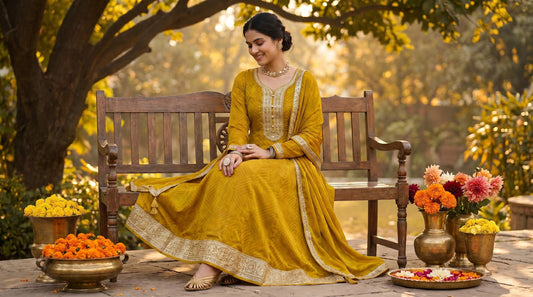
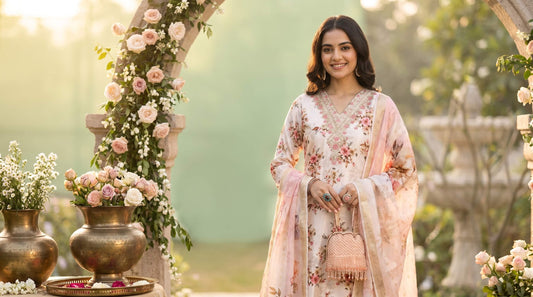
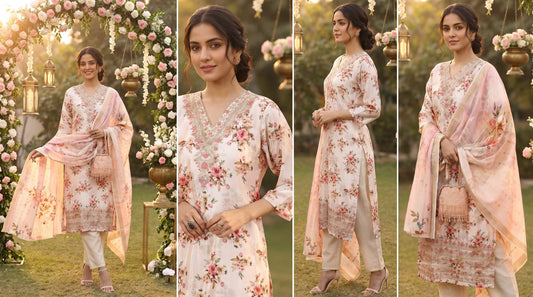
It is not an anarkali — the anarkali's flare begins progressively from the bust, without a structural waist definition. The frock suit has a bodice: a fitted, structured upper section from shoulder to waist or hip. From that point, the skirt section flares. This bodice-to-skirt construction is where the frock suit gets its name and its character — the silhouette echoes a Western frock construction, applied to Indian fabrics, worn with churidar and dupatta.
The result is a garment with more structural definition than an anarkali and more festive personality than a straight kurti. The waist is visible. The flare is definite rather than gradual. The silhouette has a graphic clarity that makes it readable even in casual fabrics.
This is precisely why women who know frock suits search specifically for them. The specific combination — visible waist, flared skirt, ethnic fabric — is not something that can be substituted with an anarkali or a lehenga. It exists in its own proportional territory.
The Construction: Why It Is Harder Than It Looks
The frock suit appears straightforward. Fitted top, flared skirt, join them at the waist. In practice, each element requires specific construction quality to work.
The bodice
The bodice of a frock suit is the garment's structural anchor. Everything else — the drape of the skirt, the overall silhouette, the way the garment sits on the body — depends on whether the bodice is correctly constructed.
A correctly constructed bodice has: interfacing (a stabilising inner layer) that gives the fabric structure without making it stiff; clean princess seams or side seams that follow the body's actual curve; a neckline that lies flat rather than gaping or pulling; and sleeve attachment that allows full arm movement without the shoulder seam travelling toward the neck.
The test in the trial room: put on the bodice section and raise both arms above your head. If the entire bodice rises significantly, the bodice is either too small or the sleeves are too tightly attached. Lower your arms back to your sides. If the bodice stays raised and has to be pulled down, the fit is wrong. A correctly fitted, correctly constructed bodice returns to its position with the arms and stays there.
The test on delivery: hold the bodice section up by the shoulders and assess whether it holds its shape independently. A well-constructed bodice holds a visible shape — you can see the three-dimensional form of the fitted bodice without a body inside it. A poorly constructed bodice collapses and lies flat. This prediction test is not perfect, but it correlates strongly with how the garment behaves during wearing.
The waist seam
The join between the bodice and skirt section is the most structurally important seam in the garment and the most visible quality indicator when examining the inner construction.
On the inside of the garment, at the waist seam: look for clean finishing — either a bound seam, a French seam, or clean overlocking on both seam allowances. Raw, unfinished edges at the inner waist seam indicate that the rest of the garment's construction is likely similarly careless. This seam is against the skin at the waist for the duration of wearing. Poor finishing creates an irritation point.
On the outside: the waist seam should lie flat and create a clean horizontal line. If it puckers or waves, the bodice and skirt pieces were not cut or assembled with compatible seam allowances — a construction error that cannot be corrected without deconstructing the seam.
The flared skirt
The skirt section of a frock suit can be constructed in several ways: gathered, A-line panel, or circular panel. Each creates a different flare quality.
Gathered skirts have more casual, organic movement — appropriate for cotton frock suits and everyday wear. A-line panel skirts have structured, even flare appropriate for formal or festive occasions. Circular panel skirts have maximum volume and the most dramatic photographic impact.
The panel count determines the quality of the flare — more panels creates smoother, more even volume. A four-panel gathered skirt has fewer smooth transitions between panels than an eight-panel skirt. The difference is visible when the garment is in motion: more panels equals more fluid movement.
The hem quality on the flared section is the most visible quality indicator and the most commonly compromised element in budget frock suits. A curved skirt hem requires either careful bias binding, careful single-turn hemming with the fabric eased to the curve, or a clean serged edge that lies flat. A curved hem that is hemmed incorrectly — straight hemming on a curved cut — puckers along its length, creating a scalloped effect that undermines the skirt's clean line.
Fabrics for Frock Suits
Georgette frock suits
The most common festive frock suit fabric. Georgette has sufficient drape to create a fluid flare in the skirt and enough weight to hang cleanly from the waist seam. Georgette frock suits photograph well — the fabric's slight transparency creates visual depth at the skirt's layers and embellishment reads clearly against the fabric's surface.
For occasions: sangeet, semi-formal family functions, cocktail events. Georgette's fluid quality makes it appropriate from mid-to-high formality registers.
Crepe frock suits
More structured than georgette and more appropriate for office and semi-formal contexts. Crepe holds the bodice's shape well and creates a clean, structured flare in the skirt section. Crepe frock suits wrinkle less during wearing than georgette and maintain their silhouette through a longer day.
For occasions: office parties, daytime family functions, casual formal events.
Cotton frock suits
The most practical and the most appropriate for casual occasions and outdoor events. Cotton frock suits in block prints, floral prints, or solid colours are cheerful, comfortable, and appropriate for daytime functions where the visual register is festive rather than ceremonial.
The limitation: cotton's weight means the flared skirt has less visual lightness than georgette or crepe. The skirt drapes more heavily, which reads well in structured solid colours but can look slightly stiff in very lightweight cotton.
Chanderi frock suits
Seasonal and festive. Chanderi's natural sheen and fluid drape create a frock suit silhouette that reads as intrinsically more refined than synthetic alternatives. Chanderi frock suits are appropriate for family celebrations, festive functions, and occasions where the garment needs to read as high-quality without being ceremonially heavy.
Velvet frock suits
Winter and evening functions. Velvet frock suits in jewel tones — deep burgundy, emerald, navy — with embellishment at the bodice create a look of significant visual luxury. The fabric's weight gives excellent structure to the bodice and creates a dramatic, full skirt section. The limitation: velvet is the warmest fabric in the frock suit category and inappropriate for summer or outdoor functions.
Occasion Suitability
Office parties and farewell events: The frock suit's most natural habitat. Mid-length (knee to mid-calf), structured bodice, minimal embellishment, in crepe or georgette. With churidar and heels. Reads as dressier than a standard kurti without the ceremonial weight of a full anarkali.
Children's birthday parties and casual celebrations: Where printed cotton and floral frock suits work best. The festive personality of the silhouette without the formal embellishment. Comfortable and appropriate for outdoor event movement.
Semi-formal family functions: Georgette or chanderi frock suit with embellishment at the bodice neckline. With churidar and simple jewellery. Sits correctly in the mid-formality range that many daytime family functions occupy.
Festive occasions: An embellished frock suit — with zari work at the bodice, mirror embellishment at the hem, or sequin work on the skirt — can work for mehendi and sangeet functions, particularly for guests who want to look festive without committing to full lehenga formality.
The Churidar and Legging Decision
Traditional frock suits are worn with churidar — the tightly fitted trouser with gathered fabric at the ankle. This pairing is proportionally correct: the visual contrast between the voluminous frock skirt and the narrow churidar creates balance that emphasises the frock's silhouette.
Contemporary frock suits are sometimes worn with straight palazzo pants or simple leggings. Both can work, but the legging option is most successful when the frock suit's hem is longer — mid-calf or below — so the legging functions as a base rather than competing with the frock's hem for visual attention.
Footwear: block heels and kitten heels work best. Very high stilettos with a frock suit can shift the proportion toward overtly fashion-forward, which may or may not be the intention. Flat kolhapuri sandals work well for casual cotton frock suits in casual settings.
Conclusion
The frock suit rewards buyers who know what they are looking for and know how to evaluate it. The silhouette is genuinely beautiful when the construction is correct — the defined bodice creating a clear waist, the flared skirt creating festive volume, the whole garment reading as considered and structured without the ceremonial weight of a lehenga. The construction checks in this guide — the bodice hold test, the inner waist seam examination, the hem flatness assessment — take less than two minutes and reliably identify well-made frock suits from poorly constructed ones. Apply them on delivery, before the tags are removed, and the frock suit becomes one of the most reliably successful festive purchases an Indian woman can make for the specific occasion range it serves.
Anarkali Kurti Guide — Understanding The Silhouette Difference
Previous
Ethnic Gowns for Women: Why the One-Piece Approach Is Quietly the Smartest Festive Choice
Next
Types of Lehenga: Every Silhouette, Construction, and Colour Explained Without the Confusion