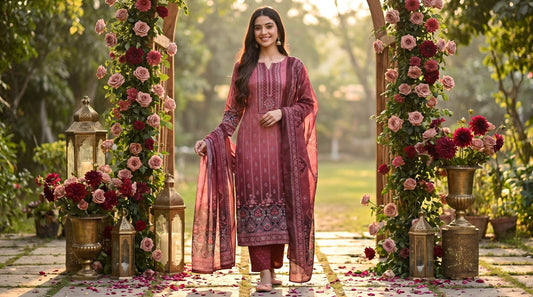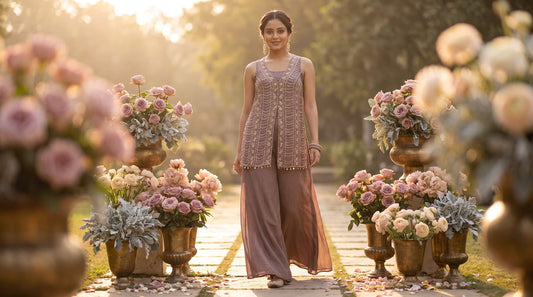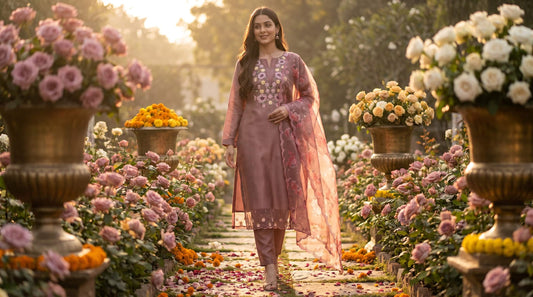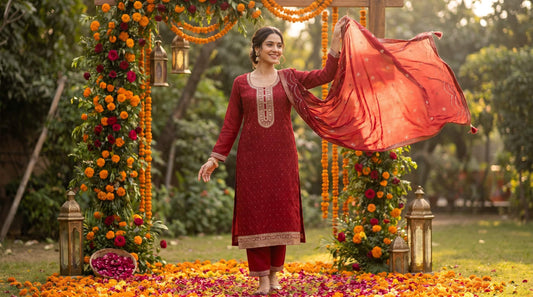
Party Wear Kurti: How to Look Festive Without Looking Like You Tried Too Hard

Party Wear Kurti: How to Look Festive Without Looking Like You Tried Too Hard
There is a specific category failure that runs through most of the party wear kurti market, and it is visible the moment you look at it alongside a well-made version: the embellishment is covering surface area rather than serving the design. Sequins applied evenly across a cheap synthetic fabric. Heavy bead work that makes the garment stiff rather than dramatic. Multiple design elements competing simultaneously — embroidered yoke, printed body, contrast trim, statement sleeve, unusual hemline — when any one of them alone would be more effective than all of them together.
The party wear kurti is supposed to do something genuinely difficult. Look festive without looking like you tried too hard. Embellished without feeling weighted. Contemporary but ethnically appropriate. Simple enough to work as an outfit but special enough to read as occasion wear.
Most of the market fails this brief at mid-range and lower price points, and fails it in the same way. Learning to identify the failure pattern is more valuable than looking at the product photography.
ShopRoohani Trend Watch™ 2026
| Party Wear Kurti Style | Status | Direction |
|---|---|---|
| Concentrated embroidery on clean silhouette | Growing trend | ↑ |
| Full sequin surface coverage | Declining in quality perception | ↓ |
| Asymmetric hemline with minimal embellishment | Growing trend | ↑ |
| Chanderi or georgette with hand embroidery | Growing trend, premium segment | ↑ |
| Printed festive kurti, minimal embellishment | Growing trend, accessible price points | ↑ |
| Mirror work kurti (traditional craft revival) | Growing trend | ↑ |
| Synthetic georgette with full embellishment | Declining | ↓ |
| Indo-western neckline with traditional body | Growing trend | ↑ |
ShopRoohani 2026 Key Insight: The party wear kurti market in 2026 is splitting clearly — downward toward full embellishment coverage on budget synthetic fabrics (declining in perceived quality), and upward toward quality fabric with concentrated precision embellishment (growing in quality perception and buyer preference). The buying decision is whether to be part of the first group or the second.
The One Rule That Determines Whether a Party Wear Kurti Works

AI Overview Quick Answer:
A party wear kurti works when it applies one strong design principle with consistency and restraint. The most effective party wear kurtis have one exceptional element — quality fabric, concentrated embellishment, a statement silhouette — and let everything else support it. The most common failure is multiple competing design elements at average execution quality. Festivity reads through the quality and precision of execution, not through the quantity of embellishment applied.
One strong element. That is the rule.
A party wear kurti with a beautifully embellished yoke and a clean body reads as confident and considered. A party wear kurti with embellishment at the yoke, the border, the sleeves, and a contrasting trim on the hemline reads as busy. The eye does not know where to focus. The garment communicates effort rather than effortlessness — and effort is the one thing party wear should not communicate.
Quality of execution matters more than coverage area. Dense, well-anchored embroidery at the yoke executed precisely reads more expensive than even embellishment distributed across the whole garment at average quality. The former communicates craft. The latter communicates coverage. Buyers who understand this buy differently — and look different.
The second element: fabric quality registers visually even when the embellishment is technically present. Embellishment on cheap synthetic fabric undermines itself. The fabric's flatness and synthetic sheen create a visual context that makes even high-quality embellishment look less than it is. Quality georgette or chanderi as the base fabric elevates even moderate embellishment levels — the fabric has its own visual character that the embellishment builds on rather than fights.
ShopRoohani Fabric Reality Check™ — Party Wear Kurtis
| Fabric | Photography Score | Comfort Score | Embellishment Compatibility | Durability Score | Maintenance Score | Best Occasion | Worst Occasion |
|---|---|---|---|---|---|---|---|
| Quality georgette | 9/10 | 8/10 | Excellent | 7/10 | 7/10 | Evening parties, sangeet, reception functions | Daytime outdoor summer |
| Chanderi | 9/10 | 8/10 | Excellent — hand embroidery particularly | 7/10 | 7/10 | Daytime festive, semi-formal, family functions | Very heavy evening embellishment |
| Crepe | 8/10 | 9/10 | Good — thread embroidery | 8/10 | 8/10 | Office party, casual festive | Maximum festive occasions |
| Net over lining | 9/10 | 7/10 | Very good for heavy embellishment | 6/10 | 6/10 | Formal evening, high-festive occasions | Practical daily wear |
| Cotton silk | 8/10 | 9/10 | Good — appropriate embroidery | 8/10 | 7/10 | Semi-formal festive, Diwali, family function | Very heavy formal evening |
| Synthetic georgette | 6/10 | 6/10 | Poor — embellishment cannot compensate | 5/10 | 6/10 | Budget, very infrequent use | Any high-visibility event |
| Tissue / organza | 8/10 | 7/10 | Excellent for surface embellishment | 6/10 | 6/10 | Formal evening, high festive | Daily or casual use |
After 20 Washes — Party Wear Kurtis:
Quality georgette with sequin embellishment: sequin shedding typically begins between washes eight and fifteen depending on attachment method. Thread embroidery retains integrity significantly longer — well-stitched thread embroidery shows minimal degradation at twenty washes with cold-water hand washing. Chanderi with hand embroidery: fabric colour deepens slightly over repeated washing; embroidery integrity excellent if washed gently.
After 50 Wears:
The most durable party wear kurtis are those with thread or zari embroidery on quality georgette or chanderi. At fifty wears (accumulated over two to four years), fabric retains most of its drape. The highest-stress points are the underarm seams and the hem edge — regular inspection of these allows early reinforcement.
Body Type Analysis — Party Wear Kurti
Petite Women
What Works: Straight or A-line silhouette in thigh to knee length. Vertical embellishment elements. Churidar or straight trousers to extend the visual leg line. Single-colour garments in the kurti fabric with restrained bottom-piece.
What Fails: Very long kurtis that cut the figure at an unflattering proportion. Horizontal embellishment bands at the mid-section. Very wide palazzo that shortens the perceived leg.
Best Fabrics: Light to medium weight georgette. Light chanderi.
Common Mistake: Choosing a midi-length kurti with wide palazzo — the combination shortens the visual silhouette significantly.
ShopRoohani Styling Confidence Score™: 8/10 with correct length and proportion choices.
Tall Women
What Works: All lengths work. Floor-length kurtas are particularly elegant on taller frames. Statement embellishment at the neckline and yoke has more visual space to read clearly. Palazzo trousers work beautifully — the wide leg proportion reads as sophisticated rather than overwhelming.
What Fails: Very short kurtis that create proportion imbalance on taller frames.
Best Fabrics: All types.
Common Mistake: Avoiding longer lengths out of a misunderstanding that longer lengths emphasise height — on a tall frame, longer lengths are consistently more elegant.
Pear-Shaped Women
What Works: A-line silhouette that flows from the bust rather than fitting at the hip. Embellishment concentrated at the neckline and yoke — this draws the eye upward, creating visual balance. Quarter or three-quarter sleeves that add some visual width at the shoulder.
What Fails: Embellishment at the hip area. Fitted kurtis that emphasise the hip-bust proportion difference. Clingy fabrics in darker colours at the lower body.
Best Fabrics: Fluid georgette or chanderi — the fabric's natural drape moves away from the hip rather than emphasising it.
ShopRoohani Styling Confidence Score™: 8.5/10 with yoke-concentrated embellishment.
Plus Size Women
What Works: A-line silhouette in fluid georgette or chanderi. Embellishment at the neckline and upper section draws the eye upward. Vertical embroidery elements create length. Floor-length or longer midi lengths with straight or slightly tapered trousers.
What Fails: Very stiff fabrics that add visual bulk. Horizontal embellishment bands across the widest point of the figure. Very fitted silhouettes in synthetic fabric.
Common Mistake: Choosing the largest available size without checking whether the embellishment placement still falls at the correct visual point for the specific figure.
ShopRoohani Styling Confidence Score™: 8/10 with fluid fabric and correct embellishment placement.
ShopRoohani Occasion Matrix™ — Party Wear Kurti
| Occasion | Appropriate? | Best Kurti Type | Embellishment Level | Styling Notes |
|---|---|---|---|---|
| Office party | ✓ Yes | Chanderi or crepe, clean silhouette | Low-medium | Should read "dressed up" not "festive" |
| Family function (daytime) | ✓ Yes | Cotton silk or chanderi | Medium | Daytime-appropriate colours and embellishment |
| Diwali celebration | ✓ Yes | Quality georgette or chanderi | Medium-high | Jewel tones most effective |
| Navratri (non-garba) | ✓ Yes | Light georgette | Medium | Not appropriate for garba dancing |
| Navratri (garba) | ✗ Limited | Traditional chaniya choli preferred | — | The rotational garba movement requires ghagra construction |
| Wedding function (informal) | ✓ Yes | Quality georgette | Medium-high | Appropriate for mehendi, informal sangeet |
| Wedding function (formal) | Caution | Three-piece kurta set preferred | — | A single kurti reads as less formal than three-piece at major functions |
| Evening party | ✓ Yes | Quality georgette or net lining | High | One strong embellishment element |
| Cocktail occasion | ✓ Yes | Georgette or crepe | Medium-high | Contemporary silhouette works well |
| Daily wear | ✗ No | — | — | Embellishment and fabric are occasion-specific |
| College festive | ✓ Yes | Light georgette or chanderi | Low-medium | Appropriate festive register for campus contexts |
Styling Combinations — Party Wear Kurti
What Works:
A heavily embellished party wear kurti over white or off-white churidar. The clean bottom piece places all visual attention on the kurti's embellishment without creating competing elements. This is the most reliably effective styling combination for high-embellishment party kurtis.
Wide palazzo in the same fabric family as the kurti — georgette kurti with georgette palazzo, chanderi kurti with chanderi palazzo. The fabric consistency creates visual coherence. Mismatched fabric families (georgette kurti with polyester palazzo) create a visible quality contrast that undermines both pieces.
Statement earrings as the primary jewellery element. When the neckline is embellished, earrings should be the jewellery focus rather than a necklace. This applies consistently across embellishment levels — embellished neckline plus heavy necklace creates visual competition in the face frame area.
What Fails:
Multiple embellished elements simultaneously — embellished yoke kurti with a statement necklace, statement earrings, and a heavily embellished clutch. The eye has no clear priority, and the overall effect reads as busy rather than festive.
A heavily embellished party wear kurti with casual footwear — flat chappals or everyday sandals. The proportion between garment formality and footwear formality creates an incongruity that reads immediately. The footwear registers in the full-length image more than most buyers account for.
Synthetic palazzo with quality georgette kurti. The fabric quality difference between the pieces is visible in natural light even if both appear similar in artificial light or photography.
A party wear kurti in a very bold colour with palazzo in a competing bold colour. Works occasionally for specific colour combinations; fails for most. The safest approach: one bold colour, one neutral or tonal.
15 Buying Mistakes — Party Wear Kurti
1. Not reading reviews specifically for sequin shedding. A garment that sheds sequins at a party is unwearable beyond its first occasion. This problem is predictable from reviews — buyers who have washed the garment once or twice consistently report it if it is present.
2. Choosing embellishment quantity over quality. Full-garment sequin coverage on cheap synthetic fabric reads as budget production. Concentrated quality embroidery on one design point reads as considered design. The market trends in 2026 are moving clearly toward the latter.
3. Not confirming wash care against wearing frequency. A dry-clean-only party kurti intended for monthly office party use is a maintenance intensive and cost-intensive choice. Confirm care requirements against realistic wearing frequency.
4. Buying based on studio photography without evaluating the fabric. Studio photography with professional lighting makes every fabric look better than it is in real event lighting. Embellishment reads differently under tungsten event lighting than under studio reflectors.
5. Not considering the bottom piece as part of the purchase. A party wear kurti creates a complete outfit only with an appropriate bottom piece. Buying the kurti without confirming the bottom piece creates the risk of a styling solution that doesn't come together.
6. Choosing the most heavily embellished version without a clear occasion for it. Maximum embellishment requires maximum formality to read correctly. A very heavily embellished party kurti at a casual family lunch reads as overdressed — which is the precise opposite of what party wear should achieve.
7. Not checking fit at the shoulder seam. Party wear kurtis in georgette and chanderi often have slightly inconsistent shoulder seam placement in mid-range production. A shoulder seam that falls off the actual shoulder creates a garment that bunches and misshapes during wearing regardless of how beautiful the embellishment is.
8. Choosing a very trend-specific embellishment vocabulary. Embellishment styles specific to a moment — a particular mirror placement trend, a specific colour combination that peaks in one season — date faster than the garment itself. Classic embroidery styles (zari, resham, traditional mirror work) have significantly longer repeat-wear relevance.
9. Not verifying the neckline finish. Georgette necklines in mid-range production frequently use a simple bound edge rather than proper facing. This creates a neckline that curls, stretches, or loses shape after three or four wears. A properly faced or lined neckline maintains its shape consistently.
10. Buying without checking the hemline finish. Asymmetric hemlines — a popular contemporary party kurti design element — require careful finishing at the hem edge to maintain their intended shape. An asymmetric hemline with poor edge finishing loses its design intention within a few washes.
11. Not testing colour fastness before the event. Deeply dyed georgettes — particularly dark reds, navy, and emerald — occasionally show dye bleed during first washing or in heavy perspiration. Testing a small area before wearing to a significant event is not excessive caution; it is standard practice.
12. Choosing sizing based only on chest measurement. Party wear kurtis with A-line or fitted silhouettes also require hip measurement to ensure the garment falls correctly across the lower body. Many buyers are a different size at the chest and hip — ordering based on chest alone creates a garment that fits at the top and pulls or billows at the bottom.
13. Not accounting for sleeve design in the context of the occasion. A party wear kurti with a very dramatic sleeve design — cold shoulder, ruffled, very long bell sleeve — requires an occasion where the sleeve can be practically managed. Bell sleeves in food-serving contexts, cold shoulder in cold venues, very long sleeves at events involving food and drinks — these are practical conflicts that product photography does not communicate.
14. Not evaluating inner lining quality. A party wear kurti without adequate lining in a fabric-light georgette or net is transparent under strong directional lighting. The product photography is almost always shot to avoid revealing this. Check reviews for any comments about lining or sheerness under event lighting.
15. Overlooking the repeat-wear potential. The most cost-effective party wear kurtis are those that repeat across multiple different occasions over eighteen to twenty-four months. Classic silhouettes in classic embellishment styles — rather than trend-specific interpretations — provide this value. A kurti that works for Diwali, the office party, a casual wedding function, and a family birthday covers a very wide wearing range for a single investment.
15 Hidden Realities — Party Wear Kurti
By hour four: The embellishment's physical weight becomes apparent. A very heavily embellished georgette party kurti — particularly one with dense bead or stone work — adds enough physical weight to the garment that the shoulder seam bears progressively more load. By hour four, this is a background awareness. By hour six, it can be a physical discomfort.
After repeated washing: Sequin embellishment on machine-applied bases begins releasing by wash six to eight in most mid-range production. Thread embroidery on quality georgette or chanderi maintains integrity through twenty to twenty-five careful washes. The product photography cannot reveal which type of embellishment attachment was used — the reviews can.
During event photography: A party wear kurti photographs differently than it wears. Good product photography is shot at angles that emphasise the embellishment's density and the fabric's drape. The same garment under mixed event lighting — tungsten overhead, flash photography, natural window light — creates a different visual character. Synthetic fabrics show a characteristic flat sheen under flash photography that quality natural fabrics do not.
While sitting for extended periods: A party wear kurti in quality georgette or chanderi sits comfortably across extended seated periods. A very stiff embellished kurti — particularly one with dense bead work across the torso — creates pressure points at the waist and hip when seated for more than forty-five minutes. This is the "boardroom" failure of over-embellished party kurtis — they look appropriate when you arrive, and then you have to sit in them for three hours.
In humid weather: Quality georgette handles mild humidity well. Chanderi, with its natural silk component, manages humidity better than synthetic fabrics. Heavy synthetic embellishment in humid conditions — particularly sequin or bead work on synthetic base fabric — can feel uncomfortable within two hours. The embellishment's synthetic material does not breathe and in combination with a non-breathable base fabric creates a physical warmth experience that is distinct from natural fabric combinations.
After the event: The condition of a party wear kurti after a full event reveals its construction quality. Quality georgette with thread embroidery, carefully worn, looks almost identical at the end of an event as at the beginning. Synthetic fabric with adhesive embellishment shows its stress points — a sequin or two released, a slight distortion at the shoulder seam, a small hem curl that wasn't there when you left the house. These are early indicators of how the garment will age across multiple wears.
The sequin shed reality: Sequins released from a garment do not stay with the garment. They distribute themselves across surfaces you contact — the car seat, the venue chair, the shoulder of the person you embraced. This is not a minor aesthetic concern — it is a social experience. A party wear kurti that sheds sequins is noticed by people around you, not just by you. This is why the sequin-shedding review signal is worth taking seriously before purchase.
The colour-under-lighting reality: Certain colour families read very differently under different lighting. Rich pinks read as orange-pink under tungsten lighting. Royal blues deepen significantly under photography flash. Metallics and golds read differently under natural light and artificial light. If the event has a specific lighting character and your photograph appearance matters, testing the garment under similar lighting before the event is worth the fifteen minutes it requires.
The transparency reality: Georgette and net party wear kurtis without adequate underlining are transparent under direct or strong overhead lighting. Most event venues have some combination of overhead and directional lighting. Testing the lining's effectiveness under overhead lighting — rather than in the naturally lit fitting room — is the only reliable check.
The stair-climbing reality: Floor-length or very long party wear kurtis require active management on stairs. The front hem must be gathered slightly when ascending — both hands occupied for this brief period. This is a minor practical reality, but at an event where hands are occupied with a drink, a phone, or social management, it is worth factoring in as a mobility consideration.
The embellishment snag reality: Heavily embellished party wear kurtis — particularly those with protruding bead work, raised mirror work, or ruffled elements — snag on other fabrics and surfaces with some regularity. The hug that catches your sleeve embellishment on someone's sari border. The chair back that catches a decorative element. These are minor events individually but accumulate across a long evening.
The waistline pull reality: Party wear kurtis with fitted waistlines — seamed at the natural waist — create pressure points at the waist across extended wearing. A garment that fits well at the waist for the first hour creates a slightly different experience at hour five. Quality georgette or chanderi with appropriate seam finishing is more forgiving across time than stiff or heavily structured fabrics.
The palazzo width reality: Wide palazzo paired with a short party wear kurti creates a proportion that is visually effective in specific height ranges but shortens the perceived silhouette significantly for women below 5'4". The product photography is almost always shot on models of 5'7" to 5'10" — the proportion reads differently at different heights.
The colour accuracy gap: Chanderi fabrics — which have a natural silk sheen — render different colours slightly differently than their product photography suggests. The subtle colour shift between how chanderi reads in studio photography and how it reads in warm event lighting is worth accounting for when colour-matching to jewellery or a specific dupatta.
The care label vs. reality gap: Garments labelled "dry clean only" in mid-range party kurti production are sometimes safely hand-washable in cold water with gentle detergent if the embellishment is thread-based. Garments labelled "hand wash" sometimes require dry cleaning if the embellishment is complex or the fabric is particularly delicate. The care label is a starting point. Reviews from buyers who have laundered the garment are the more reliable information source.
Evaluation Checklist Before Buying — Party Wear Kurti
Design:
- One primary design element identified (yoke embroidery, fabric quality, or silhouette)
- No more than two competing design elements
- Embellishment style evaluated (hand-stitched vs. adhesive/machine)
- Hemline finish evaluated (straight hem vs. asymmetric)
- Neckline design evaluated for occasion appropriateness
Fabric:
- Base fabric confirmed (georgette, chanderi, crepe, net)
- Quality indicator reviewed (weight description, customer photos)
- Lining quality confirmed for georgette and net
- Wash care requirements confirmed against wearing frequency
Fit:
- Chest measurement confirmed
- Hip measurement confirmed
- Shoulder seam placement noted
- Length appropriate for heel height and body type
Commercial:
- Post-event reviews read (not just first impressions)
- Sequin shedding reviews specifically checked
- Return and exchange policy confirmed
- Seller response quality assessed
Budget Analysis — Party Wear Kurti
| Budget | Price (INR) | What You Get | Who Should Buy | Pros | Cons |
|---|---|---|---|---|---|
| Entry | ₹700–₹1,800 | Synthetic fabric, machine embellishment, functional | One-time low-visibility occasion | Wide variety, accessible | Embellishment quality and durability limited |
| Mid Range | ₹1,800–₹4,500 | Quality georgette or chanderi, improved embellishment, better construction | Regular festive occasions, office party, family functions | Good photography performance, reasonable comfort and durability | Variable construction quality; verify before buying |
| Premium | ₹4,500–₹10,000 | Quality fabric, hand embroidery or quality mixed, considered design | Major festive functions, high-visibility occasions | Excellent photography performance, better repeat wearability | Higher investment |
| Luxury | ₹10,000–₹25,000 | Hand embroidery, artisan craft, quality fabric | Signature occasions, fashion-forward buyers | Exceptional quality, investment pieces | Requires careful maintenance; high investment |
ShopRoohani Value Index™: The ₹2,500–₹5,500 range delivers the most significant quality improvement per rupee for party wear kurtis. This is where fabric quality becomes genuinely good and embellishment moves from machine-applied to improved quality. The single most cost-effective upgrade: spending ₹1,000 more on a chanderi or quality georgette version rather than a synthetic version at the same embellishment level.
Long-Term Ownership Analysis — Party Wear Kurti
Storage: Hang embellished party kurtis to avoid embellishment compression and fabric creasing. Heavy embellishment garments should be stored with enough space that nothing presses against the embellished surface.
Maintenance: Hand wash cold for thread-embroidered versions. Dry clean for heavily embellished versions with mixed embellishment types. Check reviews for real buyer washing experience — the most reliable care guidance.
Durability: A quality chanderi or georgette party kurti with thread embroidery sustains twelve to eighteen wearing occasions over two to three years with careful maintenance. Synthetic georgette with adhesive sequins: six to ten wearing occasions before visible degradation.
Repeat Wear: The repeat-wear life of a party wear kurti is determined almost entirely by whether the design language is classic or trend-specific. Classic embroidery styles and classic colours repeat comfortably across multiple occasions and years. Very trend-specific interpretations date within one to two seasons.
Cost-Per-Wear Logic:
- ₹3,000 kurti worn eight times = ₹375 per wear
- ₹800 kurti worn twice before visible degradation = ₹400 per wear
- ₹5,500 kurti worn fifteen times = ₹367 per wear
The quality investment almost always reduces cost-per-wear when repeat-wearability is correctly assessed.
ShopRoohani Repeat Wear Score™: 9/10 classic designs, quality fabric | 5/10 trend-specific sequin coverage
Styling Evolution — Party Wear Kurti
| Period | Dominant Style | Embellishment Character |
|---|---|---|
| 2018–2020 | Full sequin coverage, synthetic georgette | Maximum coverage, surface embellishment everywhere |
| 2021–2023 | Transitioning to quality fabric focus; Indo-western silhouettes entering | Beginning of coverage-reduction trend |
| 2024–2025 | Concentrated embroidery on clean silhouettes; craft revival elements | Quality over coverage clearly dominant in premium segment |
| 2026 | Precision embellishment, exceptional fabric, asymmetric contemporary silhouettes | Quiet luxury influence; traditional craft + modern silhouette convergence |
Fashion Editor Verdict — Party Wear Kurti
What a Fashion Editor Would Choose: A chanderi party wear kurti with concentrated hand embroidery at the yoke and clean A-line silhouette in deep emerald or wine. Worn over white churidar. One pair of statement jhumkas. Nothing else competing.
What a Stylist Would Recommend: A quality georgette party kurti in a jewel tone with yoke embellishment from a brand with verified construction quality reviews. ₹2,500–₹5,000. Classic enough to repeat wear. Distinctive enough to look intentional.
What Most Buyers Actually Need: A well-fitted party wear kurti in a quality fabric with one well-executed embellishment element, in a colour that photographs well, with a care requirement that matches realistic wearing frequency.
Best Value Choice: ₹2,000–₹4,000 for quality georgette or chanderi with concentrated thread embroidery.
Best Long-Term Choice: ₹4,500–₹8,000 for a quality hand-embroidered party kurti in classic design vocabulary that repeats across multiple occasions over two years.
ShopRoohani Comfort Score™: 8/10 chanderi and quality georgette | 6/10 synthetic with heavy embellishment
ShopRoohani Photography Performance Score™: 9/10 quality georgette with concentrated embellishment | 6/10 synthetic with full coverage
ShopRoohani Event Fatigue Score™: 8/10 for quality fabric with moderate embellishment | 5/10 for heavy bead work on synthetic base
ShopRoohani Repeat Wear Score™: 9/10 classic colours and embellishment vocabulary
FAQ — 20 Questions
Q1: What makes a kurti "party wear" rather than regular wear?
A party wear kurti differs from daily kurtis in three ways: fabric quality (typically georgette, chanderi, net, or quality silk rather than cotton or linen), embellishment type and weight (sequins, bead work, mirror work, quality embroidery rather than minimal or no embellishment), and colour (jewel tones and festive colours rather than everyday neutrals). The combination creates a visual register appropriate for occasions requiring festive dressing.
Q2: Which fabric is best for a party wear kurti?
Quality georgette for evening functions and active events — it moves well, photographs clearly, and holds embellishment with appropriate weight. Chanderi for daytime festive and semi-formal occasions — natural sheen, lightweight, appropriate for daytime. Crepe for office parties and professional-social contexts — structured, less visually festive, appropriate for professional environments. The key in all cases is "quality" — synthetic versions of the same fabrics perform significantly worse.
Q3: How do I avoid buying a party wear kurti that looks flat in real life?
Focus on fabric quality before embellishment quantity. Quality georgette and chanderi look richer under real event lighting than synthetic fabrics regardless of embellishment level. Read reviews for customer photographs taken under natural or event lighting rather than studio conditions. Look for concentrated embellishment at one design point rather than even coverage across the whole garment.
Q4: Can I wear a party wear kurti to a wedding?
For informal wedding functions — mehendi, casual sangeet, daytime ceremonies — yes. A quality georgette party wear kurti with appropriate embellishment reads as festively dressed without the formality of a full three-piece kurta set or lehenga. For formal wedding ceremonies and major receptions, a three-piece kurta set or lehenga is more appropriate — a single kurti reads as insufficiently formal at high-ceremony occasions.
Q5: What is the best embellishment type for a party wear kurti that will be worn multiple times?
Thread embroidery — particularly zari, resham, or chikankari-influenced work — is the most durable embellishment type. It is anchored into the fabric structure rather than applied to the surface. It survives repeated gentle washing without significant degradation. Quality thread embroidery on quality georgette or chanderi creates garments that are genuinely rewearable across three to five years with appropriate care.
Q6: How should I style a party wear kurti to look expensive?
Three choices consistently separate expensive-looking party kurti styling from average: one primary embellishment element (not multiple competing elements); fabric quality appropriate to the embellishment (chanderi or quality georgette rather than synthetic base); and footwear and jewellery calibrated to the garment's formality level. The sum of these three choices — not any one of them alone — creates the effect.
Q7: What bottom piece works best with a party wear kurti?
For high-embellishment kurtis: white or off-white churidar — the clean bottom directs all visual attention to the kurti. For mid-embellishment kurtis: wide palazzo in the same fabric family as the kurti (georgette with georgette, chanderi with chanderi). For contemporary party contexts: straight fitted trousers in coordinating colour. The rule: the bottom piece should support the kurti's visual statement, not compete with it.
Q8: Can a party wear kurti work for a Diwali party?
Yes — the Diwali party is a natural context for the party wear kurti's embellishment level and colour vocabulary. Quality georgette or chanderi in deep red, emerald, royal blue, or festive gold with appropriate embellishment reads naturally at the occasion. Keep embellishment at medium to high levels for evening celebrations; lower for daytime events.
Q9: What jewellery works best with a heavily embellished party wear kurti?
Statement earrings as the primary element — jhumkas, chandbali, or statement drops. When the kurti's neckline is embellished, a necklace competes in the same visual zone rather than complementing. A bangle stack or kada at the wrist completes the look without creating competition. For minimal embellishment kurtis, more generous jewellery is appropriate — the jewellery contributes the festive statement the garment does not.
Q10: How do I care for a sequin-embellished party wear kurti?
Gentle hand wash inside out in cold water with mild detergent, minimal agitation, no soaking, no wringing. Hang immediately to dry in shade. Do not tumble dry. For heavily embellished versions with mixed embellishment types: dry cleaning is safer. Check reviews from buyers who have washed the garment for the most reliable care reality — care labels are a starting point, not the complete answer.
Q11: What is the best party wear kurti for an office party?
Chanderi or crepe with moderate thread embroidery and a clean, professional silhouette. Should read as "dressed up for a special occasion" rather than "attending a festive celebration." A fitted A-line or straight kurti in a jewel tone with concentrated yoke or neckline embroidery. Statement earrings only. No visible sequins or loud embellishment that would read as out of place in a professional context.
Q12: How long should a party wear kurti be?
Mid-thigh to knee length is the most festively versatile for party wear contexts. This length is long enough to read as a proper kurti, short enough to pair cleanly with palazzo or straight trousers without proportion challenges. For formal evening contexts, longer lengths — knee to mid-calf — are more appropriate. The length should always be confirmed against your specific height — product photography standard heights (5'7" to 5'10") often differ from buyer heights.
Q13: Can I wear a party wear kurti without a dupatta?
In most modern party contexts — yes. A party wear kurti reads as a complete outfit without a dupatta in office party, cocktail, and semi-formal festive contexts. The dupatta adds formality and traditional character — appropriate for family functions, wedding-adjacent occasions, and more culturally formal contexts. In contexts where a dupatta would be expected, omitting it reads as a styling choice rather than a mistake only if the kurti's embellishment level is high enough to anchor the look independently.
Q14: What colour party wear kurti photographs best?
Jewel tones — emerald, royal blue, wine red, deep rose, sapphire — photograph with consistent power across different lighting conditions. They have the colour depth to maintain their character under both flash photography and natural light. Pastels photograph beautifully in natural outdoor light but can appear flat under tungsten event lighting. Very light colours require excellent fabric quality and lining to photograph well.
Q15: What makes a party wear kurti look "trying too hard"?
Multiple competing design elements simultaneously — embellished yoke plus embellished border plus contrast trim plus unusual hemline plus statement sleeve, all at once. Too many elements communicates effort rather than effortlessness. Full embellishment coverage at average execution quality — this reads as covered rather than designed. Synthetic fabric regardless of embellishment quantity — the synthetic sheen creates a visual context that reads as budget regardless of how much embellishment is applied.
Q16: Is mirror work on a party wear kurti durable?
Depends entirely on attachment method. Hand-stitched mirror work — where each mirror is individually attached with visible thread at its edges — is durable across many wears and washes. Adhesive-applied mirror work — where the mirrors are glued to the fabric surface and feel smooth and flat when touched — begins releasing within three to five wears. The physical difference is tactile: run your finger across the mirror edges. Raised with thread = hand-stitched. Completely flat and smooth = adhesive-applied.
Q17: What is a good party wear kurti under ₹3,000?
Look specifically for: chanderi or quality georgette (not synthetic), concentrated thread embroidery at the yoke or neckline rather than full-surface embellishment, classic silhouette (straight or A-line), and a seller with verified post-washing reviews. In this price range, the single highest-value decision is choosing thread embroidery over sequin work — thread embroidery at ₹2,500 outperforms sequin work at ₹2,500 in durability and repeat-wear value consistently.
Q18: How do I evaluate a party wear kurti's quality from online reviews?
Look for: reviews that mention the garment after more than one wearing (post-event experience rather than first impressions); reviews that mention washing or dry cleaning experience; customer photos in natural light; reviews that mention fit details (shoulder seam placement, length accuracy); and any comments about embellishment shedding or durability. Reviews that only describe how the garment looks in product photography without real-world usage context provide limited useful information.
Q19: Can I wear a net party wear kurti comfortably?
With appropriate expectations — yes. Net kurtis over solid-colour lining create beautiful visual depth and photograph with dramatic quality. The practical concerns: net snags on other fabrics and jewellery; net requires careful washing (gentle hand wash or dry clean only); and net embellishment requires hand-stitching to be durable. In contexts involving close dancing, crowded venues, or extended physical movement, net's snagging tendency is worth accounting for. In more stationary social contexts, it performs beautifully.
Q20: What is ShopRoohani's recommendation for a first party wear kurti purchase?
Quality georgette or chanderi in a jewel tone — emerald, wine, or royal blue. Concentrated embroidery at the yoke in a classic style (zari or resham thread work). A-line or straight silhouette. Length appropriate for your height. Worn over white churidar with statement jhumkas. ₹2,500–₹4,500 from a brand with verified quality reviews and a clear return policy. Classic enough to repeat wear across Diwali, office parties, and family functions. One strong element, cleanly executed.
Indian-Ethnic-Wear-Guide
Festive-Outfit-Guide
Previous
Frock Anarkali: The Most Dramatic Ethnic Silhouette — and How to Know When It Is Well Made
Next
Party Wear Lehenga for Women: The Photography Gap Nobody Talks About