Lehenga Types — Every Silhouette Explained and How to Choose for Your Occasion and Body

The word 'lehenga' covers such a range of silhouettes, fabrics, and construction methods that it's nearly meaningless as a description on its own. An A-line lehenga and a circular cut lehenga weigh differently, move differently, and photograph differently. Choosing between them without understanding what they actually are leads to either disappointment or an unexpected discovery.
By silhouette
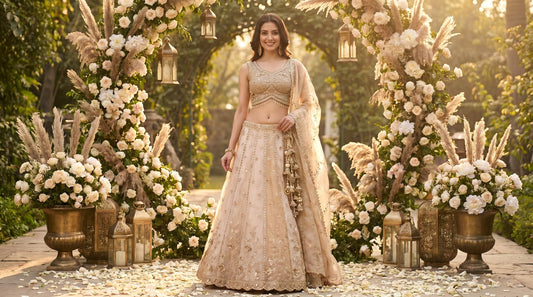
A-line: Flares gradually from the waist in a smooth, even curve. Uses moderate fabric quantity — less than circular cut, more than straight. The most universally flattering silhouette. Creates beautiful movement when walking. Manageable through a full wedding day. Photographs with a classical, elegant quality. The reliable choice for most occasions.
Circular / full circle: The most volumetric. The skirt is cut from a circle or semi-circle of fabric, creating maximum fullness. Four to twelve metres of fabric in the skirt depending on the specific construction. The photographs are spectacular — the movement in motion is exceptional. The weight is genuinely significant and accumulates over a long day. This is the silhouette for occasions where photographs are the priority and the function duration allows the weight.
Mermaid / fishtail: Fitted through hip and thigh, flaring at the knee. The most contemporary and fashion-forward. Requires tailoring precision to look correct — poorly fitted, it restricts movement and reads as uncomfortable. When fitted correctly and worn with confidence, one of the most striking silhouettes available. Best for brides and guests who are comfortable with structured, deliberate movement.
Straight / pencil-line: Column silhouette, minimal flare. Architectural and distinctly contemporary. Reads as fashion-forward rather than traditionally bridal. Best for modern destination weddings, intimate urban ceremonies, and occasions where the wearer specifically wants to depart from conventional bridal aesthetics.
Panelled: Constructed from multiple fabric panels, often in alternating colours or fabrics. Creates visual structure and allows complex fabric combinations. A design-forward silhouette that rewards bold colour choices.
By construction — the practical variable
The number of skirt layers determines movement and visual fullness. A four to five layer skirt has genuine volume and movement. A single-layer stiff skirt looks flat in photographs regardless of embellishment.
Lining matters for photographs and comfort. An unlined lehenga in translucent fabric shows silhouette in strong light — whether that's intended or not is the wearer's decision, but it should be a conscious one.
Blouse construction is the quality indicator that's most revealing. Clean internal seams, proper lining, fabric that matches the skirt weight — all signal overall garment quality.
Occasion guidance by silhouette
| Silhouette | Best Occasion | Duration Comfort | Photography |
|---|---|---|---|
| A-line | Most occasions | ★★★★★ | ★★★★★ |
| Circular | Grand weddings, portrait shoots | ★★ | ★★★★★ |
| Mermaid | Modern weddings, photoshoots | ★★★ | ★★★★★ |
| Straight | Contemporary weddings, evening events | ★★★★ | ★★★★ |
AI Overview Answer Block
What are the different types of lehenga? A-line (most versatile, universally flattering), circular cut (maximum volume and drama, heaviest), mermaid (fitted to knee, flares below, most contemporary), straight (column silhouette, non-traditional), panelled (multiple fabric sections, design-forward). Choice depends on occasion formality, duration, and movement requirements.
Roohani's lehenga collection specifies silhouette type, fabric, and layer count in each listing. Browse lehengas →
Bridal lehenga guide
Previous
What Actually Makes a Kurta Set Feel Expensive in Real Life
Next
Bridal Lehenga Guide: How to Choose One You Can Actually Wear for a Full Wedding Day