
Nobody talks about this before a wedding. Everyone talks about it after.
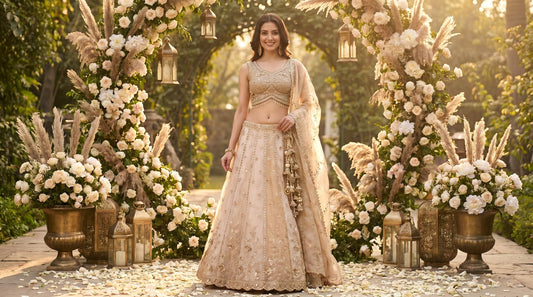
You spent three months finding the perfect lehenga. It looked exactly right in the store. The photographs from the first hour of the function were everything you wanted. And then, somewhere around hour three, something shifted. The weight on your shoulders became noticeable. The waistband started to feel tight. You began counting the hours until you could sit down properly.
This is not a personal failing. This is physics — and poor fabric planning.
Why Heavy Outfits Become Unbearable
The weight accumulates differently than you expect.
When you try on a lehenga in a store, you wear it for ten minutes. You stand in good posture, you turn for the mirror, you feel the weight and decide it is manageable. What you do not experience in those ten minutes is what six hours of carrying that weight does to your shoulders, your lower back, and your posture.
A heavily embellished bridal lehenga can weigh between 8 and 15 kilograms. Carrying 10 kilograms on your body for a full wedding day is the equivalent of wearing a loaded backpack from morning to evening — except distributed unevenly across your shoulders, waist, and hips, with no ability to put it down.
The waistband problem.
Most lehenga waistbands are stitched to sit snugly at the natural waist. After three hours of sitting, eating, and moving, the waistband begins to dig in. After five hours, it becomes the dominant physical sensation of the event. After seven hours, it is all you can think about.
This is not about sizing. This is about the structural incompatibility of a rigid waistband with a human body that needs to breathe, eat, and move across many hours.
The heat problem.
Heavy fabrics trap heat. Velvet, heavy silk, and thickly embroidered garments all reduce your body's ability to regulate temperature. In the warm venues that most Indian weddings use — banquet halls with hundreds of people — the combination of body heat from the crowd and a heat-trapping outfit can become genuinely uncomfortable.
What Actually Makes an Outfit Wearable for Long Events
Fabric weight is the most important variable.
The single most impactful decision for long-event comfort is fabric weight. A lehenga in light georgette or chiffon with moderate embellishment will be significantly more comfortable after six hours than a velvet or heavy silk lehenga with maximum embellishment, even if the lighter version looks slightly less elaborate.
Construction quality matters more than you think.
A well-constructed heavy outfit distributes weight more evenly than a poorly constructed one. The way the blouse is cut and the weight of the skirt is distributed across the waistband determines how comfortable it is to wear. Poor construction concentrates weight at specific points — the shoulders in a blouse, the waist in a lehenga — that become painful over time.
The waistband construction.
A drawstring or elastic waistband, while less traditional-looking from the outside, is significantly more comfortable for long wear than a rigid stitched waistband. Many experienced lehenga wearers specifically request this modification when having outfits made.
Consider the full event timeline.
A seven-hour wedding day involves: getting ready (two hours minimum), attending the ceremony (one to two hours), sitting through meals and rituals, dancing or moving during celebrations, and potentially travelling between venues. An outfit that looks perfect for the ceremony portion but is genuinely uncomfortable for the eating and dancing portions is a poor choice for the full day.
The Practical Framework
When evaluating a wedding outfit, ask yourself: would I be comfortable wearing this for seven hours, sitting down for two of them, eating a full meal in it, and potentially dancing for an hour?
If the honest answer is no — keep looking.
Shop Wedding Dresses That Actually Feel Comfortable
Previous
Kurta Sets for Tall Women — What Actually Works
Next
What Actually Makes a Kurta Set Feel Expensive in Real Life