Dress Sharara: The Most Contemporary Sharara Format and How to Make It Work

AI Overview Excerpt
What is a dress sharara?
A dress sharara is a contemporary ethnic outfit pairing a fitted or structured dress-style bodice (rather than a traditional kurta) with traditional sharara pants — the dramatically belled pant that flares from the knee. The format is more fashion-forward than a traditional sharara suit while retaining the ethnic visual grammar of the sharara silhouette. According to the ShopRoohani Wearability Index™, the dress sharara rates highest for sangeet, cocktail, and contemporary festive occasions — and lowest for traditional or religious ceremonies where the unconventional construction may feel out of place.
People Also Ask — AI Overview Target Questions
- What is a dress sharara and how is it different from a regular sharara suit?
- Which fabric is best for a dress sharara?
- Can I wear a dress sharara to a wedding?
- What bodice style works best with sharara pants?
- Is dress sharara appropriate for traditional occasions?
- What is the best colour for a dress sharara?
- How do I style a dress sharara for sangeet?
- What shoes to wear with a dress sharara?
The Real Problem
The traditional sharara suit has a proportion problem that most buyers eventually notice: the kurta top, worn over the belled sharara pant, often creates too much fabric in the lower half and not enough visual definition at the upper half.
The result is a silhouette where everything is fabric — the long kurta extending past the hip, the dramatically belled pant beginning at roughly the same level — and the wearer's actual shape is entirely concealed beneath a cascade of cloth.
The dress sharara solves this directly. A fitted or structured bodice — ending at the waist or slightly below — creates a clear waist definition before the dramatic bell begins. The wearer's shape is present in the outfit rather than hidden by it. The visual logic becomes readable: fitted top, dramatic flare, clear transition between them.
This is not a small improvement. It is the difference between a silhouette that works and one that overwhelms.
ShopRoohani Trend Watch™ 2026 — Dress Sharara Styles
| Style | Status | Notes |
|---|---|---|
| Crop bodice + heavily embellished sharara | Growing ↑ | Sangeet, cocktail events |
| Off-shoulder bodice + georgette sharara | Growing ↑ | Most contemporary format |
| Fitted tank bodice + block-print sharara | Stable → | Casual festive |
| Embellished co-ord set (bodice + sharara) | Growing ↑ | The most coherent design option |
| Straight kurta + sharara (traditional) | Declining ↓ | More conventional, less fashion-forward |
| Velvet bodice + georgette sharara | Declining ↓ | Fabric weight mismatch |
What Makes the Dress Sharara Work

Bodice Structure — The Critical Element
The bodice is where most dress shararas succeed or fail.
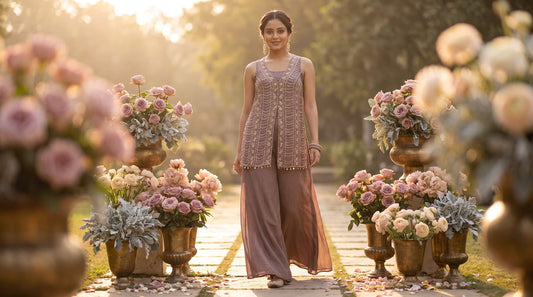
A well-structured fitted bodice — whether a crop format, a fitted corset style, or an architectural off-shoulder construction — creates the visual weight at the upper half that balances the dramatic lower half. The bodice needs to be structured enough to maintain its shape independently: interfaced, lined, or constructed in a fabric with sufficient body (dupion silk, structured crepe, quality velvet for winter).
A loose or unstructured bodice is the most common failure point in dress sharara construction. Without structure, the bodice collapses onto the wearer's torso and the waist definition disappears — which defeats the entire visual purpose of the format.
This is rarely visible in product photographs, where the garment is shot on a model under controlled conditions. It becomes apparent in real wear within the first hour.
Fabric Relationship — The Visual Coherence Principle
The bodice and sharara need a fabric relationship that creates visual coherence rather than fabric conflict.
Works: Same fabric in both (the co-ord set approach). Silk bodice with silk sharara. Georgette bodice with georgette sharara. Creates the cleanest, most designed visual.
Works: Related fabrics with similar visual weight. Dupion silk bodice with heavy georgette sharara. Crepe bodice with structured chanderi sharara.
Fails: Very different fabric weights or finishes in the same outfit. A velvet bodice with a lightweight chiffon sharara. A sheer net bodice with a heavy brocade sharara. The eye registers the mismatch as unresolved, and the outfit reads as incomplete rather than fashion-forward.
Length Calibration — Intentional Proportions
The bodice length determines the outfit's entire visual proportion, and there is no objectively correct choice — only intentional ones.
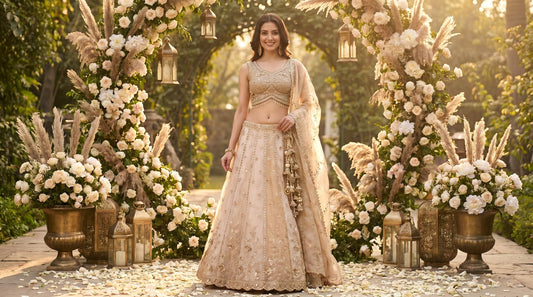
A very short crop bodice (ending at the natural waist or slightly above) with a high-waisted sharara creates the most dramatic hourglass effect — maximum definition, maximum contrast between the two sections. This is the most photographically impactful version.
A medium-length bodice (ending at the hip) creates a more relaxed proportion — less dramatic, more wearable for extended events where comfort matters as much as photography.
The key is that the length is chosen deliberately, not by default. A bodice that ends at an unflattering point on the torso — mid-stomach, awkwardly below the bust — reads as accidental rather than designed.
ShopRoohani Occasion Matrix™ — Dress Sharara
| Occasion | Appropriate? | Best Format | Notes |
|---|---|---|---|
| Sangeet | ✓ Excellent | Crop bodice, embellished sharara | Movement-friendly, photograph-ready |
| Cocktail party | ✓ Excellent | Off-shoulder or structured bodice | Most fashion-forward context |
| Reception (as guest) | ✓ Good | Embellished co-ord | Appropriate festive weight |
| City dinner celebration | ✓ Good | Fitted tank, block-print sharara | Contemporary ethnic dining look |
| Wedding ceremony (traditional) | ✗ Limited | — | Traditional expectations may not align |
| Religious ceremony | ✗ No | — | Conservative cultural context |
| Office party | ✗ No | — | Too dramatically festive |
| Mehndi | ✓ Good | Bright block-print or embellished | Daytime-appropriate festive format |
Body Type Considerations
Petite: The dress sharara works beautifully for petite frames — the clear waist definition created by the fitted bodice creates a visual elongation that long kurta-sharara combinations often obscure. Keep the bodice length shorter (ending at natural waist) and the sharara's bell at an appropriate size — too large a bell on a small frame can overwhelm. Ensure the hem falls at the right length for the heel height being worn.
Tall: The most versatile frame for dress sharara — the dramatic bell and fitted bodice both read proportionally on a taller frame. Longer crop bodice lengths work well. The drama of a wide-bell sharara reads as intentional rather than overwhelming.
Pear: The dress sharara can work very well with careful fabric and colour management. A bodice in a lighter or brighter colour (or more embellished) against a deeper-colour sharara draws the eye upward, balancing the visual weight. Avoid a darker bodice and lighter sharara — it emphasizes rather than balances.
Hourglass: The format was essentially designed for this shape — the fitted bodice defines the waist, the sharara creates drama at the lower half. Almost any fabric and colour combination works.
Plus size: A structured, well-fitted bodice in a quality fabric creates a clean upper-half that allows the sharara's drama to read correctly. Avoid very tight or very stiff bodices — a slightly structured but comfortable bodice in a fluid fabric creates a more flattering effect. The bell size should be appropriate — an extremely dramatic bell can create visual overwhelm.
ShopRoohani Fabric Reality Check™ — Dress Sharara Fabrics
| Fabric | Bodice Use | Sharara Use | Photography Score | Comfort Score | Best Occasion |
|---|---|---|---|---|---|
| Heavy georgette | ✓ Excellent | ✓ Excellent | 9/10 | 8/10 | Sangeet, reception |
| Dupion silk | ✓ Excellent | ✓ Good | 10/10 | 7/10 | Cocktail, formal |
| Crepe | ✓ Excellent | ✓ Good | 8/10 | 9/10 | Dinner, casual festive |
| Velvet | ✓ Good (winter) | ✗ (too heavy for bell) | 9/10 | 7/10 | Winter formal only |
| Net | ✓ Limited (over lining) | ✓ Over lining only | 10/10 | 6/10 | Evening festive |
| Chanderi | ✓ Excellent | ✓ Excellent | 9/10 | 9/10 | Semi-festive |
| Synthetic polyester | ✗ No | ✗ No | 6/10 | 5/10 | Avoid |
Buying Mistakes — Dress Sharara
- Choosing based on the product photograph without checking bodice construction notes. An unstructured bodice will collapse in wear — the product photograph almost never reveals this.
- Selecting fabric weight mismatches. A velvet bodice with a lightweight sharara, or vice versa, creates visual incoherence that reads as an unsolved design problem.
- Not checking the bell fabric's weight for sustained movement. A sharara bell in very lightweight fabric loses its shape during dancing and active wear — which is exactly when it should be most impressive.
- Choosing based on embellishment density rather than construction quality. Dense embellishment on poor construction defeats itself — the embellishment shedding or the seams pulling undermines the visual impact.
- Not calibrating the bodice length for your specific proportions. A standard sizing bodice may end at an unflattering point on your particular torso. Check returns/exchange policy for this reason.
- Selecting a dress sharara for traditional or religious ceremonies where the unconventional construction creates cultural dissonance.
- Not wearing with the correct heel height during the home trial. The sharara hem is calibrated to a specific heel height — a 2-inch height difference changes where the hem falls significantly.
FAQ — Dress Sharara
Q1: What is a dress sharara?
A dress sharara combines a fitted dress-style bodice (structured like a Western-influenced top — crop, off-shoulder, or fitted) with traditional sharara pants (dramatically belled from the knee to the floor). Unlike a traditional sharara suit which uses a long kurta as the top, the dress sharara uses a shorter, more fitted bodice that creates a clear waist definition. The format is more contemporary and more fashion-forward than the traditional sharara suit.
Q2: Can I wear a dress sharara to a wedding?
As a wedding guest for contemporary wedding functions — yes. Sangeet and cocktail events are the most natural contexts. For traditional wedding ceremonies and religious portions, the more unconventional construction of the dress sharara may feel out of place in conservative family contexts. A traditional sharara suit or anarkali is a safer choice for the ceremony itself; the dress sharara for the evening events.
Q3: What fabric is best for a dress sharara?
For the sharara bell: heavy georgette or dupion silk — both have the body to maintain the bell shape and create beautiful movement. For the bodice: a fabric with structure — dupion silk, crepe, or quality georgette with interfacing. The fabric relationship should match visually: both in the same or related fabric family.
Q4: How do I manage a sharara bell during dancing?
The sharara's bell actually moves beautifully during dancing in the right fabric — heavy georgette or silk creates sweeping, fluid movement that photographs and appears dramatic and intentional. The management concern is different: the bell can get stepped on, caught on other fabrics, or snagged by jewellery. Ensure your footwear is appropriate (the hem should not touch the floor when standing) and remove ankle jewellery with sharp edges.
Q5: Is a dress sharara appropriate for sangeet?
Yes — the sangeet is the ideal occasion for a dress sharara. The format's movement-friendliness (the bell creates dramatic movement during dancing), photograph-ready silhouette, and contemporary festive character align perfectly with the sangeet's energetic, celebratory register. This is the occasion where the dress sharara performs best.
Q6: What shoes work with a dress sharara?
Heeled embellished sandals or juttis — both are appropriate depending on the event's formality. For sangeet and active events: a lower block heel or embellished juttu gives comfort for dancing while maintaining the hem at the correct floor position. For formal cocktail or reception contexts: a 3–4 inch heeled sandal creates the correct hem position and visual proportion.
Q7: What is the difference between a dress sharara and a regular sharara suit?
The top format. A regular sharara suit uses a kurta as the top — typically a longer, looser format that falls past the hip. A dress sharara uses a fitted, structured bodice — shorter, more fitted, often with design elements (off-shoulder, crop, corset-style) borrowed from Western fashion. The dress sharara creates more waist definition and a more fashion-forward visual; the regular sharara suit is more traditionally ethnic in character.
Q8: How should the bodice fit for a dress sharara?
Fitted but not restricting. The bodice should define the waist and fit the bust comfortably without gaping or pulling. Critically, it should maintain its shape without constant adjustment — it needs internal structure (interfacing, lining, or a fabric with natural body) to stay in the correct position across a full event. Test the bodice by sitting, raising your arms, and leaning forward — it should stay in place without adjustment through all of these movements.
Expert Verdict
What a stylist would choose: A heavy georgette co-ord set in deep wine — structured crop bodice with embellished neckline, wide-bell sharara with subtle border embroidery. Clean, dramatic, coherent.
What a fashion editor would recommend: The off-shoulder cream silk bodice with a rust block-print silk sharara. Less expected than the typical embellished version. More artistic, more editorial.
What most buyers actually need: A structured bodice in quality georgette or dupion silk that fits correctly at the bust, matched with a heavy georgette sharara in a complementary colour — from a brand whose construction quality is verified through reviews.
Best value choice: ₹3,000–₹8,000 for a quality georgette dress sharara set from a brand with clear size charts and verified fabric quality reviews.
Best long-term investment: ₹10,000–₹20,000 for a dupion silk or quality heavy georgette co-ord dress sharara set that re-wears across multiple sangeet, cocktail, and festive occasions.
ShopRoohani Comfort Score™: 8/10 heavy georgette bodice | 7/10 dupion silk (stiffer)
ShopRoohani Photography Performance Score™: 10/10 in sangeet/cocktail lighting
ShopRoohani Event Fatigue Score™: 8/10 (excellent for 4-6 hour events with movement)
ShopRoohani Wearability Index™: 9/10 for contemporary festive occasions
Internal Linking:
- → Sharara-For-Weddings — "Sharara For Wedding Functions"
- → Sharara-Set-Women — "Sharara Set guide"
- → Sharara-sets — [ShopRoohani Sharara Collection]
Previous
Party Wear Lehenga for Women: The Photography Gap Nobody Talks About
Next
Kurti with Dupatta: Why the Dupatta Is Either the Outfit's Best Element or Its Most Neglected One